1 Executive Summary: The Architect’s TL;DR
1.1 Why This Matters Now: The Rise of Composable AI
The AI landscape is shifting rapidly. Where yesterday’s architectures revolved around deploying standalone large language models (LLMs), today’s innovation is driven by composable AI systems that orchestrate models, tools, and data into unified, business-driven workflows. Solution architects are tasked with more than just selecting the “best” model; now, they must design robust, scalable AI-powered applications that combine reasoning, memory, real-time knowledge, and external integrations. Choosing the right orchestration framework is pivotal to both technical and business success.
1.2 At a Glance: Semantic Kernel – The Enterprise Orchestrator
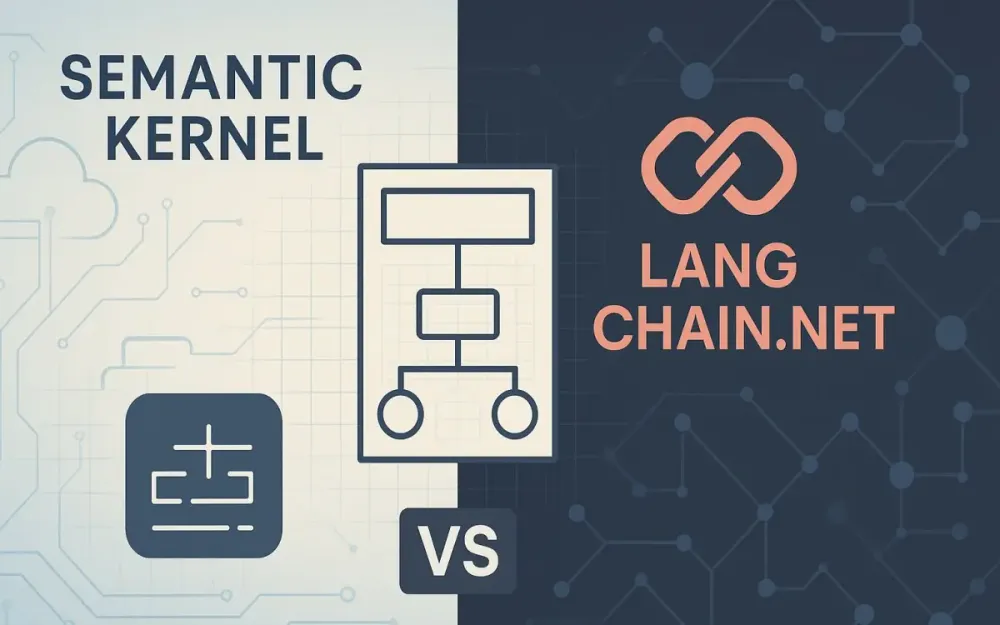
Semantic Kernel (SK), backed by Microsoft, is an open-source orchestration framework designed for enterprise use cases. It provides deep integration with Azure AI services, robust plugin support, strong typing, managed memory, and first-class planning capabilities. It offers a structured, component-based approach, ideal for architects prioritizing maintainability, compliance, and enterprise readiness.
1.3 At a Glance: LangChain.NET – The Rapid Prototyping Powerhouse
LangChain.NET is the .NET port of the popular Python-based LangChain project. Community-driven and highly modular, LangChain.NET emphasizes flexibility and rapid prototyping. It supports a vast ecosystem of LLMs, APIs, and vector databases, making it a go-to for architects and developers seeking quick experimentation, integration freedom, and access to cutting-edge features.
1.4 Key Decision Factors: A High-Level Matrix
| Dimension | Semantic Kernel | LangChain.NET |
|---|---|---|
| Control | High (Structured) | High (Flexible, less opinionated) |
| Flexibility | Moderate (Convention-driven) | Very High (Composable, open) |
| Enterprise Integration | Deep (Azure, M365, Copilot) | Moderate (Broader integrations) |
| Ecosystem | Microsoft-centric, growing | Community-driven, diverse |
| Openness | Open Source, MS steered | Open Source, community led |
| Prompt Engineering | Strong, prompt templates | Strong, with chaining focus |
| Learning Curve | Moderate (well-documented) | Moderate-High (depends on depth) |
| Best for | Enterprise-grade AI, compliance | Prototyping, custom AI workflows |
1.5 The Verdict in a Nutshell: When to Choose Which Framework
Choose Semantic Kernel when your focus is enterprise-grade solutions, robust security and compliance, integration with Microsoft services, and repeatable architectures. Opt for LangChain.NET if you need rapid prototyping, maximum flexibility, experimentation with multi-model orchestration, or broad integrations beyond the Microsoft stack.
2 Introduction: Beyond the Hype – Architecting Real-World AI
2.1 The New Frontier: From Standalone Models to Integrated AI Systems
The days of siloed language models are waning. Forward-thinking enterprises are now building integrated AI systems that not only generate text or code but reason, plan, act, and interface with complex environments. Think of modern AI as a “digital worker” – able to perceive, decide, act, and remember.
But how do you design such systems reliably, securely, and scalably? The answer lies in AI orchestration frameworks.
2.2 The Role of the AI Orchestration Framework
An AI orchestration framework provides the “connective tissue” between LLMs, data sources, APIs, tools, and business logic. It manages memory, coordinates multi-step reasoning, handles grounding through Retrieval-Augmented Generation (RAG), and often deals with user interaction, observability, and security.
Architects must evaluate frameworks not just by their “demo” potential, but by their ability to support maintainable, extensible, and compliant AI-powered applications.
2.3 Introducing the Contenders: Microsoft’s Semantic Kernel and the Community-Driven LangChain.NET
- Semantic Kernel is the brainchild of Microsoft, with strong alignment to Azure and enterprise development patterns. It aims to be the orchestration engine behind Microsoft Copilot and partner solutions.
- LangChain.NET brings the beloved Python LangChain experience to the .NET ecosystem. Its community-first approach means rapid evolution, cutting-edge integrations, and a modular core that appeals to innovators and tinkerers alike.
Both are open-source, cloud-ready, and deeply extensible. But each targets subtly different audiences and use cases.
2.4 Who is This Article For? A Guide for the Modern Architect
This guide is for solution architects, enterprise architects, and senior developers responsible for designing, evaluating, and delivering AI-powered applications in production. If you are deciding how to scaffold your next AI solution – and which orchestration platform to standardize on – this article is for you.
2.5 How This Article is Structured: From Theory to Practice
- We’ll start with foundational concepts in AI orchestration.
- Then, we’ll dissect both frameworks in depth – features, architecture, extensibility, and code.
- We’ll wrap up with guidance, recommendations, and future-proofing advice for architects.
- Real-world examples and decision frameworks are included to make complex trade-offs tangible.
3 The Foundations: Core Concepts in AI Orchestration
Before comparing frameworks, let’s clarify key concepts that underpin both Semantic Kernel and LangChain.NET.
3.1 What is an AI Agent? A Practical Definition
An AI agent is an autonomous software component that leverages one or more language models to process information, make decisions, interact with users, and orchestrate tools or APIs to achieve a goal. In practical terms, an agent:
- Receives prompts or events
- Interprets intent
- Leverages LLM(s) for reasoning
- Executes workflows, invokes tools, or interacts with APIs
- Maintains context and memory
Think of an agent as the “conductor” of your AI application, coordinating capabilities and knowledge sources.
3.2 The Anatomy of an AI Agent
Let’s break down the typical parts of an AI agent.
3.2.1 The “Brain”: The Large Language Model (LLM)
The core of any AI agent is the LLM. Models like GPT-4, Llama 3, and Gemini can:
- Parse complex input
- Generate coherent, context-aware responses
- Chain reasoning steps
- Interface with external APIs (via function calling)
The framework you choose should make it easy to integrate, configure, and swap out LLMs.
3.2.2 The “Senses”: Perception and Input Processing
Agents often require more than simple text. They might need to:
- Parse structured data (JSON, XML)
- Process images, audio, or other modalities
- Validate and pre-process user input
Handling multi-modal and structured input is increasingly vital for real-world applications.
3.2.3 The “Tools”: Skills, Plugins, and Functions
What makes agents useful is their ability to act beyond text generation. This is achieved through:
- Skills (Semantic Kernel): Modular functions that encapsulate business logic, API calls, or data access.
- Tools (LangChain.NET): Chained components or plugins to interface with external systems.
Examples include querying a database, fetching real-time stock prices, sending emails, or performing CRUD operations.
3.2.4 The “Memory”: Short-term and Long-term Context
To act intelligently, agents must retain and recall relevant information:
- Short-term memory: The conversation or session context (chat history, user state)
- Long-term memory: Persistent data such as knowledge bases, user profiles, or RAG-powered vector stores
Architects should consider how frameworks handle memory, persistence, and context switching.
3.2.5 The “Will”: Planning and Reasoning
Advanced agents don’t just react. They:
- Plan multi-step workflows
- Make decisions based on current state, user goals, and constraints
- Execute chains of skills or tools, adjusting as needed
Both Semantic Kernel and LangChain.NET provide planners and chain executors to support these advanced capabilities.
3.3 The Importance of Prompt Engineering in Orchestration
Prompt engineering is more than writing clever instructions. In orchestration frameworks, prompts often contain:
- Placeholders for dynamic data
- References to tools/skills
- Instructions for function calling or chaining
- Guardrails (to ensure safe, relevant outputs)
Well-structured prompts are reusable, testable, and version-controlled. Both frameworks provide abstractions for managing prompts as first-class assets.
3.4 Retrieval-Augmented Generation (RAG): The Key to Grounding AI in Reality
LLMs are only as current as their training data. RAG patterns allow agents to:
- Retrieve relevant documents from vector databases or knowledge stores
- Inject retrieved data into prompts for grounding
- Deliver answers based on both model knowledge and real-time, authoritative sources
Effective RAG is essential for applications needing up-to-date, accurate, and explainable outputs. The orchestration framework should make RAG patterns easy to implement and maintain.
4 Deep Dive: Microsoft’s Semantic Kernel
4.1 The Philosophy: “Code-First” AI and Enterprise-Grade Orchestration
Semantic Kernel (SK) is built on a “code-first” philosophy, aligning closely with modern .NET development practices. It empowers architects to reason about AI not as a magical black box but as a reliable, extensible component in a broader, orchestrated system. This code-centric model means that AI functionality—prompt templates, skills, planners, memory, and connectors—are all treated as first-class citizens within the same strongly-typed, version-controlled codebase as your core application logic.
This approach contrasts sharply with low-code/no-code or purely declarative systems. In SK, everything is exposed as C# objects, interfaces, or composable modules, giving architects and senior developers fine-grained control, advanced testing opportunities, and deep integration with enterprise CI/CD pipelines. It also ensures that your AI workflows are maintainable and observable, traits that become critical at scale or under compliance scrutiny.
Why does this matter? Because large enterprises need to orchestrate complex, cross-system AI interactions in a way that is auditable, secure, and governed—without giving up developer agility. Semantic Kernel delivers this via structured abstractions, predictable behaviors, and strong integration points into the broader Microsoft stack.
4.2 Core Architecture
At its heart, Semantic Kernel is a set of modular, extensible services. Understanding its architecture is key for architects evaluating how it will fit into their existing landscape.
4.2.1 The Kernel: The Central Processing Unit
The Kernel is the orchestrator—the “brain” that coordinates every interaction in SK. It exposes a set of APIs and configuration points to register skills, manage memory, route prompts, and invoke planners. This central service is intentionally lightweight but highly extensible.
A typical workflow might look like this:
- Register native (C#) and semantic (prompt-based) functions as skills
- Configure connectors for LLMs, storage, or enterprise data
- Pass user input or events to the kernel
- Let the kernel plan, reason, and execute across skills, tools, and memory as needed
Everything, from skill invocation to memory management, is funneled through this central orchestration point, providing both clarity and control.
4.2.2 Plugins and Functions: The Building Blocks of Skills
Skills in SK are collections of functions. These functions may be:
- Native: Implemented directly in C# (or other .NET languages). Perfect for business logic, API calls, data queries, and more.
- Semantic: Based on prompt templates and executed by an LLM. Used for generation, summarization, classification, or any task best suited to the model’s strengths.
Plugins, in this context, are containers for related skills. They can be imported, versioned, and shared across solutions. This modularity is central for large projects, where reuse, governance, and testing are non-negotiable.
Example:
Suppose you have a CalendarSkill with C# functions for reading and creating events, alongside a semantic function to summarize meeting notes. These are packaged as a plugin, discoverable and reusable across agents or planners.
4.2.3 The Planner: Autonomous Goal-Oriented Reasoning
Planners in SK represent a leap from procedural workflows to AI-driven autonomy. A planner accepts a high-level goal—often in natural language—and decomposes it into executable steps by chaining skills and leveraging memory as needed.
There are two core types:
- Sequential Planners: Define linear sequences of steps. Useful for known, repeatable processes.
- Action Planners: More dynamic, using the LLM’s reasoning to decide which skills to invoke and in what order, based on context and available tools.
Planners are composable, testable, and can be constrained with guardrails or business logic. This unlocks everything from guided chatbots to fully autonomous digital agents.
4.2.4 Connectors: Bridging to Models and Services
SK is not tied to a single model provider or storage engine. Connectors are adapters that bridge the kernel to external LLMs, embedding services, vector databases, or enterprise APIs.
Examples include:
- Model Connectors: Azure OpenAI, OpenAI.com, Hugging Face, and others.
- Memory Connectors: Azure AI Search, Pinecone, Qdrant, or in-memory stores.
- Service Connectors: Microsoft Graph, custom REST APIs, or third-party SaaS.
Architects can register custom connectors to ensure that their unique business data or infrastructure is part of the AI experience.
4.2.5 Memory: Integrating with Volatile and Persistent Stores
Memory is not an afterthought in SK—it’s foundational. There are clear abstractions for:
- Volatile memory: Session or in-memory state. Perfect for chatbots or short-lived tasks.
- Persistent memory: Backed by enterprise-grade stores like Azure AI Search or vector databases. Ideal for RAG, personalization, or compliance.
Memory is accessible to skills, planners, and directly to the kernel. Developers can write, read, and query memory in strongly-typed ways, ensuring both robustness and safety.
4.3 Extensibility and Customization
One of SK’s greatest strengths is its deep extensibility, enabling you to tailor the framework to your organization’s unique requirements.
4.3.1 Creating Native Functions in C#
Native functions are pure .NET code, giving you all the power and safety of the C# language.
public class WeatherSkill
{
    [KernelFunction]
    public string GetForecast(string city)
    {
        // Replace with real API call or business logic
        return $"The forecast for {city} is sunny and 22°C.";
    }
}
These functions are discoverable by the kernel and can be chained with semantic functions or exposed as part of larger planners.
4.3.2 Importing Semantic Functions from Prompts
Semantic functions use rich prompt templates, parameterized with variables, to leverage the generative power of LLMs.
var summarySkill = kernel.CreateSemanticFunction(
    "Summarize the following notes: {{$input}}. Provide a concise executive summary."
);
Prompt templates can be versioned, tested, and reused across projects, ensuring consistency and maintainability.
4.3.3 Leveraging OpenAPI for Automatic Plugin Generation
A standout feature is SK’s ability to generate skills/plugins automatically from OpenAPI (Swagger) specifications. This means you can expose entire APIs to the AI agent with minimal effort, fully documented and type-safe.
- Import a Swagger definition.
- Generate C# client code and corresponding skills.
- Register these as plugins, instantly making your APIs available to AI-driven workflows.
This bridges the gap between legacy systems and modern AI, accelerating integration without sacrificing safety or clarity.
4.4 Integration with the Microsoft Ecosystem
For organizations invested in Microsoft technologies, SK offers unparalleled synergies.
4.4.1 Azure OpenAI and the Power of the Azure Stack
SK integrates natively with Azure OpenAI, providing managed access to models, enterprise-grade security, and governance. This is especially valuable for regulated industries or global-scale deployments. Beyond OpenAI, SK works seamlessly with other Azure services, including Cognitive Search, Blob Storage, Key Vault, and more, streamlining end-to-end solution development.
4.4.2 Microsoft Graph Connectors: Unleashing Organizational Data
Through Microsoft Graph, SK-based agents can access and orchestrate data across Microsoft 365: emails, calendars, files, Teams messages, SharePoint content, and more. This enables true “Copilot-class” solutions—AI that understands and acts upon the real work context of your users.
Example use cases include:
- Automated meeting summaries from Outlook and Teams.
- Knowledge assistants that surface documents across OneDrive, SharePoint, and Exchange.
- Custom workflows that combine user signals from M365 with LLM reasoning.
4.4.3 The Copilot Stack: Building on a Proven Foundation
SK is the core engine behind Microsoft’s Copilot suite. By aligning with SK, architects are effectively building on the same foundation used for Copilot for M365, Dynamics, and Power Platform. This ensures architectural alignment, supportability, and future-proofing, especially for organizations planning broad AI adoption.
4.5 Strengths and Weaknesses from an Architectural Standpoint
Strengths
- Enterprise-Ready: Designed from the ground up for compliance, governance, and scalability.
- Deep Ecosystem Integration: Native support for Azure, Microsoft Graph, and M365.
- Extensibility: Strong abstractions for skills, plugins, planners, memory, and connectors.
- Observability: Built-in telemetry, logging, and monitoring hooks for enterprise environments.
- Maintainability: Type-safe, code-first architecture aligns with .NET best practices and CI/CD pipelines.
- Security: RBAC, managed identities, and plugin isolation for sensitive or regulated workloads.
Weaknesses
- Learning Curve: More structured and convention-driven than some alternatives. May require adaptation for teams used to scripting or rapid prototyping.
- Ecosystem Focus: Strongest when used with Azure and Microsoft services; integrations outside this stack may require more effort.
- Community Pace: While rapidly evolving, SK is primarily Microsoft-driven. Community-led innovation may lag compared to fully grassroots projects.
5 Deep Dive: LangChain.NET
5.1 The Philosophy: “Chain-of-Thought” and Rapid Application Development
LangChain.NET is fundamentally inspired by the “chain-of-thought” paradigm. This means that complex reasoning or workflows are built as explicit, modular chains of components—each responsible for a discrete piece of functionality. The goal is to make it simple to reason about, extend, and debug AI-powered workflows by composing them out of small, reusable units.
LangChain.NET is community-driven, with a strong emphasis on flexibility, rapid prototyping, and experimentation. This makes it a favorite among researchers, startups, and teams who value agility and want to blend cutting-edge AI models with custom tools, data sources, and logic.
A key benefit: nothing is hidden. You have complete transparency into the flow of data and reasoning, which is especially valuable when debugging or optimizing novel agent architectures.
5.2 Core Architecture
LangChain.NET is built on a composable, pipeline-based design.
5.2.1 Chains: The Sequential Building Blocks
A chain is a reusable sequence of operations, which may include prompt formatting, LLM calls, output parsing, tool invocation, and more. Chains can be:
- Simple: Format a prompt, call the model, return the result.
- Complex: Retrieve context from a vector store, merge with user input, call the LLM, route based on output, and invoke further tools.
Chains are the primary abstraction for building repeatable, testable AI-powered workflows.
5.2.2 Agents and Tools: Dynamic Decision-Making
Agents in LangChain.NET are responsible for making decisions about which tools to use and in what order, based on user intent, conversation state, and LLM reasoning.
Tools are pluggable, stateless or stateful components that expose business logic, data access, or integrations to the agent. Examples include:
- Web search adapters
- Database or API connectors
- Custom function evaluators
- Domain-specific logic
Agents can invoke tools explicitly or let the LLM “decide” which to use, unlocking powerful autonomous behaviors.
5.2.3 Document Loaders and Text Splitters: The Data Ingestion Pipeline
LangChain.NET treats data ingestion as a first-class concern, essential for RAG workflows and knowledge bots. Two key abstractions:
- Document Loaders: Extract structured or unstructured data from diverse sources—PDFs, emails, databases, web pages, S3, SharePoint, and more.
- Text Splitters: Break large documents into smaller, contextually coherent chunks for embedding and retrieval.
This makes it easy to ground your LLM with custom, domain-specific knowledge—whether onboarding millions of documents or continuously updating live data.
5.2.4 Vector Stores and Embeddings: The Foundation of RAG
Retrieval-augmented generation (RAG) is a core pattern in LangChain.NET, supported out-of-the-box:
- Embeddings: Integrate with any provider (OpenAI, Cohere, Hugging Face, local models) to convert text into vector representations.
- Vector Stores: Store and query these embeddings for similarity search, leveraging Pinecone, Qdrant, Chroma, Weaviate, or custom stores.
This architecture enables advanced knowledge retrieval, semantic search, and context injection at scale.
5.2.5 Memory Modules: Managing Conversational State
LangChain.NET provides modular memory components, critical for conversational agents:
- Conversation memory: Store and retrieve chat history, user preferences, or intermediate outputs.
- Custom memory: Persist arbitrary state across agent sessions or workflows.
- Hybrid approaches: Blend short-term (RAM) and long-term (vector store) memory for nuanced, personalized interactions.
Architects can swap, extend, or combine memory modules as the solution demands.
5.3 Extensibility and Customization
LangChain.NET is designed to be extended in every dimension.
5.3.1 Building Custom Chains
Chains are composable pipelines. Building custom chains allows you to codify business logic, enforce data validation, or implement domain-specific reasoning in a testable, modular fashion.
var chain = new SequentialChain()
    .Add(new PromptFormatter("Extract key facts: {input}"))
    .Add(new LlmCall(openAiProvider))
    .Add(new OutputParser(MyCustomFactParser));
This approach enables experimentation: swap in new components, reorder steps, or nest chains to fit complex workflows.
5.3.2 Creating and Integrating Custom Tools
Tools are the “arms and legs” of your agent. Creating a custom tool is as simple as implementing a well-defined interface.
public class StockPriceTool : ITool
{
    public string Name => "GetStockPrice";
    public async Task<string> ExecuteAsync(string input)
    {
        // Call an external financial API
        return $"The price of {input} is $123.45";
    }
}
Agents can call this tool explicitly, or let the LLM decide when to use it, creating opportunities for autonomous, context-aware behaviors.
5.3.3 The Power of the Expression Language (LCEL)
LangChain Component Expression Language (LCEL) is a recent innovation that brings declarative, chain-based development to LangChain.NET. With LCEL, you can define chains as expressions—easy to read, refactor, and version control.
This is especially valuable for complex, multi-branch workflows or when collaborating across large teams, as it separates logic from implementation details.
Example:
var lcelChain = ChainExpression
    .Input("user_input")
    .Then("context_retriever")
    .Then("llm_query")
    .Then("output_formatter");
LCEL is still evolving, but promises to make LangChain.NET even more accessible and maintainable.
5.4 The Open-Source Advantage
5.4.1 A Vast Ecosystem of Integrations
LangChain.NET inherits a thriving ecosystem from its Python parent:
- Support for virtually every major LLM and embedding provider
- Connectors for dozens of databases, cloud storage, and enterprise tools
- Document loaders for almost every business-relevant file type or data source
- Integration points for workflow engines, observability platforms, and more
This means that almost any requirement—no matter how niche or specialized—can be addressed without “vendor lock-in” or heavy rework.
5.4.2 Community-Driven Innovation and Support
LangChain.NET evolves at the pace of the AI community. New features, integrations, and bugfixes are contributed daily by developers across the world. This ensures early access to state-of-the-art capabilities, support for emerging best practices, and rapid turnaround on issues.
Active forums, Discord servers, and GitHub discussions also mean you’re never far from help or inspiration. For organizations with the ability to move fast and the appetite to innovate, this is a decisive advantage.
5.5 Strengths and Weaknesses from an Architectural Standpoint
Strengths
- Maximum Flexibility: Architect any workflow, integration, or agent architecture. Nothing is locked down or opinionated.
- Rapid Prototyping: Build, test, and iterate quickly, ideal for R&D, startups, or early-phase enterprise projects.
- Broad Integration: Connect to any model, vector store, document source, or tool, whether open-source or proprietary.
- Community-Driven: Fast access to bleeding-edge features and a thriving support network.
- Transparent and Inspectable: Every step in the chain is explicit and inspectable—critical for debugging or optimization.
Weaknesses
- Governance and Compliance: Out-of-the-box, not as focused on RBAC, telemetry, or enterprise compliance as SK. These must be added as needed.
- Consistency and Upgrades: Community-driven releases mean breaking changes can occur; architects must monitor dependencies and integration points closely.
- Learning Curve for Deep Features: The flexibility comes with complexity—mastering advanced chaining, agent logic, or custom retrievers can require deep expertise.
- Ecosystem Fragmentation: Rapid growth means overlapping solutions and some lack of standardization. Selecting the right “stack” for your use case may require careful vetting.
6 Head-to-Head Architectural Comparison: A Criteria-Based Evaluation
Selecting the right AI orchestration framework is ultimately a matter of matching architecture to your organization’s unique requirements. Let’s break down the core differentiators, using criteria that matter to enterprise architects and senior developers.
6.1 Abstraction Level
6.1.1 Semantic Kernel: Structured and Opinionated
Semantic Kernel’s abstraction model is intentional and opinionated. Microsoft’s framework nudges teams toward well-defined patterns:
- Skills are always grouped as plugins, with strong separation between native (C#) and semantic (LLM-driven) functionality.
- Planners encourage the use of LLMs for dynamic workflow generation but always within a predictable, governable boundary.
- Prompt templates are not only supported but treated as versioned, managed assets—enabling prompt operations to become part of your software development lifecycle.
This results in a more “enterprise” flavor: high predictability, robust integration, and a strong bias toward maintainability. SK makes it easy for architects to enforce architectural standards, documentation, and even CI/CD validation for prompts, skills, and memory schemas.
6.1.2 LangChain.NET: Flexible and Unopinionated
LangChain.NET, by contrast, is fundamentally unopinionated and compositional. Every chain, agent, and tool is just another swappable module. There are few restrictions on how you build your solution:
- Chains can be arbitrarily nested, forked, or merged.
- Agents are fully customizable, able to decide autonomously or be strictly guided.
- Tools and memory can be registered, replaced, or dynamically generated at runtime.
This “choose your own adventure” flexibility is ideal for rapid prototyping, hybrid AI/ML workflows, and environments where innovation pace trumps process discipline. The trade-off: It’s easy to create non-standard, hard-to-maintain systems if best practices are not established upfront.
6.2 Extensibility and Modularity
6.2.1 Semantic Kernel’s Plugin Architecture
In SK, extensibility means plugins. Each plugin encapsulates related skills, which can be discovered, versioned, and shared across teams or solutions. Plugins expose both native and semantic functions, and can be automatically generated from OpenAPI specs or handwritten in C#.
Key advantages:
- Governance: Plugins can be version-controlled, tested, and scanned for compliance.
- Discoverability: Skills are registered with descriptive metadata, making it easier for planners (and humans) to find and invoke them.
- Safety: Plugins can be isolated, with controlled access to sensitive resources or APIs.
6.2.2 LangChain.NET’s Composable Chains and Tools
LangChain.NET’s extensibility is rooted in the composability of its chains and tools. You can create:
- Custom chains for business logic, branching, or error handling.
- Custom tools to wrap APIs, access databases, or perform calculations.
- Custom retrievers for bespoke document indexing and semantic search.
Every part of the framework can be replaced or extended, which empowers you to build highly specialized architectures.
Architectural note: While this approach maximizes flexibility, it requires careful design discipline to ensure maintainability. In larger teams, it’s wise to establish “approved” tool sets, common chain patterns, and robust documentation practices.
6.3 Ease of Use vs. Control
6.3.1 Getting Started: The Learning Curve for Each
-
Semantic Kernel: The learning curve is moderate. If your team knows C# and .NET, understanding skills, planners, and connectors is intuitive. Prompt templates and semantic functions require some LLM awareness, but Microsoft’s documentation and samples are strong. SK’s structure may feel restrictive to developers used to script-first or notebook-driven workflows.
-
LangChain.NET: The learning curve varies based on your ambition. Building simple chains is straightforward, but the sheer breadth of components and options can be overwhelming for newcomers. Documentation is evolving but not as centralized as SK’s. For rapid prototyping and experimentation, few frameworks are as fast to get running.
6.3.2 Fine-Grained Control: Where Each Framework Shines
-
Semantic Kernel: Excels in scenarios where you want to tightly govern what the agent can do, ensure skills and plugins are well-defined, and maintain strict separation of responsibilities. Useful when compliance, auditing, and handover to other teams matter.
-
LangChain.NET: Shines in projects where you need full control over every part of the pipeline. If you want to experiment with novel chain-of-thought patterns, integrate new models or tools overnight, or prototype architectures not yet formalized in the literature, LangChain.NET gives you that freedom.
6.4 State and Memory Management
6.4.1 Semantic Kernel’s Approach to Context
In SK, memory is a structured service. Whether you use in-memory (volatile) storage or persistent, enterprise-grade stores (like Azure Cognitive Search), the memory abstraction ensures that:
- State is type-safe and versioned.
- Session context, conversation history, and knowledge bases can be separated and managed independently.
- Memory access can be audited, secured, and, if necessary, encrypted at rest.
Example: A chatbot can access both session history and a persistent knowledge base, deciding when to use each, while all access is logged and observable.
6.4.2 LangChain.NET’s Diverse Memory Options
LangChain.NET offers maximum flexibility:
- Choose between in-memory, Redis-backed, vector store, or custom memory modules.
- Blend multiple memories: short-term chat, long-term retrieval, or even graph-based knowledge.
- Memory modules are pluggable at the agent or chain level, allowing for multi-agent scenarios with distinct or shared memories.
Architectural tip: This diversity is powerful but requires discipline. Without conventions, state management can become fragmented—leading to inconsistent user experiences or data leakage between sessions.
6.5 Debugging and Observability
6.5.1 Tracing Execution in Semantic Kernel
SK integrates seamlessly with Microsoft’s observability stack. You get:
- Activity tracing and telemetry via Azure Monitor or Application Insights.
- Detailed logs for every skill invocation, planner step, and memory access.
- Correlation IDs to tie user sessions to AI agent activity.
These capabilities are crucial for production use, especially when troubleshooting intermittent failures, diagnosing user complaints, or auditing sensitive operations.
6.5.2 LangSmith and the LangChain.NET Ecosystem
LangChain.NET is rapidly integrating with LangSmith, a cross-platform observability tool designed for the LangChain family. LangSmith offers:
- Fine-grained trace visualizations for chains, agent steps, tool calls, and model outputs.
- Metrics and dashboards for monitoring performance, cost, and error rates.
- Easy debugging of complex, multi-step workflows—especially those involving tool use and RAG.
For teams building multi-agent or deeply compositional systems, these tools are invaluable for understanding “what happened” and “why” during agent execution.
6.6 Community and Enterprise Support
6.6.1 The Power of Microsoft’s Backing
Semantic Kernel’s roadmap, documentation, and support ecosystem are all strongly backed by Microsoft. Benefits include:
- Enterprise-grade SLAs for Azure integrations.
- Predictable roadmap aligned with the M365 Copilot stack.
- A growing community, but with a high baseline of quality and governance.
- Certification-ready documentation, compliance, and security features.
6.6.2 The Breadth of the LangChain Community
LangChain.NET, by virtue of its community-first DNA, enjoys:
- Faster adoption of cutting-edge features (e.g., support for new models or vector stores).
- A huge pool of open-source integrations, connectors, and utilities.
- Community-driven documentation, code samples, and forums—ideal for early problem-solving.
- Peer-driven innovation: features often appear in the ecosystem before formal release in other stacks.
For organizations eager to tap into AI’s leading edge, or those looking for non-Microsoft, cross-cloud integrations, LangChain.NET’s community can be a decisive asset.
7 Practical Implementation: Real-World Scenarios
Practical implementation is where framework theory meets the complexity of real business challenges. This section unpacks how Semantic Kernel and LangChain.NET perform in two critical AI use cases for enterprise teams: building a secure knowledge bot and designing an autonomous customer service agent. The goal is not simply to demonstrate how things “work,” but to reveal the deeper architectural impacts of each framework on scalability, extensibility, security, and maintainability.
7.1 Scenario 1: The Enterprise Knowledge Bot
7.1.1 The Goal
Create a conversational AI agent that can answer natural language questions using internal company documentation—such as policies, technical guides, HR handbooks, or proprietary procedures—while maintaining rigorous data privacy, security, and traceability. The bot must provide grounded, citation-backed responses, supporting use cases like onboarding, compliance, and technical troubleshooting.
7.1.2 The Semantic Kernel Approach
Semantic Kernel’s design, with its enterprise identity integration, structured plugin system, and built-in RAG support, makes it a compelling choice for this type of knowledge bot.
7.1.2.1 Architecture Diagram
A high-level architecture for this scenario with Semantic Kernel could look like:
[User] ──> [Frontend (Web/Teams/Slack)] ──> [API Gateway] ──> [Semantic Kernel Host]
                                                  |
                                                  V
                           [Azure AD]      [Enterprise Logging & Monitoring]
                             |                    |
                             V                    |
       [Azure OpenAI] <─> [Kernel: Plugins, Planner, Memory] <─> [Azure Cognitive Search / Vector DB]
                                              |
                                          [Document Ingestion Pipeline]
Core elements:
- Semantic Kernel Host: Orchestrates the workflow, applies plugins, manages planners, and integrates memory.
- Azure Cognitive Search/Vector DB: Powers retrieval-augmented generation (RAG), indexing internal documents as vector embeddings.
- Azure OpenAI: Handles LLM completions and function calls.
- Access Control Plugin: Ensures only permitted content is retrieved, leveraging Azure AD for authentication and authorization.
7.1.2.2 Code Snippets
1 Setting Up the Kernel and Connecting Azure OpenAI & Azure Cognitive Search
var kernel = Kernel.CreateBuilder()
    .AddAzureOpenAIChatCompletion(
        deploymentName: "<your-deployment>",
        endpoint: "<your-endpoint>",
        apiKey: "<your-azure-openai-key>")
    .AddAzureCognitiveSearch(
        endpoint: "<search-endpoint>",
        indexName: "<index-name>",
        apiKey: "<search-key>")
    .Build();
2 Creating a RAG Pipeline with Plugins
Semantic Function (for contextual Q&A):
var qaFunction = kernel.CreateSemanticFunction(
    @"You are an enterprise assistant. Given the following context, answer the user query as precisely as possible.
Context: {{$input}}
User question: {{$question}}
If you do not know the answer, say 'I don't know' and suggest where to look.");

kernel.ImportSkill(qaFunction, "EnterpriseQnA");
Memory Configuration:
var memoryStore = new AzureCognitiveSearchMemoryStore("<search-endpoint>", "<index-name>", "<search-key>");
kernel.UseMemoryStore(memoryStore);
3 Native Function for Access Control
Suppose only certain users may access HR or Legal content. This logic should sit directly in the RAG pipeline.
public class AccessControlSkill
{
    private readonly IIdentityService _identityService;
    public AccessControlSkill(IIdentityService identityService) => _identityService = identityService;

    [KernelFunction]
    public bool IsUserAuthorized(string userId, string docId)
    {
        // Consult enterprise directory / entitlements
        return _identityService.HasDocumentAccess(userId, docId);
    }
}
Plug in this skill to filter retrieval results before passing context to the LLM:
// Fetch relevant docs (using embeddings)
var results = await kernel.Memory.SearchAsync(query, topK: 5);

// Apply access control
var authorizedDocs = results.Where(r =>
    accessControlSkill.IsUserAuthorized(userId, r.DocumentId));

// Concatenate context for prompt
var context = string.Join("\n", authorizedDocs.Select(r => r.Content));

// Call the QnA skill
var answer = await kernel.RunAsync(
    context,
    question,
    kernel.Skills.GetFunction("EnterpriseQnA", "Default")
);
7.1.2.3 Architectural Considerations
Security:
- Integrate with Azure AD for user authentication, ensuring all calls carry user context (JWT, claims).
- Access control checks must be performed both at ingestion (filtering which documents are indexed for each user group) and at retrieval (ensuring a user cannot view a doc they are not entitled to).
- Sensitive data should be encrypted in transit and at rest, especially in vector stores.
Scalability:
- Azure Cognitive Search and Azure OpenAI provide elasticity, but it’s essential to monitor query throughput, embedding generation latency, and storage limits as data grows.
- For global deployments, consider geo-replicated vector stores and LLM endpoints to reduce latency.
Integration with Enterprise Identity:
- Use single sign-on to seamlessly integrate with enterprise portals, Microsoft Teams, or intranet dashboards.
- All bot actions, accesses, and retrievals should be logged and traceable per user for auditing.
Maintainability:
- Skills and plugins can be versioned as NuGet packages or DLLs, allowing DevOps teams to roll out upgrades and hotfixes without breaking existing workflows.
- Prompts should be maintained as managed assets—ideally with review, A/B testing, and explicit versioning in source control.
7.1.3 The LangChain.NET Approach
LangChain.NET is particularly appealing for teams that need to integrate many document formats, run multi-cloud, or experiment with non-Microsoft vector stores.
7.1.3.1 Architecture Diagram
A typical LangChain.NET solution for the knowledge bot looks like:
[User] → [Bot UI (Web/Teams)] → [LangChain.NET App Server]
           |
   [Document Loaders: PDF, DOCX, Web, Email, etc.]
           |
  [Text Splitters: Recursive, Semantic, Custom]
           |
   [Embeddings Provider: OpenAI, Cohere, Local]
           |
 [Vector Store: Pinecone/Qdrant/Chroma/Elastic/Custom]
           |
       [Retriever] → [Prompt Template] → [LLM]
           |
      [Response with Citations]
7.1.3.2 Code Snippets
1 Loading and Chunking Documents
var pdfLoader = new PdfDocumentLoader("C:/docs/hr_policy.pdf");
var docxLoader = new DocxDocumentLoader("C:/docs/tech_manual.docx");
var allDocs = pdfLoader.Load().Concat(docxLoader.Load()).ToList();

var textSplitter = new RecursiveTextSplitter(chunkSize: 512, overlap: 64);
var allChunks = allDocs.SelectMany(doc => textSplitter.Split(doc.Content)).ToList();
2 Embedding and Indexing in a Vector Store
var embeddings = new OpenAIEmbeddings("<api-key>");
var vectorStore = new PineconeVectorStore("<api-key>", "<environment>", "<index-name>");

await vectorStore.AddDocumentsAsync(allChunks, embeddings);
3 Retrieval Chain with Prompt Template
var retriever = new VectorStoreRetriever(vectorStore, embeddings);

var promptTemplate = new PromptTemplate(
    @"You are a helpful assistant. Use the following context to answer the question.
    If you don't know, say so.
    Context: {context}
    User Question: {input}");

var retrievalChain = new RetrievalAugmentedChain(
    llm: new OpenAIProvider("<api-key>"),
    retriever: retriever,
    promptTemplate: promptTemplate
);

// At runtime
string question = "What is the procedure for requesting remote work approval?";
var answer = await retrievalChain.RunAsync(question);
Console.WriteLine(answer.Output);
4 Adding Per-Document Access Control (Custom Retriever)
LangChain.NET allows you to inject filtering logic into the retriever:
public class AccessControlledRetriever : VectorStoreRetriever
{
    private readonly IAccessService _accessService;
    private readonly string _userId;

    public AccessControlledRetriever(IVectorStore store, IEmbeddings embeddings, IAccessService accessService, string userId)
        : base(store, embeddings)
    {
        _accessService = accessService;
        _userId = userId;
    }

    public override async Task<IEnumerable<DocumentChunk>> RetrieveAsync(string query, int topK = 5)
    {
        var docs = await base.RetrieveAsync(query, topK);
        return docs.Where(d => _accessService.CanUserAccess(_userId, d.DocumentId));
    }
}
7.1.3.3 Architectural Considerations
Choosing the Right Vector Store:
- LangChain.NET supports many options. Pinecone offers managed, globally available hosting with high QPS; Qdrant and Chroma are open-source and suitable for on-premises, air-gapped, or regulated use cases.
- Consider latency, scaling, cost, and regional availability.
Data Pipeline Management:
- Modular document loaders mean new sources (SharePoint, S3, email) can be integrated as business needs evolve.
- Document chunking should be tuned to balance embedding accuracy, LLM context window size, and retrieval performance.
- Ingestion pipelines should be idempotent and support versioning, so that document updates or removals are reflected in the index without downtime.
Access Control:
- Implement access control as close to the retriever as possible. Don’t rely on LLM instructions for enforcement.
- For highly regulated environments, consider encrypting embeddings or using attribute-based access control at query time.
Maintainability and Extensibility:
- Chains and tools are easily swapped or updated. You can experiment with new LLMs, prompt templates, or retrievers without rearchitecting your application.
- All pipeline components can be unit-tested in isolation for high-confidence upgrades.
7.1.4 Verdict for This Scenario
Semantic Kernel is the best fit when:
- You need ironclad integration with Microsoft security and compliance.
- The enterprise is committed to Azure, Office 365, or Copilot extensibility.
- Skills/plugins must be versioned, governed, and managed as code artifacts.
LangChain.NET is ideal when:
- Document sources, vector stores, or LLM providers may change.
- You want to rapidly experiment with data pipelines or retrieval methods.
- Multi-cloud or hybrid environments are a requirement.
- Your team is comfortable working with loosely coupled, modular components and accepts a steeper learning curve for extensibility.
7.2 Scenario 2: The Autonomous Customer Service Agent
7.2.1 The Goal
Design a customer service agent capable of:
- Holding multi-turn conversations with customers.
- Looking up order statuses, processing returns, answering account questions.
- Handling context switches and ambiguous user inputs gracefully.
- Escalating to a human agent when necessary, with full conversation handover.
This agent must integrate with enterprise back-end APIs (order, returns, user management), enforce policy, and handle complex, non-linear workflows.
7.2.2 The Semantic Kernel Approach
Semantic Kernel excels at orchestrating complex, secure, multi-step workflows where traceability and policy compliance are critical.
7.2.2.1 Architecture Diagram
[Customer] → [Web/Chat Interface] → [API Gateway] → [Semantic Kernel Host]
                                                 |
                                    [Planner: Dynamic Workflow Engine]
                                                 |
            [Order Management Plugin]   [Returns API Plugin]   [FAQ Plugin]   [Escalation Skill]
                                                 |
                                   [Enterprise Identity]   [Backend APIs]   [Human Agent Queue]
                                                 |
                             [Telemetry, Logging, Monitoring, Tracing]
7.2.2.2 Code Snippets
1 Using the Planner for Goal-Oriented Execution
var planner = new ActionPlanner(kernel);

string userInput = "My package hasn't arrived. Can you check my order status?";
var plan = await planner.CreatePlanAsync(userInput);

// The planner decides which plugins to invoke and in what order
var response = await kernel.RunAsync(plan, userContext: conversationState);
2 Generating Plugins from OpenAPI Specs
dotnet skplugin generate --openapi https://api.shop.com/swagger/v1/swagger.json --output ./Plugins/OrderManagementRegister the plugin and expose all API endpoints as kernel-native skills.
3 Managing Conversational State
SK maintains state via kernel memory:
// Save conversation context
await kernel.Memory.SaveAsync(conversationId, "lastOrderId", orderId);

// Retrieve in subsequent turns
string lastOrderId = await kernel.Memory.GetAsync<string>(conversationId, "lastOrderId");
4 Escalation Skill Example
public class EscalationSkill
{
    [KernelFunction]
    public string EscalateToHuman(string context)
    {
        // Send context to CRM/handoff system, notify human agent
        return "I’m connecting you to a specialist. Please wait.";
    }
}
Register this skill so the planner can invoke it based on LLM/skill output or business rules.
7.2.2.3 Architectural Considerations
Workflow Complexity:
- Planners interpret ambiguous input, break it down into subtasks, and invoke the necessary plugins.
- Built-in guardrails ensure the agent doesn’t access unauthorized APIs or make unsupported decisions.
Reliability:
- All API calls, user interactions, and workflow steps are logged, monitored, and correlated per user/session.
- Plugins can be versioned and isolated, minimizing the blast radius of API or logic changes.
Long-Running Conversations:
- Memory abstraction supports stateful sessions spanning minutes, hours, or even days, supporting asynchronous escalations or callback workflows.
Handoff to Humans:
- Context (chat history, order status, intent) can be serialized and pushed to CRM, ticketing, or live agent systems, ensuring seamless transitions.
7.2.3 The LangChain.NET Approach
LangChain.NET offers maximum flexibility for agent and tool orchestration—ideal for rapidly evolving customer service use cases or organizations with diverse backend systems.
7.2.3.1 Architecture Diagram
[Customer] → [Bot Interface] → [LangChain.NET Agent]
          |         |                |           |            |
    [Conversational Memory]   [Order Status Tool]   [Returns Tool]   [FAQ Tool]   [Escalation Tool]
                                   |                       |
                          [Order API]              [CRM/Human Agent System]
                                   |
                      [Observability & Tracing (LangSmith)]
7.2.3.2 Code Snippets
1 Defining Tools
public class OrderStatusTool : ITool
{
    public string Name => "GetOrderStatus";
    public async Task<string> ExecuteAsync(string input)
    {
        // Call order API, parse status
        return $"Order status for {input}: Shipped";
    }
}
public class ReturnsTool : ITool { /* ... */ }
public class EscalationTool : ITool
{
    public string Name => "EscalateToHuman";
    public async Task<string> ExecuteAsync(string input)
    {
        // Push conversation to live agent system
        return "A human agent will join shortly.";
    }
}
2 Creating an Agent with Tools and Memory
var memory = new ConversationBufferMemory();
var tools = new List<ITool> { new OrderStatusTool(), new ReturnsTool(), new EscalationTool() };
var agent = new Agent(memory, tools, new OpenAIProvider("<api-key>"));

// Multi-turn chat
var result = await agent.RunAsync("I want to return my order.");
3 Custom Tool for Human Handoff
public class EscalationTool : ITool
{
    public string Name => "EscalateToHuman";
    public async Task<string> ExecuteAsync(string input)
    {
        // Log escalation event, send message to agent dashboard
        return "Transferring you to a human representative.";
    }
}
4 Handling Context Switches and Ambiguity
LangChain.NET’s chain-of-thought pattern enables handling ambiguous or multi-intent user queries:
var multiToolAgent = new Agent(memory, tools, provider);
string input = "I want to know my order status and also return an item.";

// Agent breaks down input, uses both tools as needed
var response = await multiToolAgent.RunAsync(input);
7.2.3.3 Architectural Considerations
Agent Patterns:
- LLM-driven “reactive” agents can dynamically select tools based on intent classification, or fallback to deterministic rule-based selection for compliance.
- For more complex workflows, custom chains or planners can be built to orchestrate multi-step logic.
Tool Selection and Management:
- Tools are independently deployable and testable, allowing backend API upgrades or replacements without agent refactoring.
- Can integrate any REST, GraphQL, or event-driven backend—useful for businesses not “all-in” on one vendor or platform.
Predictable Behavior and Observability:
- Integration with LangSmith or custom tracing middleware enables detailed session tracing, debugging, and performance monitoring.
- Multi-turn context can be easily persisted, shared, or handed off, supporting omnichannel workflows.
7.2.4 Verdict for This Scenario
Semantic Kernel is preferable for:
- Organizations prioritizing compliance, auditability, and predictable workflow governance.
- Environments tightly integrated with Microsoft, where back-end APIs can be exposed as OpenAPI and managed as plugins.
- Solutions requiring robust, type-safe session management and observability.
LangChain.NET excels for:
- Teams needing to move quickly, experiment with novel agent strategies, or integrate a variety of back-end tools.
- Use cases where flexibility, multi-cloud support, or hybrid integration (REST, GraphQL, on-premises, SaaS) are essential.
- Architectures where modularity, rapid prototyping, and tool/chain experimentation are valued over strict process discipline.
8 Advanced Architectural Patterns
AI frameworks are only as effective as the architectures they enable. In practice, enterprise requirements often demand patterns that go well beyond single-agent, single-model workflows. The next generation of intelligent applications must handle complexity, adapt to changing contexts, and ensure the right balance between autonomy and control.
8.1 Multi-Agent Systems: When One Agent Isn’t Enough
As AI deployments mature, single-agent designs begin to hit real-world limits. Enterprises increasingly require multi-agent systems, where multiple specialized agents collaborate, compete, or delegate to solve complex tasks. This mirrors how real-world teams operate: each “agent” brings unique knowledge, skills, and responsibilities.
When Do You Need Multi-Agent Systems?
- Task Decomposition: Complex workflows (like insurance claims or regulatory filings) can be broken into subtasks, each handled by an agent specialized in a domain (legal, financial, HR, etc.).
- Expert Collaboration: Some answers require multiple perspectives. For instance, a medical knowledge bot might route symptoms to an agent specialized in diagnosis and another for drug interactions.
- Conflict Resolution: Agents with different goals may negotiate (e.g., procurement vs. compliance) to arrive at a business-acceptable solution.
Implementing Multi-Agent Patterns
Semantic Kernel: Planners can be orchestrated to assign subtasks to different agents. Skills and plugins encapsulate domain-specific logic, and memory can be partitioned by agent or shared for collaboration.
LangChain.NET: Supports dynamic agent spawning. Chains can route outputs between agents. LangGraph (an experimental subframework) allows for graph-based coordination, with agents modeled as nodes and interactions as edges.
Sample Architecture:
[User] → [Orchestrator Agent]
             /      |        \
 [Domain Agent] [Compliance Agent] [Research Agent]
             \      |        /
           [Shared Memory/Knowledge Base]
Each agent can use its own LLM, skillset, and tools. The orchestrator manages the delegation and aggregation of responses.
Architectural Insight: Carefully design inter-agent protocols and communication. Decide what memory is shared, how context is passed, and how to resolve contradictory outputs. Logging and observability must span all agents for end-to-end traceability.
8.2 Hybrid Approaches: Using Semantic Kernel and LangChain.NET Together
While organizations often default to a single orchestration framework, hybrid architectures are not only possible—they are increasingly practical. There are valid scenarios where leveraging both Semantic Kernel and LangChain.NET in the same enterprise solution provides distinct advantages.
Hybrid Use Cases
- Best-of-Breed Integration: Use Semantic Kernel for secure, compliant, M365-integrated workflows, while deploying LangChain.NET components for rapid prototyping or to access non-Microsoft models and vector stores.
- Phased Migration: Migrate legacy LangChain.NET workloads into a Semantic Kernel-based core without a risky, big-bang transition.
- Composable Microservices: Treat each framework as a service with a clear contract. For example, use SK for user-facing chat and workflow orchestration, and LangChain.NET microservices for RAG, data ingestion, or experimental agents.
How Hybrid Architectures Work
- Inter-Process Communication: Agents built with each framework can communicate via REST, gRPC, or message queues, sharing context and results.
- Shared Memory or Indexes: Both frameworks can point to the same vector store or database, standardizing document ingestion and retrieval.
- Pluggable Components: Semantic Kernel plugins can wrap external endpoints powered by LangChain.NET, and vice versa.
Example:
A bot built with Semantic Kernel handles M365 authentication and conversation management. When complex document retrieval is required from a non-Azure vector DB, it calls a LangChain.NET-powered RAG service over HTTPS, receiving contextually rich responses that are then summarized, formatted, and governed by the SK host.
Architectural Best Practice: Define clear APIs between frameworks. Centralize logging, access control, and error handling at integration boundaries.
8.3 Human-in-the-Loop: Designing for Collaboration Between AI and Humans
No matter how advanced, LLM-powered agents will regularly encounter ambiguous, risky, or novel cases where human judgment is required. Human-in-the-loop (HITL) design is vital for building trustworthy, enterprise-ready AI systems.
Common Patterns
- Escalation: When an agent is uncertain, cannot access required data, or policy mandates review (e.g., legal advice, critical HR decisions), escalate to a human expert.
- Approval Workflows: Agents can draft content, summarize findings, or propose actions—but final approval must come from a designated human (e.g., sending contracts, financial transactions).
- Annotation and Feedback: Agents capture and route user corrections, allowing continuous improvement and supervised learning.
Implementing HITL
Semantic Kernel: Define escalation skills/plugins. Log candidate actions, route to a workflow (e.g., Power Automate, Teams Approval), and track human feedback in kernel memory.
LangChain.NET: Create custom tools for “Request Human Input.” Agents can detect low confidence, call this tool, and pause workflow execution until human input is received via API/webhook.
Architecture Example
[AI Agent] -- (Confidence < threshold / escalation trigger) --> [Human Review Portal]
   ↑                                                                  |
   |----------------------< Feedback / Correction <-------------------|
Architectural Guidance:
- Ensure traceability of AI-human interaction (who approved what, when, and why).
- Use human feedback to retrain prompts, fine-tune LLMs, or update retrieval strategies.
- Secure HITL endpoints, as they become critical decision points in sensitive workflows.
8.4 Security Considerations for AI Agents: Prompt Injection, Data Leakage, and More
Security is not optional in AI systems—especially for solutions touching sensitive corporate knowledge or business processes.
1 Prompt Injection Attacks
LLM agents are vulnerable to prompt injection, where malicious input manipulates prompts to subvert guardrails, extract private data, or execute unintended actions.
Prevention Strategies:
- Sanitize and validate all user inputs.
- Explicitly constrain what functions or plugins can be invoked by LLM planners.
- Use prompt templates with strict variable substitution, never concatenating raw user input directly.
- Employ output post-processing and guardrails to prevent data exfiltration.
2 Data Leakage and Privacy
RAG systems risk exposing confidential data if vector stores are not properly access-controlled, or if embeddings themselves leak information.
Prevention Strategies:
- Enforce attribute-based access control (ABAC) at the retriever level—not just in the UI.
- Encrypt embeddings and sensitive memory at rest.
- Log and monitor all retrievals, especially for high-risk documents.
- Never rely on LLM-generated disclaimers as the only data protection.
3 API and Tool Security
- Authenticate and authorize all API/tool invocations from the agent.
- Limit API permissions to least privilege.
- Isolate plugins with side-effecting operations (e.g., payments, user management).
- Use managed identities or secrets vaults, never storing API keys in code or prompts.
4 Observability and Incident Response
- Correlate logs across AI agent activity, API/tool access, and user actions.
- Integrate with SIEM and incident response workflows.
- Regularly review telemetry for anomalous behavior, abuse, or data access patterns.
Architectural Note: Security in AI orchestration must be holistic, covering prompt design, plugin invocation, data flows, and human touchpoints. “Security by design” is a non-negotiable for production deployments.
9 The Future: Roadmap and Vision
Both Semantic Kernel and LangChain.NET are evolving rapidly, not just in features, but in how they are shaping AI application development and orchestration.
9.1 Semantic Kernel: The Path to Deeper Microsoft 365 Integration
Microsoft’s investment in Semantic Kernel is focused on making it the default orchestrator for enterprise Copilot solutions. Future priorities include:
- Deeper M365 Integration: Direct, seamless access to Outlook, Teams, OneDrive, and SharePoint data and actions—unlocking new use cases for automation, summarization, and contextual assistance.
- Governed Plugin Marketplace: An enterprise-curated ecosystem where skills/plugins can be discovered, vetted, and integrated—mirroring app stores for traditional SaaS but for AI workflows.
- AI Workflow Composition: Visual, declarative design of end-to-end AI workflows, blending prompt engineering, skill orchestration, and business logic in a unified platform.
- Compliance Automation: Tighter integration with Microsoft Purview, Defender, and Sentinel for automated data classification, DLP, and real-time risk mitigation in AI workflows.
Architectural Vision: SK becomes not just a framework, but the “AI operating system” for the Microsoft enterprise ecosystem.
9.2 LangChain.NET: The Evolution of LangGraph and Composable AI
LangChain.NET’s future is community-driven, experimental, and ecosystem-rich.
- LangGraph and Multi-Agent Coordination: LangGraph is enabling explicit modeling of agent interactions as graphs, supporting negotiation, parallelism, and dynamic workflow recomposition. This will allow for highly adaptive, intelligent multi-agent systems in C#.
- RAG and Data-Centric AI: Expect tighter integrations with open vector stores, custom retrievers, and non-text modalities (images, audio, tabular data) for domain-specific use.
- Universal Connectors: The ecosystem is racing to support every major LLM, embedding model, and vector database, enabling true model-agnostic, multi-cloud orchestration.
- Declarative and Low-Code Tools: The emergence of LCEL (LangChain Expression Language) will lower barriers to entry, making advanced AI chaining accessible to non-expert developers and even business users.
Architectural Vision: LangChain.NET positions itself as the “glue” of the AI stack—connecting best-of-breed tools, models, and services across clouds and domains.
9.3 The Broader Trends: The Future of AI Orchestration
AI orchestration is shifting from monolithic “prompt and respond” to modular, secure, and highly governed workflows. Architects should expect:
- Standardization of Inter-Agent Protocols: As multi-agent and hybrid frameworks mature, expect open standards for agent communication, memory, and workflow coordination.
- Federated and Privacy-First AI: Data sovereignty and privacy will drive adoption of on-prem, edge, and federated orchestration patterns.
- Composable AI Marketplaces: Reusable, certifiable AI plugins (skills, tools, chains) will become as standard as microservices or REST APIs.
- Human-First and Safe AI: Expect built-in support for human-in-the-loop, explainability, policy enforcement, and dynamic risk assessment in all leading orchestration frameworks.
10 Conclusion: The Architect’s Final Verdict
10.1 Recapping the Key Differences
- Semantic Kernel offers structure, security, and a natural path to Microsoft 365 and Azure integration. It is the framework of choice for organizations prioritizing compliance, maintainability, and ecosystem alignment.
- LangChain.NET is defined by flexibility, rapid innovation, and ecosystem breadth. It enables architects to prototype, experiment, and integrate across a landscape of LLMs, vector stores, and novel AI patterns.
10.2 A Decision-Making Framework for Your Next Project
Ask yourself:
- Is compliance, security, and Microsoft integration non-negotiable? → Choose Semantic Kernel.
- Do you need to support multiple LLMs, vector stores, or hybrid cloud/on-prem data? → LangChain.NET is better suited.
- Are you building for rapid experimentation, new workflows, or multi-agent intelligence? → LangChain.NET excels.
- Do you require managed, governed skills/plugins, prompt versioning, and first-class support? → Semantic Kernel is your ally.
Hybrid architectures are not only viable—they may become the norm in large enterprises.
10.3 Final Thoughts: The Importance of Choosing the Right Tool for the Job
Orchestrating AI in production isn’t about “which framework is best.” It’s about which approach matches your constraints, risks, and ambitions. The right tool is the one that allows your organization to innovate confidently, scale securely, and deliver measurable business value—today and as AI’s capabilities expand.
Modern architects must balance vision with pragmatism. The frameworks, patterns, and best practices you adopt today will set the pace and direction for your organization’s AI journey in the years ahead.
11 Appendix
11.1 Glossary of Terms
- Agent: An AI system that autonomously takes actions, leveraging LLMs, memory, and tools.
- Chain: A sequence of operations (e.g., prompt formatting, LLM call, tool execution) composing an AI workflow.
- Plugin/Skill: Modular, reusable logic—either native code or LLM-prompt-driven—that extends agent capabilities.
- Planner: Component that decomposes goals into actionable steps or sequences.
- RAG (Retrieval-Augmented Generation): Pattern combining LLMs with external document retrieval for grounded answers.
- Vector Store: A database for storing and searching embedding vectors.
- Prompt Injection: Attack where untrusted input manipulates AI behavior via crafted prompts.
- Human-in-the-Loop: Pattern for incorporating human judgment into automated AI workflows.
11.2 Links to Official Documentation and Community Resources
- Semantic Kernel Documentation
- Semantic Kernel GitHub
- LangChain.NET Documentation
- LangChain.NET GitHub
- LangSmith Observability Platform
- Microsoft Copilot Ecosystem
- OpenAI API Reference
11.3 Further Reading
- “Retrieval-Augmented Generation: Applications and Patterns” – O’Reilly AI
- “Architecting Copilot Solutions with Semantic Kernel” – Microsoft Learn
- “LangGraph: Multi-Agent Graph Architectures” – LangChain Community Blog
- “Security for LLM Applications: Threats and Mitigations” – OWASP AI Top 10
- “The Rise of Composable AI: Industry Trends” – Gartner Research