1 Introduction: The New Frontier of Quality Assurance
Quality assurance has always been the backbone of reliable software delivery. Yet, despite decades of progress in automation, a stubborn bottleneck persists: the creation and maintenance of test cases and their documentation. We have sophisticated frameworks that can execute thousands of tests in parallel across cloud infrastructure, but when it comes to designing what to test, writing the scripts, and producing the necessary documentation, we still lean heavily on human effort. This imbalance is increasingly unsustainable in a world of accelerated release cycles, microservices sprawl, and heightened user expectations. For example, authoring a 10-endpoint API suite that previously consumed 1.5 days of effort can now be reduced to under 3 hours when assisted by AI-generated tests and documentation.
1.1 The Bottleneck of Modern Software Delivery
Let’s ground this in a real scenario. Imagine a fintech startup releasing updates to its payments API twice a week. CI/CD pipelines are wired to spin up ephemeral environments, run automated checks, and ship to production in hours. The release machinery is there. But before code can be validated, testers or developers must manually:
- Read through Jira tickets or Confluence specifications
- Translate requirements into test cases
- Write unit tests, API integration tests, and possibly end-to-end UI scripts
- Document test plans and update traceability matrices
This step alone can take days, especially for complex features with multiple edge cases. As a result, teams face two bad options: delay releases while tests are written, or cut corners on coverage and documentation. Both outcomes hurt velocity and confidence.
Even with tools like Selenium, Playwright, or Pytest streamlining execution, the creative burden of test authoring remains a drag. In short: execution is automated, but design and documentation are not. That’s where large language models step in.
1.2 The Promise of Generative AI
Over the past three years, Large Language Models (LLMs) like GPT-4, Claude 3, Gemini 1.5, and open-source models like Llama 3 have advanced far beyond being conversational chatbots. At their core, they are reasoning engines trained on vast amounts of text and code. They understand function signatures, architectural patterns, and common failure modes.
Instead of simply generating prose, they can:
- Parse a Python class and suggest meaningful unit tests
- Translate an OpenAPI spec into executable integration tests
- Take a user story and produce Gherkin BDD scenarios
- Generate realistic mock data and test documentation
This means the most tedious parts of QA—the blank-page moments of drafting tests and documentation—can now be bootstrapped by AI. Engineers shift from “creator of every test” to “curator of AI-generated drafts.” The difference is massive: coverage goes up, time to test goes down, and quality becomes proactive rather than reactive.
It is also important to note what is not in scope here. Our focus is on functional testing—unit, integration, and end-to-end validation. Areas such as performance benchmarking, chaos engineering, and accessibility testing are out-of-scope for this discussion. However, the same AI techniques can assist in those domains as well, by generating load test scaffolds, fault injection scripts, or accessibility heuristics, which we will briefly reference where relevant.
1.3 Meet the “AI Test Engineer”
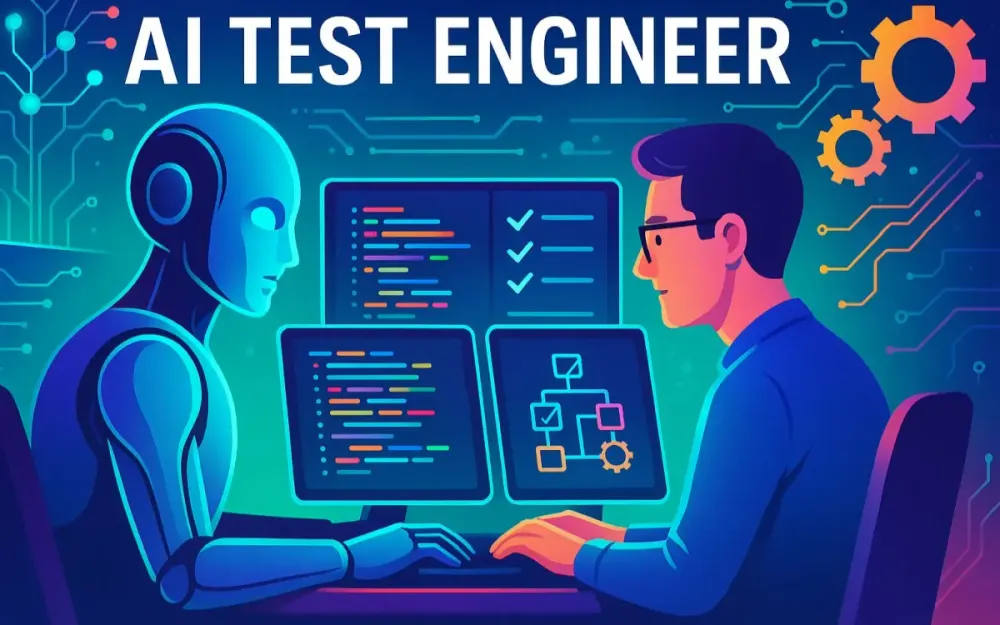
We call this new paradigm the AI Test Engineer. It is not a person and it is not just a tool. Think of it as an augmentation layer—a co-pilot that works alongside developers, testers, and architects.
The AI Test Engineer does not replace skilled QA professionals. It multiplies their effectiveness by automating the repetitive, error-prone parts of the job:
- It reads code and requirements faster than any human
- It proposes tests you might overlook, especially edge cases
- It generates consistent documentation without fatigue
Yet, human judgment remains vital. Engineers review, refine, and validate the AI’s output, ensuring correctness and contextual alignment. In this sense, the AI Test Engineer acts as a force multiplier, not a substitute.
1.4 What This Article Will Cover
This guide takes you from first principles to advanced application. We will explore:
- The paradigm shift: why LLMs are changing the testing landscape.
- The foundational concepts behind using LLMs in QA.
- How to architect a full AI-driven test generation system.
- Practical implementations with real code examples—unit, integration, and end-to-end.
- Extending AI beyond test cases into documentation, data, and traceability.
- Best practices, pitfalls, and security considerations.
- What the future holds: autonomous test agents, self-healing scripts, and predictive quality.
By the end, you’ll see not just how this works in theory, but how you can begin applying it in your own environment today.
2 The Paradigm Shift: Understanding LLMs in the Context of Software Testing
The adoption of LLMs in QA is not just a new tool in the toolbox—it’s a paradigm shift. To appreciate why, we need to understand where test automation has come from, what LLMs uniquely bring to the table, and where their limitations still lie.
2.1 The Evolution of Test Automation
The history of test automation can be summarized in three waves:
- Record-and-playback tools (1990s–2000s): Early frameworks like WinRunner and QTP allowed testers to record UI actions and replay them. These scripts were brittle—small UI changes often broke them.
- Keyword- and data-driven frameworks (2000s–2010s): Tools like Robot Framework introduced reusable keywords and data tables, separating logic from data. This improved maintainability but still required significant manual authoring.
- Behavior-Driven Development (BDD, 2010s onward): Gherkin syntax and tools like Cucumber or SpecFlow allowed teams to define tests in natural language linked to executable code. This aligned developers, testers, and product owners—but writing Gherkin scenarios and glue code remained labor-intensive.
Where are we today? Most teams still rely on human effort to design test cases. Frameworks help execute and organize tests, but they don’t generate them. That is the bottleneck LLMs can break.
LLMs represent the fourth wave: automation not just of execution, but of design and documentation. Instead of testers writing every scenario, LLMs propose them, freeing humans to validate and extend rather than create from scratch.
| Dimension | Traditional Automation | LLM-Assisted Automation |
|---|---|---|
| Authoring Time | Hours to days per feature | Minutes to hours with AI draft |
| Coverage Breadth | Limited to human imagination | Broader, includes edge case proposals |
| Maintenance | High, scripts break on changes | Lower, AI regenerates updated tests |
| Flakiness | Common with UI/script coupling | Reduced, though prompts may misfire |
| Governance | Manual review and sign-off | Human-in-the-loop validation loop |
2.2 Why LLMs are a Game-Changer for QA
Code Comprehension
Traditional static analysis tools parse syntax. LLMs go further—they infer semantic meaning. For example, given this function:
def calculate_discount(price: float, user_type: str) -> float:
    if user_type == "premium":
        return price * 0.8
    elif user_type == "student":
        return price * 0.9
    return price
An LLM doesn’t just see if/elif. It infers likely test cases:
- Premium users get a 20% discount
- Students get a 10% discount
- Other users pay full price
- Edge cases: negative price, unexpected
user_type
That semantic leap transforms testing from “verify syntax paths” to “validate business logic.”
Natural Language to Code
LLMs excel at translating requirements into testable scripts. Consider a user story: “As a customer, I want to reset my password so that I can regain access if I forget it.”
An LLM can generate:
- Gherkin scenarios (
Given,When,Then) - API calls to
POST /reset-passwordwith valid and invalid inputs - Assertions on expected error messages
This reduces the cognitive friction of turning human language into automated checks.
Pattern Recognition and Edge Case Inference
Humans tend to test the happy path first. LLMs, trained on millions of code examples, often surface non-obvious edge cases: missing fields in JSON payloads, integer overflows, race conditions in concurrency. While not always correct, they widen the net of consideration, helping teams achieve higher coverage with less effort.
2.3 Core Capabilities of an LLM in Testing
Let’s map the capabilities most relevant to QA teams:
- Test Case Generation: From unit tests (e.g., Pytest, JUnit) to integration and end-to-end (e.g., Cypress, Playwright).
- Synthetic Test Data Generation: Creating realistic datasets for load testing or edge validation.
- Automated Test Documentation: Summarizing what tests cover, generating test plans, producing traceability matrices.
- Code Refactoring for Testability: Suggesting dependency injection, mockable interfaces, or decoupling patterns.
- Bug Description and Triaging: Taking logs or stack traces and turning them into structured bug reports with reproduction steps.
Each of these reduces manual toil and accelerates the QA cycle.
Cross-Stack Applicability
LLMs are not bound to a single programming ecosystem. For example, the same prompt—“Generate unit tests for a Calculator.add function that sums two integers”—can yield outputs across languages:
JUnit (Java):
@Test
public void testAdd() {
    Calculator calc = new Calculator();
    assertEquals(5, calc.add(2, 3));
    assertEquals(0, calc.add(-2, 2));
}
Jest (TypeScript):
test('add', () => {
  const calc = new Calculator();
  expect(calc.add(2, 3)).toBe(5);
  expect(calc.add(-2, 2)).toBe(0);
});
This cross-stack fluency highlights how LLMs can accelerate testing in polyglot environments without retraining teams from scratch.
2.4 Acknowledging the Limitations (No Silver Bullet)
Of course, LLMs are not flawless. Overreliance without safeguards can backfire. Key limitations include:
Hallucinations
LLMs sometimes generate plausible but wrong code. For example, they might reference a function that doesn’t exist. This makes human review non-negotiable. A “trust but verify” stance is essential.
Context Window
Models can only consider a limited amount of input (e.g., 200k tokens in some cases, but often less). For large codebases, you can’t simply paste everything. This is why retrieval-augmented generation (RAG) and embeddings matter—feeding the model only the most relevant slices of code.
Determinism
Run the same prompt twice and you might get different tests. This is by design: LLMs sample from probability distributions. While diversity can surface new cases, it also means you need consistency strategies—like fixing random seeds or caching validated outputs.
Security & IP Concerns
Sending proprietary code to public APIs is risky. Compliance teams worry about data leakage, IP exposure, and regulatory violations. The solution: use enterprise-secure offerings (Azure OpenAI, Anthropic Enterprise), or run open-source models locally with frameworks like Ollama or vLLM. QA cannot ignore security when adopting AI.
3 Architecting the AI Test Generation System: A Blueprint for Implementation
Building an AI-powered test generation system is not just about calling an API with a chunk of code and asking for tests. It requires an architecture that bridges multiple domains: source control, requirements management, embeddings, large language models, and continuous integration pipelines. Without structure, you end up with brittle experiments. With structure, you get a repeatable, scalable system that earns trust across engineering teams.
3.1 High-Level System Architecture
At a high level, the system resembles an end-to-end pipeline with clear inputs, a processing core, and outputs. The inputs include all the artifacts that define software behavior: the code repository, requirements (Jira, Azure DevOps, Confluence), and interface specifications (OpenAPI or GraphQL). The processing core is the AI Test Generation Engine, which integrates static analysis, embeddings, prompt engineering, and LLMs. Finally, the outputs are tangible QA deliverables: unit and integration test code, Gherkin .feature files, test data, documentation, and traceability matrices.
Imagine this flow as three boxes connected by arrows:
- Inputs: GitHub repository, Jira epics, OpenAPI specs
- Processing Core: Context provider → prompt construction → LLM inference → validation loop
- Outputs:
test_calculations.py,orders.feature, syntheticusers.csv, test plan PDFs
In practice, this architecture can be wired into CI/CD. For example, a GitHub Action might trigger when a pull request is opened, automatically generating candidate tests and attaching them as comments or new files.
3.2 Key Components of the Engine
3.2.1 Code Intelligence Layer (The Context Provider)
The first challenge in making LLMs useful for testing is context provisioning. A function rarely stands alone; its behavior depends on surrounding classes, dependencies, and data models. Feeding the entire codebase to a model is impossible due to token limits. Instead, we selectively gather relevant context.
Static Code Analysis
One approach is to parse the code into an Abstract Syntax Tree (AST). Libraries like Python’s built-in ast or the cross-language tree-sitter make this practical.
import ast

code = """
def calculate_total(items):
    return sum(item['price'] for item in items if item['active'])
"""

tree = ast.parse(code)
for node in ast.walk(tree):
    if isinstance(node, ast.FunctionDef):
        print(f"Found function: {node.name}")
Output:
Found function: calculate_totalFrom this structure, you can extract function names, parameters, docstrings, and dependencies. When using ast.get_source_segment, avoid reopening the file—reuse the original code_str to prevent double I/O and mismatched segments. This metadata is fed to embeddings to help retrieval later.
Embeddings & Vector Databases
To scale beyond small snippets, we need a Retrieval-Augmented Generation (RAG) pipeline. Here, each function, class, or spec section is converted into a vector embedding (a high-dimensional representation of semantics) and stored in a vector database.
Popular options include:
- ChromaDB: Lightweight, open-source, easy to embed into pipelines
- Pinecone: Cloud-hosted, optimized for production scale
- Weaviate: Feature-rich, with built-in semantic search
Example: embedding code chunks with OpenAI’s embeddings API and storing them in ChromaDB.
import chromadb
from openai import OpenAI

client = chromadb.PersistentClient(path="./chroma_store")

collection = client.create_collection(
    name="codebase",
    metadata={"namespace": "v1", "embedding_model": "text-embedding-3-small"}
)

embedding = OpenAI().embeddings.create(
    input="def calculate_total(items): return sum(...)",
    model="text-embedding-3-small"
)

collection.add(
    documents=["calculate_total function"],
    embeddings=[embedding.data[0].embedding],
    ids=["func_001"]
)

results = collection.query(
    query_embeddings=[embedding.data[0].embedding],
    n_results=5,
    where={"namespace": "v1"}
)
For reproducibility, explicitly set collection metadata (namespace, embedding model). Chunks should be created at the function or class level—not entire files—to ensure precise retrieval. Use top_k and where filters for context-aware queries.
Later, when generating tests for a new function, we query the vector DB to fetch its neighbors—dependencies, docstrings, or related specs.
3.2.2 The Prompt Engineering Core
Prompt Registry
To maintain consistency, create a prompts/ folder that holds all templates as JSON or YAML. Example schema:
name: pytest_unit_test
persona: senior_qa_engineer
input_slots:
  - code
  - num_tests
guardrails:
  - no_hardcoded_paths
  - import_target_module
version: 1.2.0
checksum: "sha256:abcd1234"
Semantic versioning and checksums let teams diff prompts over time, ensuring reproducibility across runs.
Once context is retrieved, we construct prompts. This is the “brain” of the operation.
Dynamic Prompt Templating
Instead of static strings, prompts should be templates that inject dynamic content: the function code, dependency snippets, examples, and the specific task. Jinja2 templates in Python are excellent for this.
from jinja2 import Template

template = Template("""
You are an experienced QA engineer.
Given the following code:

{{ code }}

Generate {{ num_tests }} pytest unit tests. Cover:
- Happy path
- Invalid inputs
- Boundary conditions
""")

prompt = template.render(code=function_code, num_tests=5)
Chain-of-Thought & ReAct Prompting
For complex scenarios, we can guide the model to “think step by step.” Chain-of-Thought (CoT) encourages reasoning, while ReAct combines reasoning with action. For example:
Step 1: Identify function purpose
Step 2: List possible input variations
Step 3: Design test cases
Step 4: Write pytest functions
This structured prompting often produces more coherent and thorough test suites than simple direct requests.
3.2.3 LLM Integration Layer
The choice of model matters. Options fall into two camps:
-
Cloud-hosted, frontier models:
- OpenAI GPT-4o: strong coding and reasoning
- Anthropic Claude 3 Opus: large context windows
- Google Gemini 1.5 Pro: multimodal, powerful reasoning
-
Open-source, local models:
- Llama 3 (Meta)
- Mistral 7B/8x22B
- Mixtral via Ollama or vLLM
For sensitive codebases, running Llama 3 locally might outweigh GPT-4o’s marginal accuracy advantage. Hybrid architectures are also viable: use smaller local models for simple refactorings, and larger hosted ones for complex test generation.
3.2.4 The Validation & Feedback Loop
No matter how good the model, its first attempt will sometimes fail. That’s why a validation-feedback loop is essential.
Test Executor
This component attempts to compile and run generated tests. If they fail due to syntax errors or missing imports, logs are captured.
pytest tests/test_calculate_total.py --maxfail=1Self-Correction
The feedback payload should include the exact stderr output, traceback, and any missing import details. Example:
{
  "stderr": "NameError: name 'calculate_total' is not defined",
  "traceback": "File tests/test_calc.py, line 3",
  "missing_import": "utils.calculate_total"
}
To prevent runaway loops, cap retries at two self-repair attempts before escalating to a human reviewer.
The error logs are fed back to the LLM as input. For example:
The generated test failed with error:
NameError: name 'calculate_total' is not defined

Fix the test so it correctly imports the target function from utils.py.
This feedback loop often resolves issues automatically. It mimics how a junior engineer might iterate under supervision.
3.3 Popular Frameworks and Libraries
While you can build everything from scratch, modern orchestrators simplify much of the boilerplate:
- LangChain: A popular orchestration library for chaining LLM calls, memory, and retrieval.
- LlamaIndex: Focused on retrieval pipelines, with strong support for document/code indexing.
- Haystack: Open-source framework for building retrieval-augmented NLP pipelines.
These frameworks integrate vector stores, prompt templates, and LLM calls, reducing the engineering lift. For QA systems, they provide glue between code ingestion, context retrieval, and test generation.
CI/CD Integration Example
A minimal GitHub Actions workflow can automate test generation on pull requests:
name: AI Test Generation

on:
  pull_request:
    types: [opened, synchronize]

jobs:
  generate-tests:
    runs-on: ubuntu-latest
    steps:
      - uses: actions/checkout@v3
      - name: Run AI Test Generator
        run: python scripts/generate_tests.py
      - name: Post summary as PR comment
        uses: marocchino/sticky-pull-request-comment@v2
        with:
          path: summary.md
      - name: Commit tests to branch
        run: |
          git config user.name "ai-bot"
          git config user.email "ai-bot@example.com"
          git checkout -b ai-tests
          git add tests/
          git commit -m "AI-generated tests"
          git push origin ai-tests
This ensures generated tests are visible for review but never merged directly into main without human oversight.
4 Practical Implementation Part 1: Generating Bulletproof Unit Tests
Theory is useful, but nothing convinces like working code. In this section, we’ll walk through generating real unit tests for a sample application using a retrieval-augmented approach.
4.1 The Target
Our target is a simple FastAPI application that calculates order totals with discounts. This example is intentionally modest, but the workflow scales to enterprise systems.
# app/utils.py
def calculate_discount(price: float, user_type: str) -> float:
    if price < 0:
        raise ValueError("Price cannot be negative")
    if user_type == "premium":
        return price * 0.8
    elif user_type == "student":
        return price * 0.9
    return price
We want to generate tests that cover normal, edge, and error conditions.
4.2 The RAG-Powered Approach (The Professional Method)
Step 1: Code Ingestion
We start by parsing the target function and its dependencies. Using ast again, we extract function definitions.
import ast

with open("app/utils.py") as f:
    tree = ast.parse(f.read())

functions = [node for node in ast.walk(tree) if isinstance(node, ast.FunctionDef)]
target_func = next(f for f in functions if f.name == "calculate_discount")
print(ast.get_source_segment(open("app/utils.py").read(), target_func))
This gives us the code snippet we’ll embed and retrieve later.
Step 2: Context Retrieval
Suppose our vector DB already contains embeddings for related functions (like tax calculation or order validation). We query for neighbors.
results = collection.query(
    query_texts=["calculate_discount function"],
    n_results=3
)
print(results["documents"])
Output might include related snippets like apply_coupon or validate_order. These are injected into the prompt to give the LLM broader context.
Step 3: The Master Prompt
Now we construct a detailed, context-aware prompt.
To improve repeatability, configure deterministic generation: set
temperature=0, pass a fixedseed, and request a structured JSON object of test cases before emitting runnable code. This enables policy checks and reduces nondeterminism across runs.
prompt = f"""
You are a senior QA engineer.
Here is the target function:

{target_func_code}

Here is related context:

{retrieved_context}

Generate 5 pytest tests for this function.
Requirements:
- Cover happy path for premium, student, and regular users
- Cover invalid input (negative price)
- Cover boundary condition: price = 0
- Use pytest.raises for error handling
- Follow pytest style: snake_case test names
"""
Step 4: Generation and Validation
The model produces something like:
import pytest
from app.utils import calculate_discount

def test_premium_discount():
    assert calculate_discount(100, "premium") == pytest.approx(80.0)

def test_student_discount():
    assert calculate_discount(100, "student") == pytest.approx(90.0)

def test_regular_user_no_discount():
    assert calculate_discount(100, "regular") == pytest.approx(100.0)

def test_negative_price_raises():
    with pytest.raises(ValueError):
        calculate_discount(-10, "premium")

def test_zero_price_boundary():
    assert calculate_discount(0, "student") == pytest.approx(0.0)
We then execute:
pytest tests/test_utils.pyIn production repositories, structure tests using a standard pytest layout:
- Place shared fixtures in
tests/conftest.py(e.g., sample data for users or prices).- Keep unit tests under
tests/unit/and integration tests undertests/integration/.- Pin dependencies with tools like
tox,uv, orpoetry.lockto ensure identical environments across developers and CI. This reduces “works on my machine” issues and ensures consistency.
If a test fails due to a typo, logs are fed back to the LLM for correction.
4.3 Example-Driven Generation (Few-Shot Prompting)
Prompting improves dramatically when we provide an example. Suppose our team prefers docstring-style comments above tests.
We include a reference test:
# Example test style
def test_addition_simple():
    """Verify simple addition works correctly"""
    assert 1 + 1 == 2
Then prompt:
Follow the above style for test functions.The LLM adapts, generating tests with docstrings:
def test_premium_discount():
    """Verify premium users receive 20% discount"""
    assert calculate_discount(100, "premium") == 80
This ensures consistency with organizational conventions.
4.4 Mutation Testing for Effectiveness
High test counts don’t always mean high quality. Mutation testing helps verify effectiveness by intentionally introducing small code changes (mutations) and checking if tests catch them.
For example, using mutmut:
pip install mutmut
mutmut run
mutmut results
If a test suite passes despite mutations (e.g., changing * 0.8 to * 0.9 in the discount function), that signals a gap in assertions. Mutation testing ensures AI-generated tests are not just numerous, but meaningful.
4.5 Open-Source Spotlight
Several tools already integrate these principles:
- CodiumAI: An IDE extension that analyzes code and generates candidate tests inline. It leverages embeddings and LLMs under the hood.
- Pynguin: A Python unit test generation framework (not LLM-based, but complements AI workflows).
- TestGPT prototypes: Community projects experimenting with GPT-driven test generation pipelines.
CodiumAI in particular shows how these ideas reach developers directly in their workflow. Instead of building everything custom, teams can adopt and extend such tools.
5 Practical Implementation Part 2: Automating Integration & API Tests
Unit tests validate individual functions, but integration and API tests verify whether services work together as intended. This is especially critical in distributed systems where multiple microservices, third-party APIs, and authentication layers intersect. Unlike unit tests, integration tests require structured data, real HTTP requests, and orchestration of dependent services. This is where large language models shine: they can translate an API specification into a library of executable tests that span common scenarios and edge cases.
5.1 The Source of Truth: API Specifications
When testing APIs, the most reliable input is not the code itself but the specification that defines its contract. For REST services, that’s typically an OpenAPI/Swagger document; for GraphQL, it’s the schema. These specs are written precisely to declare available endpoints, request/response payloads, authentication requirements, and error codes. Unlike code, which may evolve with hidden assumptions, the specification is the single source of truth for client-facing behavior.
Consider the following simplified openapi.json snippet for an order creation endpoint:
{
  "paths": {
    "/api/v1/orders": {
      "post": {
        "summary": "Create a new order",
        "requestBody": {
          "required": true,
          "content": {
            "application/json": {
              "schema": {
                "type": "object",
                "required": ["customerId", "items"],
                "properties": {
                  "customerId": { "type": "string" },
                  "items": {
                    "type": "array",
                    "items": {
                      "type": "object",
                      "required": ["productId", "quantity"],
                      "properties": {
                        "productId": { "type": "string" },
                        "quantity": { "type": "integer" }
                      }
                    }
                  }
                }
              }
            }
          }
        },
        "responses": {
          "201": { "description": "Order created successfully" },
          "400": { "description": "Invalid request" },
          "401": { "description": "Unauthorized" }
        }
      }
    }
  }
}
Instead of requiring a human to read this and design tests, we can feed it directly into an LLM. The model interprets the required fields, potential error codes, and response structures, producing executable scenarios.
5.2 The Walkthrough: From OpenAPI to Executable Tests
Let’s walk through the process of converting this OpenAPI spec into runnable integration tests.
Step 1: Ingesting the Spec
We begin by loading the OpenAPI document into a structured object. In Python, pydantic or openapi-spec-validator can parse and validate the schema.
import json

with open("openapi.json") as f:
    spec = json.load(f)

endpoint = spec["paths"]["/api/v1/orders"]["post"]
print(endpoint["summary"])
This prepares the content we’ll feed to the LLM. Instead of raw JSON, we can extract just the relevant parts (parameters, required fields, response codes).
Step 2: Scenario Generation
Next, we prompt the LLM to design test scenarios. Instead of code immediately, we ask it to act as a QA architect:
You are a senior QA engineer.
Given the following OpenAPI specification for POST /api/v1/orders:

[spec JSON]

Devise 8 test scenarios, including:
- Valid order creation
- Missing required fields
- Unauthorized request
- Invalid quantity values
- Edge cases for empty item arrays
- Large order payloads
Return scenarios as a numbered text list.
The LLM might respond:
- Create order with valid
customerIdand one item → expect201 Created. - Create order missing
customerId→ expect400 Bad Request. - Create order with item missing
productId→ expect400 Bad Request. - Create order with
quantity = 0→ expect400 Bad Request. - Create order with empty
itemsarray → expect400 Bad Request. - Create order with large payload (100 items) → expect
201 Created. - Create order with invalid auth token → expect
401 Unauthorized. - Create order with expired token → expect
401 Unauthorized.
Instead of free text, capture scenarios in a machine-readable JSON format:
[
  {
    "name": "valid order creation",
    "method": "POST",
    "path": "/api/v1/orders",
    "auth": "Bearer VALID_TOKEN",
    "body": { "customerId": "CUST-1", "items": [{"productId": "P123", "quantity": 2}] },
    "expect": { "status": 201, "schema": "OrderResponse" }
  },
  {
    "name": "missing customerId",
    "method": "POST",
    "path": "/api/v1/orders",
    "auth": "Bearer VALID_TOKEN",
    "body": { "items": [{"productId": "P123", "quantity": 2}] },
    "expect": { "status": 400, "schema": "ErrorResponse" }
  }
]
This lets teams audit and approve the plan before code generation.
Step 3: Code Generation
Now we loop over each scenario and generate code. Each prompt can focus on a single scenario:
Write a Python pytest function using the 'requests' library to implement this scenario:
"Create order missing customerId → expect 400 Bad Request."
The model returns:
import pytest
import httpx
import os
from tenacity import retry, stop_after_attempt, wait_exponential

BASE_URL = os.getenv("API_BASE_URL", "http://localhost:8000/api/v1")

@retry(stop=stop_after_attempt(3), wait=wait_exponential())
def post_with_retry(endpoint, payload, token="VALID_TOKEN"):
    with httpx.Client(timeout=5.0) as client:
        return client.post(
            f"{BASE_URL}{endpoint}",
            json=payload,
            headers={"Authorization": f"Bearer {token}"}
        )

def test_create_order_missing_customerId():
    payload = {"items": [{"productId": "P123", "quantity": 2}]}
    response = post_with_retry("/orders", payload)
    assert response.status_code == 400
    assert "customerId" in response.json().get("error", "").lower()
Beyond status codes, validate the response against the OpenAPI schema using jsonschema:
from jsonschema import validate

schema = spec["components"]["schemas"]["ErrorResponse"]
validate(instance=response.json(), schema=schema)
This ensures responses conform to the contract, not just the expected HTTP code.
Each test can be validated locally, corrected if necessary, and added to a test suite.
5.3 Generating Dependent Data and Mocks
Integration tests often depend on more than just payloads. You may need realistic user IDs, valid auth tokens, or mock responses from downstream services.
LLMs can generate JSON payloads on demand. For example:
Generate a valid JSON payload for creating an order with 3 items.Result:
{
  "customerId": "CUST-56789",
  "items": [
    { "productId": "PROD-111", "quantity": 1 },
    { "productId": "PROD-222", "quantity": 3 },
    { "productId": "PROD-333", "quantity": 2 }
  ]
}
Integration tests often need data seeding and cleanup. For example:
- Create a customer
- Create an order for that customer
- Delete both after the test run
Use fixtures to handle setup/teardown and generate unique IDs per run (e.g., uuid4()) to keep tests isolated. This prevents state leakage between runs.
For mocking, tools like responses (Python) or nock (Node.js) integrate smoothly. You can instruct the LLM:
Generate a Python 'responses' mock for POST /api/v1/orders returning a 201 Created with orderId.The model outputs:
import responses

@responses.activate
def test_order_created_mock():
    responses.add(
        responses.POST,
        "http://localhost:8000/api/v1/orders",
        json={"orderId": "ORD-12345"},
        status=201
    )

    import requests
    payload = {"customerId": "CUST-123", "items": [{"productId": "PROD-1", "quantity": 1}]}
    resp = requests.post("http://localhost:8000/api/v1/orders", json=payload)
    assert resp.status_code == 201
    assert resp.json()["orderId"] == "ORD-12345"
With this combination of spec ingestion, scenario generation, and data/mocks, entire API suites can be bootstrapped with minimal human effort.
5.4 Error Catalog Coverage
Every 4xx/5xx response defined in the spec should have at least one negative test. After scenario generation, produce a quick coverage report mapping endpoints to their scenarios:
Endpoint: POST /api/v1/orders
  ✓ 201 Created (valid order)
  ✓ 400 Bad Request (missing customerId, invalid quantity, empty items)
  ✓ 401 Unauthorized (invalid/expired token)
This gives teams immediate visibility into gaps in negative testing.
6 Practical Implementation Part 3: E2E Scenarios and BDD
While unit and integration tests ensure correctness at a technical level, end-to-end (E2E) tests validate full user journeys. Behavior-Driven Development (BDD) adds another layer: scenarios written in natural language (Given, When, Then) that align technical validation with business intent. LLMs are particularly effective here because BDD is structured natural language, a perfect bridge between user stories and code.
6.1 The Perfect Marriage: LLMs and Gherkin
Gherkin syntax was designed to make tests readable by both business stakeholders and engineers. Its simplicity is a feature but also a limitation—it still requires humans to author scenarios carefully. LLMs fit naturally: they can parse user stories and convert them into structured, executable scenarios. Instead of manually brainstorming edge cases, product owners can provide a high-level user story and let the model expand it into multiple detailed scenarios.
For example, a product owner might only articulate: “As a logged-in user, I want to add products to my shopping cart so I can purchase them later.” An LLM can expand this into multiple scenarios that cover not just the happy path but also exceptions like out-of-stock items or quantity restrictions.
6.2 From User Story to Gherkin Scenarios
Let’s see how a user story translates into scenarios.
Input (User Story):
“As a logged-in user, I want to be able to add a product to my shopping cart so that I can purchase it later.”
Prompt:
Generate Gherkin scenarios for the following user story.
Include:
- A happy path scenario
- Adding out-of-stock items
- Adding more than the allowed quantity
Output (feature file):
Feature: Shopping cart management

  Scenario: Add a product to the cart successfully
    Given I am logged in as a registered user
    And a product "Laptop" is in stock
    When I add the product "Laptop" to my cart
    Then the cart should contain 1 "Laptop"
    And the total price should be updated

  Scenario: Attempt to add an out-of-stock product
    Given I am logged in as a registered user
    And the product "Headphones" is out of stock
    When I try to add the product "Headphones" to my cart
    Then I should see an error message "Product is out of stock"
    And the cart should remain unchanged

  Scenario: Add more than the allowed quantity
    Given I am logged in as a registered user
    And a product "Phone" is in stock with a limit of 2 per user
    When I try to add 3 "Phone" items to my cart
    Then I should see an error message "Quantity limit exceeded"
    And the cart should contain only 2 "Phone" items
This .feature file can be checked into source control alongside the application code. It directly encodes business requirements into structured test cases.
6.3 From Gherkin to Test Code (The “Last Mile”)
The Gherkin file defines intent, but execution requires binding steps to test code. Traditionally, engineers manually implement step definitions in frameworks like Cucumber, Behave, Playwright, or Cypress. LLMs can assist by generating boilerplate code for these steps.
For example, converting the “Add a product to the cart successfully” scenario into Playwright (JavaScript):
const { test, expect } = require('@playwright/test');

test('Add a product to the cart successfully', async ({ page }) => {
  await page.goto('http://localhost:3000/login');
  await page.fill('#username', 'user1');
  await page.fill('#password', 'password');
  await page.click('button[type="submit"]');

  await page.goto('http://localhost:3000/products');
  await page.click('text=Laptop');
  await page.click('button#add-to-cart');

  await page.goto('http://localhost:3000/cart');
  const cartItems = await page.locator('.cart-item');
  await expect(cartItems).toHaveCount(1);
  await expect(cartItems.first()).toContainText('Laptop');
});
To reduce flakiness, adopt a consistent selector strategy. Use data-testid attributes in your application markup and follow the page-object pattern to encapsulate selectors.
Example page-object for the cart page:
class CartPage {
  constructor(page) {
    this.page = page;
    this.items = page.locator('[data-testid="cart-item"]');
    this.total = page.locator('[data-testid="cart-total"]');
  }
  async assertItemCount(count) {
    await expect(this.items).toHaveCount(count);
  }
}
This separates test logic from selectors, improving maintainability.
Playwright makes parallelization and debugging straightforward. A sample configuration in playwright.config.ts:
import { defineConfig } from '@playwright/test';

export default defineConfig({
  testDir: './tests',
  retries: 1,
  workers: 4,
  reporter: [['html', { outputFolder: 'playwright-report' }]],
  use: {
    trace: 'on-first-retry',
    video: 'retain-on-failure',
    screenshot: 'only-on-failure'
  }
});
This setup runs tests in parallel, captures videos and screenshots on failure, and generates an HTML report to aid triage.
The LLM can generate this scaffold automatically, but human oversight is still required. Why? Because LLMs don’t have runtime access to the DOM structure. They may guess element selectors (#add-to-cart) incorrectly. An engineer must refine selectors and assertions based on the actual UI.
Emerging Tools Bridging the Gap
Several experimental tools are tackling this “last mile”:
- Testim + AI: Attempts to auto-heal broken selectors when the DOM changes.
- Mabl: Cloud platform using AI to adapt E2E tests dynamically.
- Playwright AI Prototypes: Community projects integrating GPT to map Gherkin directly to test scripts.
While promising, none fully eliminate the need for human validation. The most practical model today is AI-assisted authoring: generate a starting point with LLMs, then refine within the test framework.
6.4 Accessibility Testing
End-to-end tests should also validate accessibility. Tools like axe-core or Pa11y can be integrated with Playwright:
import { test, expect } from '@playwright/test';
import AxeBuilder from '@axe-core/playwright';

test('Accessibility scan on cart page', async ({ page }) => {
  await page.goto('http://localhost:3000/cart');
  const results = await new AxeBuilder({ page }).analyze();
  expect(results.violations).toEqual([]);
});
LLMs can summarize these violations into human-readable issues (e.g., “Add alt text to product images”) so non-technical stakeholders can understand accessibility gaps.
When generating step definitions, constrain the LLM to your existing glue code conventions—naming, hooks, and folder structure. For example, if step files live under features/steps/ and use snake_case function names, encode that explicitly in the prompt. This prevents drift and ensures generated steps slot neatly into your framework.
7 Beyond Test Cases: Documentation, Data, and Traceability
So far, we’ve seen how LLMs accelerate the creation of tests across different levels—unit, integration, and E2E. But the role of quality assurance isn’t confined to code. Teams must also generate convincing datasets, produce documentation that stakeholders can trust, and maintain end-to-end traceability from requirements to execution. These activities traditionally involve heavy manual effort, but with AI, much of the heavy lifting can be automated or augmented.
7.1 Synthesizing Rich and Realistic Test Data
Test data is the oxygen of QA. Without representative data, even the best-written tests fail to reflect real-world behavior. Too often, developers fall back on trivial fixtures: user1, foo@example.com, 12345. These values rarely expose the bugs that lurk in production. LLMs can dramatically improve this by synthesizing complex, realistic, and varied datasets at scale.
Prompting for Complex Structures
Consider a case where we need a nested JSON payload for a banking transaction API. A basic fixture might look like this:
{"userId": "1", "amount": 100}An LLM can generate a far richer structure when prompted:
Generate a JSON payload representing a realistic international money transfer,
including sender, receiver, currency conversion, and metadata.
Output:
{
  "transactionId": "TXN-839201",
  "sender": {
    "id": "USR-1245",
    "name": "Aisha Khan",
    "accountNumber": "PK78HABB000123456789",
    "country": "PK"
  },
  "receiver": {
    "id": "USR-8821",
    "name": "Carlos Ramirez",
    "accountNumber": "ES9121000418450200051332",
    "country": "ES"
  },
  "amount": 1500.75,
  "currency": "USD",
  "conversionRate": 0.91,
  "status": "PENDING",
  "createdAt": "2025-09-19T10:45:00Z"
}
Now, edge cases like cross-border rules, currency precision, and field validation become testable.
When generating test data, prefer synthetic data over anonymized production data to avoid leaking sensitive information. Always document your team’s PII policy. Seed Faker with locale diversity (Faker("fr_FR"), Faker("ar_SA")) to capture name/address variations and non-Latin scripts. Explicitly test edge cases for dates (e.g., leap years, DST boundaries, different time zones) to ensure global correctness.
Generating Bulk Data Files
For load testing or analytics validation, you need thousands of rows, not one. Here, LLMs can collaborate with libraries like Faker to generate CSV datasets.
from faker import Faker
import csv

fake = Faker()
with open("users.csv", "w", newline="") as f:
    writer = csv.writer(f)
    writer.writerow(["id", "name", "email", "address"])
    for i in range(1000):
        writer.writerow([
            i,
            fake.name(),
            fake.email(),
            fake.address().replace("\n", ", ")
        ])
For bulk generation, add safeguards:
- Sample edge cases deliberately (nulls, extremely long strings, Unicode/RTL text).
- Define a CSV schema contract with expected column names, types, and row counts.
- Add assertions in the generator:
assert len(rows) == 1000
assert all(len(row) == 4 for row in rows)
This prevents silent drift in generated files and enforces quality of datasets.
If you prompt an LLM with: “Generate Python code to create 1000 realistic user records with names, emails, and addresses using Faker,” you get exactly this. Engineers can then tweak the schema and let the machine produce bulk files.
Combining Synthetic + Rule-Based Data
The sweet spot often comes from mixing free-form LLM creativity with deterministic constraints. For example, you can ask:
Generate 10 JSON orders where:
- Each customerId is unique
- At least 2 orders are missing the 'items' field
- At least 1 order has a negative quantity
The model combines variation with intentional invalid cases. This ensures coverage for happy paths and known risk factors in a single dataset.
7.2 Automated Test Documentation
Documentation is the least glamorous but most vital part of QA. Stakeholders—managers, auditors, even regulators—don’t read Pytest files. They need plain-language test plans, summaries, and traceability reports. LLMs excel at turning code and stories into prose.
Test Plan Generation
Suppose a new payments feature is being built. Feeding both the code snippet and a Jira story into an LLM, you can ask:
Generate a high-level test plan covering:
- Scope and out-of-scope items
- Types of testing required
- Environments and resources needed
Output:
Test Plan: Payments API - Refund Feature

Scope:
- Validate refund initiation via POST /api/v1/refunds
- Validate refund limits for premium and standard users
- Validate error handling for invalid transaction IDs

Out of Scope:
- End-to-end settlement processing
- UI rendering of refunds

Testing Types:
- Unit tests for refund validation logic
- Integration tests with transactions API
- Security tests for unauthorized access
- Performance tests under 100 concurrent requests

Environments:
- QA environment with seeded transaction data
- Mock payment gateway for external calls
This draft can be refined by humans in minutes instead of hours.
Code-to-Documentation
Equally useful is summarizing test code into human-readable descriptions. For example, a long Pytest script can be condensed into:
This suite validates the calculate_discount function:
- Premium users receive 20% discount
- Students receive 10% discount
- Regular users receive no discount
- Negative prices raise ValueError
- Zero price is handled correctly
Such summaries can populate Confluence pages or compliance reports without manual effort.
Documentation pipelines can be automated. For example, a script can summarize test suites and publish updates to Confluence daily:
import requests, json

def post_summary_to_confluence(summary):
    url = "https://confluence.example.com/rest/api/content/"
    payload = {
        "title": "Daily Test Suite Summary",
        "type": "page",
        "space": {"key": "QA"},
        "body": {"storage": {"value": summary, "representation": "storage"}}
    }
    requests.post(url, data=json.dumps(payload), auth=("user", "token"))
Combine this with a diff of test files to generate a daily changelog of added/removed tests for stakeholders.
7.3 The Holy Grail: End-to-End Traceability
Traceability ensures every requirement is covered by tests. In regulated industries like healthcare or finance, it’s non-negotiable. Traditionally, QA teams build spreadsheets mapping Jira tickets to test IDs. This is tedious and error-prone. With LLMs, we can automate tagging and extraction.
Tagging in Generated Code
When generating tests, instruct the LLM:
For each test, add a comment with the requirement ID in the format:
@Requirement: JIRA-1234
Generated test:
import pytest
from app.utils import calculate_discount

# @Requirement: JIRA-4567
def test_premium_discount():
    assert calculate_discount(100, "premium") == 80
Extracting Tags Programmatically
A simple Python script can parse all test files and build a traceability matrix:
import os, re

matrix = {}
for root, _, files in os.walk("tests"):
    for file in files:
        if file.endswith(".py"):
            with open(os.path.join(root, file)) as f:
                for line in f:
                    match = re.search(r"@Requirement:\s*(\S+)", line)
                    if match:
                        req = match.group(1)
                        matrix.setdefault(req, []).append(file)

for req, tests in matrix.items():
    print(f"{req}: {tests}")
Output:
JIRA-4567: ['test_utils.py']
JIRA-7890: ['test_api_orders.py', 'test_api_refunds.py']
This auto-generated Requirements Traceability Matrix (RTM) can then be exported to Excel or Jira, closing the loop between stories and validation.
For richer reporting, output the traceability matrix as CSV or HTML with columns such as:
- Requirement ID
- Test IDs
- Last Run Date
- Status (pass/fail)
- Evidence (link to CI report or artifact)
Example CSV row:
JIRA-4567,test_utils.py,2025-09-18,Pass,https://ci.example.com/reports/4567.htmlThis ensures every requirement has auditable links to execution results and evidence stored in CI pipelines.
8 Productionizing Your System: Best Practices and Pitfalls
Experimenting with AI-generated tests is easy; productionizing it is hard. To succeed, teams need a disciplined approach: good prompt design, strong human oversight, cost management, secure handling of code, and ROI measurement. Let’s unpack each dimension.
8.1 The Art and Science of Prompt Engineering for Testers
Prompts are the new programming interface. Poorly worded prompts yield inconsistent results. Well-crafted prompts produce reliable, reusable outputs.
The Persona Pattern
By giving the model a persona, you bias its responses. Compare:
Generate tests for this function.versus:
Act as a senior security test engineer.
Generate tests that focus on input validation, authentication bypasses, and SQL injection risks.
The latter yields focused security scenarios that a generic prompt would miss.
Zero-Shot, Few-Shot, and RAG
- Zero-shot: Quick, no context—fast but inconsistent.
- Few-shot: Add examples to guide style and coverage—stronger for consistency.
- RAG: Retrieve code-specific context from embeddings—best for large, complex codebases.
Decision rule: use zero-shot for trivial helpers, few-shot for team-specific style enforcement, and RAG for mission-critical or interdependent components.
Iteration and Prompt Libraries
Treat prompts as artifacts. Maintain a repository of tested prompts for unit, API, and BDD generation. Iterate as you see what works in your domain. Over time, this becomes institutional knowledge, as valuable as reusable code libraries.
Prompt Governance
Prompts should be treated like code. Establish a Prompt PR process where new or modified prompts are peer-reviewed. Add linting rules to check prompt length, banned phrases, and potential PII leakage (e.g., via regex scans). Create unit tests for prompts that validate golden outputs on seed functions. Finally, set up drift alerts—when a model version changes, run the same prompts against a seed repo and flag differences for review.
8.2 Human-in-the-Loop is Non-Negotiable
LLMs generate first drafts, not final truth. The engineer’s role shifts from creator to curator. They review, run, and refine tests, catching hallucinations and aligning coverage with business risk.
In practice, this means:
- LLM suggests 8 tests for an API.
- QA engineer validates them, removes duplicates, adjusts assertions, and confirms coverage.
- Only then are tests merged into the suite.
This workflow avoids blind trust while still saving 60–80% of the authoring time.
8.3 Managing Costs and Tokens
Running large models isn’t free. Every token costs money and latency. Best practices include:
- Model selection: Use GPT-4 for complex reasoning, GPT-3.5 or Mistral for simple boilerplate.
- Chunking and retrieval: Feed only relevant code snippets via embeddings.
- Caching: Store validated outputs (e.g., standard tests for common patterns) instead of regenerating.
- Batching: Generate multiple tests in one call rather than many small calls.
Cost guardrails keep spending predictable. Define per-run token budgets (e.g., max 50k tokens per PR), enforce per-PR caps, and log usage. Cache validated snippets to avoid repeated generations. Use a decision tree: start with a small local model for simple cases, and only fall back to a larger hosted model when complexity requires it.
A balanced pipeline minimizes costs while retaining quality.
8.4 Building a Secure System
Security is paramount when source code is involved.
- Never send sensitive code to public APIs. This includes business logic, credentials, or PII.
- Use enterprise-secure offerings like Azure OpenAI Service, where data stays within compliance boundaries.
- For absolute control, run open-source models locally with Ollama or vLLM.
- Apply access controls and logging so only authorized engineers invoke AI pipelines.
Versioning matters. Always pin model names and include the date (e.g., gpt-4-2025-05-01). When a provider updates models, run A/B comparisons on a seed repository, documenting regressions and differences in generated test suites. This ensures stability across upgrades.
Remember: compliance officers and security teams are stakeholders too. They must trust your system as much as developers do.
8.5 Measuring ROI
How do you prove that AI-assisted testing is worth it? Define metrics upfront:
- Test authoring time reduction: Compare average time to create a unit test before vs. after AI.
- Coverage increase: Measure lines, branches, or requirements covered.
- Defect leakage reduction: Track bugs escaping to production before and after adoption.
- Cost savings: Calculate reduction in manual QA hours and API token spend.
Example: A fintech team adopting AI-assisted unit tests reported reducing average authoring time from 40 minutes to 10 minutes per function, while increasing coverage from 55% to 78% in one quarter. That kind of data convinces leadership to invest further.
To make ROI transparent, use a simple worksheet:
ROI = (Hours_saved * Hourly_rate) – Token_costInputs:
- Average tests authored per week
- Average minutes per test (before vs. after AI)
- Hourly QA rate
- Token cost per run
Track these metrics in a dashboard (e.g., Grafana or PowerBI) so leadership can see ROI trends over time, not just anecdotal reports.
9 The Future is Now: What’s Next for AI in QA?
We’ve explored how LLMs assist in today’s workflows—helping generate tests, synthesize data, and automate documentation. But the horizon is even more exciting. What we currently use as a co-pilot will, in the near future, evolve into more autonomous systems capable of orchestrating full QA lifecycles. From agents that independently discover test paths to predictive models that highlight risky code changes, the role of AI in QA is shifting from augmentation to proactive intelligence.
9.1 Autonomous Testing Agents
The next logical leap is autonomous testing agents: systems that not only generate tests when prompted but actively explore staging environments, infer user flows, execute tests, and log results. Think of it as combining the exploratory instincts of a human tester with the automation speed of a machine.
Imagine deploying a new build of an e-commerce site to staging. An AI agent could:
- Launch a browser session in headless mode (e.g., using Playwright).
- Crawl the site, map out navigation paths, and identify possible user actions.
- Generate candidate test cases on-the-fly based on critical flows (login, checkout, search).
- Execute those tests, capturing screenshots, DOM snapshots, and logs.
- File bug reports automatically when failures occur.
To prevent runaway behavior, agents need safety rails. Scope them to a limited DOM region, enforce rate limits on navigation and requests, and restrict them to an allowed set of routes (e.g., /cart, /checkout). Before filing bug reports automatically, insert a reviewer checkpoint so engineers confirm severity and reproduction steps.
A pseudo-implementation in Python might look like:
from playwright.sync_api import sync_playwright
import openai

def explore_and_test(base_url):
    with sync_playwright() as p:
        browser = p.chromium.launch()
        page = browser.new_page()
        page.goto(base_url)

        # Gather DOM content for AI analysis
        dom = page.content()

        # Prompt AI to suggest test steps
        response = openai.ChatCompletion.create(
            model="gpt-4o",
            messages=[{
                "role": "system", "content": "You are an autonomous QA agent."
            },{
                "role": "user", "content": f"Generate test steps from this DOM:\n{dom}"
            }]
        )

        steps = response.choices[0].message["content"]
        print("Generated steps:", steps)

        browser.close()
In a mature system, these steps would be parsed into executable Playwright scripts. Bugs wouldn’t just be detected; they’d be logged in Jira or GitHub Issues complete with reproduction steps, screenshots, and logs.
Autonomous testing agents won’t eliminate QA teams—they’ll extend their reach. Instead of clicking through staging manually, QA professionals will supervise, prioritize, and refine the agent’s discoveries.
9.2 Self-Healing Tests
One of the biggest frustrations in QA automation is test fragility. A small UI change—say, a renamed CSS class or a moved button—can break dozens of E2E tests. Historically, engineers had to comb through failing tests, manually update selectors, and rerun suites. AI promises self-healing tests that adapt dynamically.
The principle is straightforward: when a locator fails, the AI doesn’t immediately mark the test as broken. Instead, it examines the DOM, compares historical snapshots, and attempts to infer the new locator. For instance, if #add-to-cart is missing but a new element with label “Add to Cart” exists, the agent updates the selector automatically.
Example in Playwright:
from playwright.sync_api import Page

def resilient_click(page: Page, selector: str, fallback_text: str):
    try:
        page.click(selector)
    except:
        # Attempt fallback by searching visible text
        element = page.locator(f"text={fallback_text}")
        if element.count() > 0:
            element.first.click()
        else:
            raise Exception(f"Failed to locate element with {selector} or text={fallback_text}")
A robust self-healing policy requires multiple signals. For instance, only update a locator when two independent heuristics agree (e.g., matching both visible text and ARIA role). Instead of silently patching, log a suggested diff and wait for human approval before committing changes. This balances adaptability with control.
Future AI-enhanced frameworks will take this further. By analyzing past DOM structures, commit diffs, and design tokens, the agent will proactively adapt tests without human intervention. Some tools like Testim and Mabl already explore this; with LLM integration, adaptability will only grow stronger.
Self-healing tests will reduce flaky failures, cut maintenance overhead, and keep CI pipelines green even as frontends evolve rapidly.
9.3 Predictive Quality Analysis
Today, QA is mostly reactive: developers write code, then QA tests it. Predictive quality analysis flips the script by asking: Which parts of this commit are most likely to introduce defects? If AI can predict risk upfront, teams can target their testing efforts intelligently.
This involves training models on historical data:
- Code churn (how often a file changes).
- Complexity metrics (cyclomatic complexity, dependency depth).
- Past bug density in modules.
- Developer patterns (e.g., junior contributors vs. senior).
An AI could then score each commit with a bug likelihood score. Imagine your CI dashboard showing:
Commit abc123: High risk (75% likelihood of defect)
 - modules/payment.py: historically bug-prone, modified 40 LOC
 - modules/cart.js: medium risk, new logic for discounts
An implementation sketch:
import joblib
import git

# Load predictive model
model = joblib.load("bug_risk_model.pkl")

repo = git.Repo(".")
commit = repo.head.commit
diff = commit.diff("HEAD~1")

features = {
    "lines_changed": sum(len(d.diff.decode().splitlines()) for d in diff),
    "files_changed": len(diff),
    "complexity_score": 8.2, # from static analysis
    "historical_bug_rate": 0.3
}

risk_score = model.predict_proba([list(features.values())])[0][1]
print(f"Predicted bug likelihood: {risk_score:.2f}")
Armed with this signal, QA leads can allocate attention where it matters. Instead of spreading thin across all changes, they focus deep testing on the riskiest modules. Over time, predictive analytics could even suggest code reviews, refactorings, or extra pair programming where risk is highest.
Predictive models come with caveats. They need sufficient historical data to train on, and concept drift (e.g., new frameworks or coding styles) can reduce accuracy over time. Fairness is another concern—avoid penalizing new contributors simply because they have fewer commits. A simple evaluation protocol is to measure precision and recall on past bug-prone file predictions before deploying models in CI.
9.4 The Evolving Role of the QA Professional
With all this automation, is QA as a profession at risk? Quite the opposite. The role is evolving from manual executor to quality strategist. In the near future, QA professionals will:
- Design and supervise AI agents: Setting parameters, validating outputs, and curating reusable scenarios.
- Focus on higher-order risks: Security, compliance, usability—areas where human judgment is irreplaceable.
- Become data interpreters: Translating predictive analytics into actionable insights for developers and managers.
- Shape organizational practices: Deciding how much automation is safe, where human review is essential, and how to measure quality outcomes.
The new title might not be QA Engineer but AI Test Orchestrator. Their job is not just to ensure correctness, but to orchestrate a symphony of human insight and machine efficiency. Those who embrace this shift will thrive in the new landscape.
10 Conclusion: Your Journey as an AI Test Engineer Starts Today
We’ve covered a lot of ground. From the bottlenecks of manual testing to the architectural blueprint of AI test systems, from practical implementations in unit and API tests to future-facing autonomous agents. The message is clear: the age of AI-augmented quality assurance has already begun.
10.1 Summary of Key Takeaways
- Manual test authoring is the last great bottleneck. LLMs directly target this by generating tests, documentation, and data.
- Architecture matters. A robust system combines static analysis, embeddings, prompt engineering, validation loops, and secure LLM integration.
- Practical workflows exist today. You can generate unit tests, integration suites, and BDD scenarios with minimal setup.
- Beyond tests, AI adds value in data synthesis, documentation, and traceability. This closes compliance gaps and accelerates audits.
- Productionization requires discipline. Prompt engineering, human-in-the-loop, cost control, and security best practices are non-negotiable.
- The future is autonomous. Testing agents, self-healing frameworks, and predictive analytics will redefine QA.
10.2 An Actionable First Step
Don’t try to boil the ocean. Pick one small, well-defined use case. For example: generate unit tests for a single pure function in your codebase using an LLM. Validate them, refine the prompt, and integrate the workflow into your CI pipeline. Once this succeeds, expand outward: integration tests, Gherkin scenarios, documentation. Gradual adoption builds trust and organizational buy-in.
A starter experiment might look like:
from openai import OpenAI

client = OpenAI()

prompt = """
You are a QA engineer.
Generate 3 pytest tests for this function:

def is_palindrome(s: str) -> bool:
    return s == s[::-1]
"""

response = client.chat.completions.create(
    model="gpt-4o",
    messages=[{"role": "user", "content": prompt}]
)

print(response.choices[0].message.content)
Run these tests, check coverage, and adjust the workflow. Small steps compound quickly.
10.3 Final Thoughts
The AI Test Engineer is not a science-fiction dream—it’s here. But adopting it wisely means treating AI as a partner, not a replacement. Machines generate, humans validate. Machines explore, humans prioritize. Machines accelerate, humans strategize.
By embracing this partnership, QA professionals unlock new levels of speed, coverage, and insight. The repetitive toil of scripting every test fades away, leaving room for what humans do best: creative problem solving, critical judgment, and holistic quality strategy.
Your journey as an AI Test Engineer starts today. The only question is: will you wait until it’s mainstream, or will you shape how your organization embraces it now?