1 Introduction: The $10,000 Surprise and the “Value” Shift
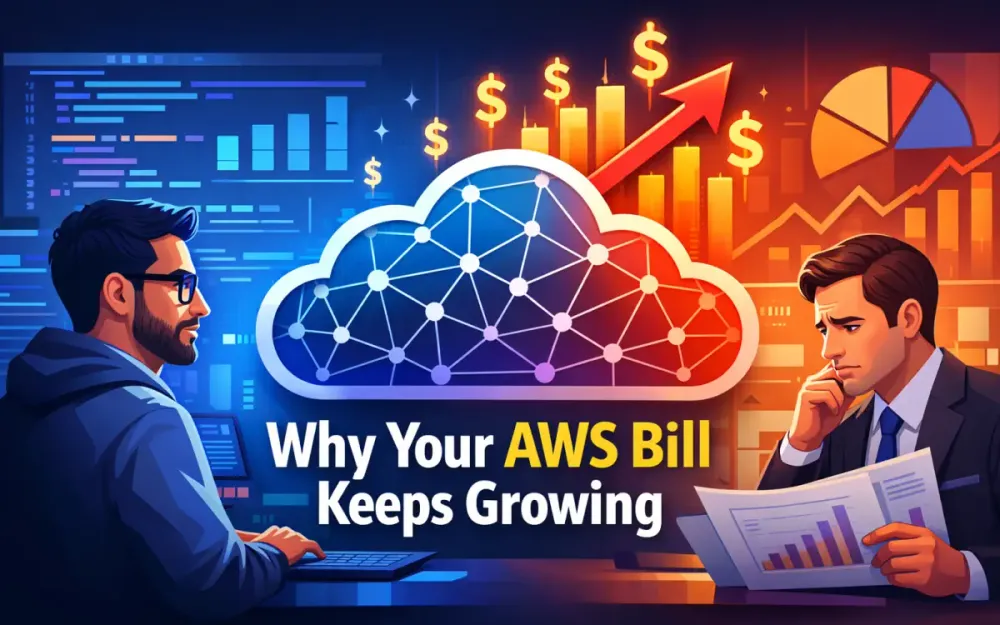
A familiar scene plays out in many engineering teams. A high-visibility service finally goes live after weeks of load testing, late nights, and careful architectural decisions. The rollout is smooth. Error rates are low, latency is stable, dashboards look green, and the system scales exactly as designed. The team celebrates what feels like a textbook cloud-native success.
Then Finance opens the monthly AWS bill and sees it has doubled.
What engineering interprets as “success at scale,” Finance experiences as unexpected variance that breaks forecasting models. From their perspective, nothing is “working as expected” if spend jumps without warning or explanation. The celebration abruptly turns into a meeting invite titled “Urgent: Cloud Spend Review.” What felt like a win now feels like a problem.
This article explains why this happens. More importantly, it explains what finance actually cares about, why cloud costs rise even in well-designed architectures, and how engineering leaders can reframe the conversation around measurable business value instead of raw infrastructure cost. The goal is not to make engineers think like accountants, but to help both sides speak a shared language.
1.1 The Disconnect
When an application scales, engineers see the cloud behaving exactly as promised. Auto Scaling Groups add instances under load without manual intervention. Serverless functions fan out into thousands of parallel executions in seconds. Managed databases increase storage, IOPS, or throughput automatically. From a technical standpoint, this is success: elasticity, resilience, and reliability delivered as advertised.
But every additional unit of “successful scale” introduces incremental cost. That cost is real, immediate, and metered precisely. Revenue, on the other hand, often lags. New users may be in free trials, enterprise contracts may take months to close, and product adoption rarely maps cleanly to infrastructure usage. The result is a timing mismatch: costs rise instantly, value materializes later.
Finance operates under a very different incentive model. Predictability matters more than theoretical optimization. A steady, high cloud bill is far easier to plan around than a moderate bill that fluctuates wildly month to month. Volatile cloud spend makes it difficult to forecast gross margins, plan cash flow, or provide credible guidance to executives and investors.
When a single deployment doubles the AWS bill overnight, it doesn’t matter that the system is stable or scalable. To finance, that spike signals operational risk. It raises uncomfortable questions: What changed? Could it happen again? Is anyone actually in control?
This disconnect exists largely because of how cloud spending is authorized. In the on-premises world, scaling required a procurement cycle—quotes, approvals, lead times, and budget checks. Engineers physically could not add $30,000 of compute capacity on a Tuesday afternoon. In the cloud, any engineer with console access or an Infrastructure-as-Code pipeline can provision resources instantly. Cost is no longer a gated decision; it is a side effect of design and deployment choices.
1.2 The 2026 Landscape: From Cost Cutting to Value Realization
By 2026, most organizations have moved past the naive “cut cloud costs by 30%” phase. That phase typically involves one-time actions: rightsizing instances, deleting unused resources, shutting down idle environments, and negotiating better pricing. These efforts matter, but they have a ceiling. Once the obvious waste is removed, there are no more easy wins.
The industry has since shifted toward value realization—a mindset where cloud spend is evaluated based on the business outcomes it enables, not just its absolute dollar amount. The question is no longer whether cloud is expensive, but whether it is economically effective.
Instead of asking, “How do we reduce our AWS bill?” leadership teams now ask more nuanced questions:
- “Are we spending the right amount for the value we create?”
- “Does our cost per customer improve as we scale?”
- “Which workloads directly drive revenue, and which are undifferentiated overhead?”
The most successful organizations treat cloud economics as part of architectural design, not as a cleanup activity. Cost efficiency becomes a quality attribute alongside performance, availability, and resilience. Design reviews include discussions about cost-per-request, cost-per-user, and scaling curves, not just throughput and latency.
This shift forces teams to rethink trade-offs. The cheapest architecture in absolute terms is rarely the best choice. Sometimes paying more enables faster delivery, better reliability, or higher revenue potential. The real objective is to maximize value density—how much business value each dollar of cloud spend produces.
Teams that adopt this perspective are able to justify increasing cloud investment with confidence. Instead of apologizing for higher bills, they can show that margins improve as usage grows, and that infrastructure spend scales more efficiently than revenue.
1.3 The “Black Box” Problem
Traditional procurement processes were built around physical assets. Buying a server involved purchase orders, approvals, delivery timelines, and installation. These steps created natural friction and visibility. Cloud infrastructure breaks all of those assumptions.
Today, engineers can spin up resources with a CLI command, a CI pipeline, or even unintentionally through a misconfigured auto-scaling policy. Procurement has no practical way to gate usage, and finance cannot observe changes in real time. By the time costs appear in a report, the decision that caused them may be weeks old.
This creates a “black box” problem across the organization:
- Finance sees totals, but not the technical causes behind them.
- Engineering sees architecture and scaling behavior, but not margin impact.
- Product sees features shipped, but not long-term cost trajectories.
ClickOps magnifies this issue. A single engineer browsing the AWS console can create a database, a load balancer, or a GPU-backed instance that costs thousands of dollars per month. Infrastructure-as-Code improves consistency and repeatability, but it also enables large fleets—entire clusters, data stores, or AI workloads—to be deployed automatically without explicit financial review.
The core problem is not irresponsibility. Engineers generally make reasonable technical decisions. The issue is opacity. The cost implications of those decisions are rarely visible at the moment they are made. For example, choosing a multi-AZ RDS deployment is often the correct availability decision, but it also increases storage costs and introduces cross-AZ data transfer charges.
Without a shared language between engineering and finance, these choices appear arbitrary or careless when viewed only through the invoice. To move forward, organizations need a model that explains cloud spend in financial terms while exposing cost drivers in ways engineers can directly influence.
2 The CFO’s Dashboard: Decoding the Financial Mindset
Cloud cost optimization rarely fails because of bad technology choices. It fails because engineering and finance are looking at the same AWS bill through completely different lenses. Engineers see a collection of services, workloads, and architectural decisions. CFOs see financial signals that influence forecasts, margins, and investor confidence.
A CFO does not think in terms of EC2 instance families, IOPS, or API Gateway requests. They think in capital allocation, gross margin, and revenue predictability. If engineering leaders want support for architectural changes, tooling investments, or refactoring work, they must understand how cloud spend appears on the CFO’s dashboard—and why certain patterns immediately raise concern.
2.1 CapEx vs. OpEx (The Eternal Struggle)
Before cloud computing, infrastructure spending was largely CapEx. Companies bought servers, networking gear, and storage upfront, then depreciated those assets over three to five years. Costs were fixed, predictable, and largely disconnected from day-to-day usage. Whether traffic doubled or halved in a given month, the infrastructure line item stayed the same.
Cloud computing replaces this model with OpEx. Infrastructure is rented, not owned, and every unit of usage has a direct, metered cost. More traffic means more Lambda invocations. More customers mean more database reads, more storage, more egress bandwidth, and more container runtime hours. Spend now moves in near-real time with system behavior.
From a financial perspective, this variability is deeply uncomfortable. Traditional forecasting assumes relatively stable cost curves. Cloud breaks that assumption.
Volatility is often more concerning than high absolute cost because:
- It makes quarterly forecasting less reliable.
- It reduces confidence in long-term financial planning.
- It introduces uncertainty into margin projections.
- It can signal weak operational controls to investors and boards.
A CFO will often accept a $300k/month AWS bill if it grows in a smooth, explainable way. That same CFO will escalate immediately if the bill jumps from $150k to $300k in a single month after a deployment. The issue is not the number—it’s the lack of predictability and control.
This is why predictable spend mechanisms such as Savings Plans, Reserved Instances, and committed-use discounts resonate so strongly with finance. These instruments intentionally trade some engineering flexibility for financial stability. From the CFO’s perspective, they convert a volatile OpEx curve into something closer to the old CapEx world—even if the underlying technology remains dynamic.
2.2 COGS vs. R&D
When finance looks at cloud spend, it is rarely viewed as a single bucket. The first question is always: What part of the business does this cost belong to? On the CFO’s dashboard, cloud costs are typically split into two major categories.
2.2.1 COGS (Cost of Goods Sold)
COGS includes all infrastructure required to serve customers in production. This covers production compute, multi-AZ databases, load balancers, CDN traffic, message queues, and any supporting services required to deliver the product.
COGS directly reduces gross margin. If customer growth causes COGS to increase at the same rate as revenue, margins remain flat. If COGS grows faster than revenue, margins shrink as the business scales—a major red flag for finance.
This is why production cloud costs are scrutinized so closely. Finance is not opposed to scaling; it is opposed to inefficient scaling. A system that becomes more expensive per customer as it grows threatens the long-term economics of the business.
2.2.2 R&D (Research and Development)
R&D spend includes development and staging environments, CI/CD pipelines, ephemeral test clusters, prototypes, and experimental workloads. These costs are treated as investments in future value rather than ongoing operational expenses.
Finance expects R&D spend to fluctuate. Teams experiment, iterate, and occasionally over-provision. That in itself is not a problem. What finance cares about is persistent waste—resources that no longer contribute to learning or delivery but continue to incur cost.
Examples that quickly erode trust include:
- dev environments left running for months,
- abandoned feature branches with dedicated infrastructure,
- test databases sized like production,
- experimental workloads that quietly become permanent.
When R&D spend looks indistinguishable from production spend, finance assumes governance is weak.
2.2.3 Why Environment Tagging Is Essential
Without consistent tagging, all cloud resources collapse into a single undifferentiated bill. Finance cannot tell whether a sudden $20k increase came from:
- a legitimate production feature launch,
- a forgotten developer sandbox,
- a misconfigured data transfer path,
- or an over-scaled Kubernetes namespace.
From finance’s perspective, untagged resources erase accountability. From engineering’s perspective, they eliminate prioritization.
Tagging must be treated as a first-class architectural requirement, not an optional best practice. A minimal, enforceable tag set typically includes:
Environment = Prod | Staging | Dev
CostCenter  = 1234
Owner       = team-email@company.com
Application = checkout-service
With these tags in place, finance can allocate spend accurately, and engineering can focus optimization efforts where they matter most—usually production COGS. Without them, cost reduction becomes guesswork.
2.3 The Metric That Matters: Unit Economics
Total cloud spend is a blunt instrument. It answers the question, “How much did we spend?” but not, “Was it worth it?” This is why finance ultimately cares less about the absolute AWS bill and more about unit economics.
Unit economics measure the cost required to deliver one unit of business value. Common examples include:
- cost per API request,
- cost per customer,
- cost per transaction,
- cost per GB processed.
These metrics reveal whether a system becomes more efficient as it scales. If traffic doubles and total cost increases by only 50%, unit cost has improved. If traffic grows but unit cost rises, something in the architecture is scaling poorly.
This reframes the conversation entirely:
- Old framing: “Our AWS bill increased to $50k this month.”
- Modern framing: “We processed 40% more transactions, while cost per transaction stayed flat at $0.004.”
Finance understands this language immediately. It aligns infrastructure decisions with margin, growth, and long-term sustainability.
In practice, calculating unit cost requires combining cost data with operational metrics. Teams typically:
- Export high-resolution usage data (requests, jobs, users).
- Map AWS Cost and Usage Report data to those same dimensions.
- Visualize trends in a BI tool such as Looker, Tableau, or QuickSight.
Once unit economics are visible, cloud spend stops being an abstract expense. It becomes a controllable, optimizable input to the business model. At that point, engineering and finance are no longer arguing about cost—they are collaborating on efficiency.
3 The Hidden Technical Inflation: Why Your Bill Actually Grows
One of the most frustrating moments for both engineering and finance is when cloud costs rise even though nothing obvious has changed. Traffic is flat. No major features shipped. Headcount is stable. And yet, the AWS bill keeps creeping upward month after month.
This phenomenon is best described as technical inflation. It is rarely the result of negligence or wasteful behavior. Instead, it emerges from architectural defaults, compounding usage patterns, and operational inertia. These costs accumulate slowly, often invisibly, until they cross a threshold that finally triggers finance’s attention. Understanding these drivers allows teams to predict growth, explain it credibly, and—most importantly—design systems that resist it.
3.1 The “Death by a Thousand Cuts” (Data & Networking)
Networking and data transfer charges are among the least intuitive components of cloud billing. Unlike compute, they are rarely front-and-center in architectural discussions. Yet over time, they become some of the most consistent sources of unplanned spend.
Engineers naturally focus on correctness, latency, and availability. Finance, however, experiences networking costs as unexplained variance. Small per-GB charges compound quietly across services, environments, and regions, creating the feeling that costs are “leaking” without a clear cause.
3.1.1 Egress Fees
Data leaving AWS—including traffic to the public internet, partner networks, SaaS providers, and even other AWS regions—is billed at rates significantly higher than internal transfers. These costs are easy to underestimate because they are tied to usage patterns rather than infrastructure size.
While services like CloudFront reduce egress for customer-facing traffic, many spikes originate elsewhere:
- large file downloads triggered by internal tools,
- data science teams exporting datasets for analysis,
- analytics jobs pulling data from S3 into external systems,
- integrations with third-party APIs or vendors.
From finance’s perspective, these costs often appear as sudden jumps with no corresponding deployment or incident. Because egress does not map cleanly to a single service owner, accountability becomes blurred.
3.1.2 NAT Gateway Costs
NAT Gateways charge per gigabyte of data processed. In isolation, the per-GB cost seems trivial. In aggregate, it becomes one of the most common sources of surprise spend.
Modern architectures favor private subnets for security, routing outbound traffic through NAT. Container workloads pulling images, patching packages, calling SaaS APIs, or syncing telemetry all funnel through the same gateway. Each action is reasonable. Together, they form a steady, compounding cost stream.
NAT costs are particularly frustrating because they scale with activity, not capacity. Finance sees growth even when no new infrastructure is added, reinforcing the sense that cloud spend is unpredictable.
3.1.3 Cross-AZ Traffic
AWS charges for data transferred between Availability Zones. These charges are often invisible during design but unavoidable in production.
Highly available architectures encourage spreading services across AZs. Microservices communicate frequently. Databases replicate data. Caches synchronize state. Message brokers distribute events. Each of these interactions incurs cross-AZ transfer costs.
In isolation, the charges are minor. At scale, especially in chatty systems, they become material.
3.1.4 Real-World Example: Chatty Microservices Across AZs
One organization deployed a microservices architecture designed for resilience and fault tolerance. Services were balanced across multiple AZs, and every dependency was considered “highly available” by default.
Over time, cost analysis revealed a pattern:
- nearly 70% of requests crossed AZ boundaries unnecessarily,
- cross-AZ transfer charges exceeded total EC2 compute spend,
- and network hops consumed nearly half of the end-to-end latency budget.
No single decision was wrong. Each service was designed responsibly. But together, they created a structural cost problem that neither engineering nor finance noticed until it was significant.
This is the essence of “death by a thousand cuts”: small, sensible choices that compound into a persistent financial drag.
3.2 Storage Rot & Orphaned Resources
If networking costs are confusing, storage costs are deceptively calm. Storage rarely triggers alarms, rarely causes outages, and rarely draws attention. It simply grows—and it almost never shrinks on its own.
From finance’s perspective, storage looks like an ever-expanding fixed cost with no obvious owner.
3.2.1 Orphaned EBS Volumes
When EC2 instances are terminated without the “Delete on Termination” flag enabled, their attached EBS volumes remain behind. These orphaned volumes quietly continue accruing charges.
In fast-moving development environments, this happens constantly. Engineers spin up instances for testing, tear them down, and move on. Months later, hundreds of gigabytes—or terabytes—of unused volumes remain, disconnected from any active workload.
Each individual volume is inexpensive. Collectively, they form a meaningful and persistent cost.
3.2.2 Snapshot Accumulation
Snapshots are designed to feel safe and cheap. Teams create them liberally before changes, migrations, or experiments. Over time, they accumulate.
Without automated lifecycle policies, snapshots often outlive their usefulness. Retention rules are forgotten, teams change ownership, and old backups persist indefinitely. The result is a long tail of storage cost that grows year over year without any operational benefit.
To finance, this looks like slow, unexplained inflation. To engineering, it often goes unnoticed entirely.
3.2.3 The “Zombie Infrastructure” Phenomenon
Non-production environments are the most common breeding ground for waste. They are easy to create, rarely monitored closely, and emotionally “low priority” to clean up.
Examples include:
- EKS clusters spun up for proof-of-concept work,
- RDS instances with zero active connections,
- S3 buckets holding temporary exports or test data,
- Redis or Memcached clusters created for load testing.
These resources are rarely maliciously left running. They are simply forgotten. Across organizations, zombie infrastructure frequently accounts for 15–40% of total cloud waste.
Without automation—scheduled teardown, TTL policies, or cleanup tooling—this category of cost grows indefinitely.
3.3 The AI & LLM Premium (2025/2026 Context)
AI workloads have introduced a new, more aggressive form of technical inflation. Unlike traditional services, AI infrastructure is both expensive per unit and highly experimental in nature. The combination is dangerous without strong guardrails.
3.3.1 GPU Instance Cost Explosion
GPU-backed instances such as AWS p4 and p5 families deliver extraordinary performance, but at a price point that dwarfs standard compute. A single GPU instance can cost more per hour than dozens of general-purpose CPU instances combined.
During experimentation, teams often treat GPUs as just another resource. Clusters are provisioned “temporarily,” but left running overnight. Autoscaling policies are tuned for performance, not cost. Training jobs are configured conservatively with oversized clusters.
Each decision is defensible in isolation. Together, they produce some of the fastest-growing cost curves in modern cloud environments.
3.3.2 Vector Database Costs
AI systems increasingly rely on vector databases to support similarity search, retrieval-augmented generation, and recommendation systems. These databases are resource-intensive by design.
They require fast SSD storage, large memory footprints, replication for availability, and sometimes cross-region synchronization. Costs scale not just with data volume, but with embedding dimensionality and query patterns.
As datasets grow, costs rise nonlinearly—often faster than teams anticipate when initial prototypes move into production.
3.3.3 “Experimental AI” as the New Source of Bill Shock
AI experimentation is essential, but it often lacks the governance maturity of traditional workloads.
Common patterns include:
- continuous embedding of streaming data without caps,
- CI pipelines that retrain models automatically,
- inference loops running unintentionally in development,
- prototype agents making high-volume calls to LLM APIs.
Because these workloads are new, cost controls are frequently absent or misconfigured. Finance encounters the result as sudden, dramatic anomalies with no historical baseline.
In many organizations, AI and LLM initiatives have become the leading cause of cloud bill shock—not because they are poorly designed, but because they scale cost faster than existing governance models can adapt.
4 Architecting for Cost: The “FinOps by Design” Approach
By now, one theme should be clear: most cloud cost problems are not caused by waste discovered too late—they are caused by decisions made too early without cost as an explicit design constraint. Retrofitting efficiency after systems are live is expensive, politically difficult, and often only partially effective.
Cost efficiency, like reliability or scalability, is an architectural property. Teams that treat cost as a non-functional requirement from day one avoid most of the surprises described in earlier sections. They do not rely on quarterly cleanup projects or emergency finance reviews. Instead, cost-awareness is embedded directly into how compute is chosen, how storage grows, and how workloads execute.
This section focuses on concrete, repeatable architectural patterns that make cost behavior more predictable and defensible—patterns that engineers can apply without slowing delivery or compromising system quality.
4.1 Compute Optimization Patterns
For most production systems, compute is the single largest contributor to ongoing cloud spend. Rightsizing helps at the margins, but the biggest gains come from structural choices that improve price-to-performance and increase utilization by default.
AMD & ARM (Graviton): The 20% price/performance instant win. Why x86 is becoming a “legacy” choice for generic workloads.
Many teams still default to x86-based instances simply because that is what they have always used. In modern cloud environments, this is rarely a technical requirement. For stateless APIs, background workers, schedulers, and data processing jobs, CPU architecture almost never affects business logic.
AWS’s ARM-based Graviton instances consistently offer better price-to-performance than comparable x86 instances—often 20% or more for the same workload. That difference compounds month after month, especially for services that run continuously.
The key shift here is architectural, not tactical. Once teams standardize on containerized workloads and multi-architecture images, CPU choice stops being a development concern. Modern runtimes—.NET, Java, Go, Python—run natively on ARM with no code changes. Performance differences exist, but for IO-bound or moderately CPU-bound services, they are rarely meaningful compared to the savings.
A practical pattern many mature teams adopt is this: Graviton by default, x86 by exception. If a workload truly requires x86—because of native dependencies or vendor constraints—it can justify that choice explicitly. Everything else inherits the cheaper, more efficient baseline automatically.
// .NET example: multi-architecture container build
// Dockerfile excerpt
FROM --platform=$TARGETPLATFORM mcr.microsoft.com/dotnet/aspnet:8.0-alpine AS base
WORKDIR /app

FROM --platform=$TARGETPLATFORM mcr.microsoft.com/dotnet/sdk:8.0-alpine AS build
WORKDIR /src
COPY . .
RUN dotnet publish -c Release -o /app/publish

FROM base AS final
COPY --from=build /app/publish .
ENTRYPOINT ["dotnet", "MyService.dll"]
Once this pattern is in place, finance benefits immediately. New services scale on cheaper infrastructure by default, without requiring ongoing enforcement or manual optimization work.
Spot Instance Orchestration: Using Spot for stateless workloads to save up to 90%, without operational chaos.
Spot Instances fundamentally reshape compute economics by exchanging availability guarantees for steep discounts. The insight that unlocks their value is simple: not all workloads need to be always-on.
CI/CD runners, batch jobs, background processors, and containerized workers are often designed to restart anyway. If interruption is expected and handled correctly, Spot becomes a near-free source of compute capacity.
The architectural requirement is interruption tolerance. Work must be restartable. Progress must be checkpointed. Failures must be cheap. Kubernetes, batch frameworks, and queue-based systems already support these patterns—the work is mostly in aligning scheduling and workload expectations.
A common pattern is a mixed-capacity cluster. Baseline, critical workloads run on on-demand or reserved nodes. Elastic or non-interactive workloads run on Spot. Placement is controlled through taints and tolerations so that only interruption-safe workloads land on Spot nodes.
# Kubernetes example: Spot-tolerant workload
apiVersion: apps/v1
kind: Deployment
spec:
  replicas: 10
  template:
    spec:
      tolerations:
      - key: "spot"
        operator: "Equal"
        value: "true"
        effect: "NoSchedule"
      containers:
      - name: worker
        image: my-batch-worker:latest
Interruption handling must be explicit. Jobs should persist state to durable storage, message queues should support retries, and processes should shut down gracefully on SIGTERM. When these patterns are applied consistently, Spot usage stops being “risky” and becomes the default for non-critical compute—often reducing compute spend more than any other single change.
4.2 Storage Tiering Strategies
Storage costs rarely trigger alerts. They do not spike dramatically. They simply grow—and almost never shrink unless designed to do so. This makes storage a prime candidate for architectural automation rather than manual management.
Implementing S3 Intelligent-Tiering immediately.
Many teams delay storage tiering because they want to “understand access patterns first.” In practice, this hesitation costs more than it saves. S3 Intelligent-Tiering exists precisely to remove the need for prediction.
Once enabled, it automatically moves objects between access tiers based on actual usage. The monitoring fee is negligible compared to the savings from moving infrequently accessed data out of hot storage. Logs, backups, exports, analytics outputs, and user-generated content benefit immediately, without application changes.
The architectural principle here mirrors earlier themes: automate decisions that humans are bad at making consistently. Access patterns change. Intelligent-Tiering adapts. Static lifecycle rules reflect assumptions that age quickly.
# boto3 example: enabling Intelligent-Tiering on a bucket
import boto3

s3 = boto3.client("s3")

s3.put_bucket_intelligent_tiering_configuration(
    Bucket="my-data-bucket",
    Id="default-tiering",
    IntelligentTieringConfiguration={
        "Status": "Enabled",
        "Tierings": [
            {
                "Days": 90,
                "AccessTier": "ARCHIVE_ACCESS"
            }
        ]
    }
)
Once enabled, storage cost optimization becomes self-maintaining, freeing teams to focus on higher-impact architectural decisions.
EFS vs. EBS: When a higher unit price results in lower total cost.
At first glance, EBS looks cheaper than EFS because the per-GB price is lower. This comparison ignores the most important difference: EBS is provisioned storage, while EFS is elastic.
With EBS, teams must guess future capacity. To avoid outages or migrations, they over-provision. The unused portion still costs money. With EFS, you pay only for what you store. Capacity expands and contracts automatically.
For workloads with spiky or unpredictable storage usage—build artifacts, shared caches, intermediate processing data—this elasticity often outweighs the higher per-GB cost. In practice, EFS frequently results in lower total spend because it eliminates chronic over-provisioning.
The architectural lesson is consistent with earlier themes: elasticity reduces financial risk. Paying slightly more per unit can dramatically reduce waste when demand is uncertain.
4.3 Serverless vs. Containers (The Economic View)
The serverless versus containers debate is often framed around control, performance, or developer experience. From finance’s perspective, the real distinction is simpler: utilization efficiency.
Scale-to-Zero: Why Lambda and Fargate are cheaper for sporadic workloads.
Serverless compute is more expensive per unit of execution, but it eliminates idle time completely. For workloads that are bursty, event-driven, or infrequently used, idle capacity dominates cost.
Internal APIs, admin tools, scheduled jobs, and event-driven pipelines often sit idle most of the day. Running them on provisioned containers means paying continuously for unused capacity. Serverless charges only when work is actually performed.
// AWS Lambda example: event-driven processing
public async Task FunctionHandler(S3Event evnt, ILambdaContext context)
{
    foreach (var record in evnt.Records)
    {
        await ProcessObjectAsync(record.S3.Object.Key);
    }
}
From finance’s perspective, scale-to-zero is extremely attractive. It converts unpredictable usage into directly proportional cost, eliminating baseline spend for low-utilization systems.
The Tipping Point: When containers become cheaper than serverless.
Serverless is not always the right answer. As traffic becomes steady and sustained, the per-invocation pricing eventually overtakes the fixed cost of reserved capacity.
The tipping point depends on three variables:
- Average execution duration
- Sustained request rate
- Equivalent compute capacity required
Once utilization crosses roughly 40–60%, reserved EC2 or EKS capacity typically becomes more economical. This is where long-running, predictable services benefit from container-based deployments backed by Savings Plans.
The mistake teams often make is choosing one model universally. The most cost-efficient organizations mix approaches deliberately. Serverless is used where elasticity dominates. Containers are used where predictability dominates.
This is the essence of FinOps by design: matching workload characteristics to economic models, not forcing architecture to fit ideology.
5 Tooling & Governance: Shift-Left Cost Management
Good architecture sets the direction, but it does not enforce behavior. As teams grow, engineers rotate, and systems evolve, even well-designed cost patterns slowly erode without guardrails. Tooling and governance exist to preserve intent at scale.
The core idea behind shift-left cost management is simple: cost feedback must arrive at the same time as technical feedback. If engineers only see cost after deployment—when finance raises concerns—it is already too late. The goal is to surface cost impact while decisions are still cheap to change, ideally during design and code review.
5.1 Infrastructure as Code (IaC) Cost Estimation
Tool: Infracost (Open Source)
Infrastructure-as-Code is one of the cloud’s greatest strengths. It enables repeatability, automation, and rapid iteration. It also enables large, fast mistakes. A single line change in Terraform can silently double monthly spend if no one sees the impact until the bill arrives.
Cost estimation shifts this feedback loop earlier. Instead of discovering cost changes in invoices or finance meetings, engineers see them alongside their code changes.
Infracost integrates directly into CI pipelines and produces a cost diff next to the infrastructure diff. Engineers reviewing a Pull Request can see not just what is changing, but what it will cost. This reframes cost from an abstract downstream concern into a concrete design parameter.
Implementation: Blocking a Pull Request if it increases the monthly forecasted bill by more than 10% without a label or justification.
This pattern intentionally introduces friction—but only when it matters. Engineers are still free to proceed, but they must explain why the increase is necessary. That explanation becomes part of the review record, visible to both engineering leadership and finance.
# GitHub Actions example
- name: Run Infracost
  run: infracost diff --path=terraform --format=json --out-file=cost.json

- name: Enforce Cost Policy
  run: python scripts/enforce_cost_threshold.py cost.json
Over time, this changes culture. Engineers begin to anticipate cost questions before they are asked. Architectural trade-offs are discussed earlier. Finance sees fewer surprises. Cost conversations move from reactive escalation to routine design review.
5.2 Kubernetes Cost Visibility
Tool: OpenCost (CNCF Sandbox project) or Kubecost
Kubernetes is extremely effective at abstracting infrastructure—and extremely effective at hiding cost. Nodes are shared, workloads are ephemeral, and billing arrives as a single cluster-sized number. Without additional tooling, no one knows who owns what.
Problem: The “Shared Cluster” black hole.
In a shared cluster, the AWS bill reflects node hours, storage, and networking, not teams or services. When costs rise, every team assumes it must be someone else’s fault. Resource requests drift upward, autoscaling becomes aggressive, and efficiency becomes nobody’s responsibility.
From finance’s perspective, this is deeply problematic. Costs are real, but ownership is unclear.
Solution: Breaking Kubernetes costs down by Namespace, Service, or Label.
OpenCost and Kubecost attribute node costs to pods based on actual CPU and memory usage. This makes it possible to implement chargeback or showback models that map cloud spend to real organizational units.
# Example: enforcing cost attribution via labels
metadata:
  labels:
    cost-center: "payments"
    owner: "payments-team"
Once teams can see their own cost curves, behavior changes almost immediately. Over-provisioning becomes visible. Idle services are questioned. Scaling decisions become more deliberate. Optimization efforts focus on the workloads that actually drive spend, not the cluster as a whole.
5.3 Tagging Strategies that Work
Tagging is the foundation of all cloud cost governance—but only if it is enforced consistently. Manual tagging relies on memory and goodwill. At scale, it always fails.
Effective tagging strategies focus on a small, mandatory set of tags that align directly with how finance analyzes spend.
Defining the “Must-Have” tags: CostCenter, Owner, Environment, ApplicationID.
These tags allow finance to answer the questions they care about most: Who owns this cost? Is it production or R&D? Which application does it support? Engineering benefits just as much, because these tags enable targeted optimization instead of broad, unfocused cost cutting.
Using AWS Config or Cloud Custodian (Open Source) to auto-quarantine untagged resources.
Automation is what turns tagging from a guideline into a system. Resources that do not meet tagging standards can be stopped, isolated, or deleted automatically. This prevents forgotten infrastructure from accumulating and sends a clear signal that cost governance is part of the platform, not an optional habit.
# Cloud Custodian example: stop untagged EC2 instances
policies:
  - name: stop-untagged-instances
    resource: ec2
    filters:
      - "tag:Owner": absent
    actions:
      - stop
The key to success is consistency. When enforcement is predictable and universal, engineers adapt quickly. Tagging becomes muscle memory. Cost visibility improves across the organization, finance gains confidence in forecasts, and architectural discussions stay grounded in both technical and economic reality.
When tooling, governance, and architecture reinforce each other, cloud economics stop being a source of friction. They become an operating advantage—one that scales with the organization instead of fighting it.
6 Advanced Strategy: Forecasting and Anomaly Detection
At this stage, the basics are assumed to be in place. Cost-aware architecture, consistent tagging, and baseline governance are no longer the problem. The remaining challenge is time—specifically, how quickly an organization can detect abnormal behavior and respond before it turns into a finance escalation.
This is where mature teams separate themselves. Instead of reacting to surprises after the bill arrives, they focus on early detection and intentional commitment. The goal is not just to understand spend, but to control its trajectory. When done well, finance stops discovering problems and starts trusting forecasts.
6.1 No More Excel Sheets
Spreadsheets fail for cloud cost management for the same reason manual infrastructure management fails: scale and delay. A monthly CSV export can explain what happened, but it cannot prevent it. By the time a human notices an issue, days or weeks of unnecessary spend have already accumulated.
Modern cost control relies on automation, pattern recognition, and real-time alerts—treating cost anomalies with the same urgency as availability incidents.
Using automated anomaly detection (AWS Cost Anomaly Detection).
AWS Cost Anomaly Detection continuously analyzes historical spending patterns and identifies deviations that exceed expected ranges. Unlike static budgets or hard thresholds, it accounts for seasonality, organic growth, and known usage cycles. This distinction is critical, because not every increase is a problem—only unexpected ones are.
The most effective setups avoid a single, global detector. Instead, teams create multiple, scoped monitors—by environment, service group, or cost center. Narrow scopes produce cleaner signals and reduce alert fatigue, which is essential if engineers are expected to respond quickly.
# boto3 example: creating a cost anomaly monitor
import boto3

ce = boto3.client("ce")

ce.create_anomaly_monitor(
    AnomalyMonitor={
        "MonitorName": "Prod-Compute-Monitor",
        "MonitorType": "DIMENSIONAL",
        "MonitorDimension": "SERVICE"
    }
)
Once enabled, anomalies surface within hours rather than weeks. Investigations shift from forensic accounting exercises to real-time operational response—while rollback or mitigation is still possible.
Setting up Slack alerts for “velocity” spikes.
Total spend is a lagging indicator. Velocity—how fast spend is increasing—is far more actionable.
A service that spends $10k per day, consistently, is predictable and manageable. A service that suddenly spends $500 in a single hour on a Sunday usually indicates something is wrong: a runaway loop, a misconfigured autoscaler, or an unexpected data flow.
Velocity-based alerts are implemented by streaming near-real-time cost data into an alerting system and applying simple rate-of-change thresholds. Importantly, these alerts are routed to the same Slack channels used for production incidents. This reinforces a key cultural message: cost anomalies are operational issues, not accounting trivia.
# Example: pseudo-code for velocity-based alerting
if hourly_spend > baseline_hourly_spend * 3:
    send_slack_alert(
        channel="#oncall",
        message=f"Cost spike detected: ${hourly_spend} in last hour"
    )
Teams that respond within minutes often prevent thousands of dollars in unnecessary spend. More importantly, finance sees fewer unexplained surprises—and gains confidence that the system is under control.
6.2 The “Commitment” Game
Once spend patterns stabilize and anomalies are under control, the next lever is commitment. This is where engineering decisions directly affect financial predictability, and where finance can become a genuine partner instead of a gatekeeper.
Savings Plans vs. Reserved Instances: Why Savings Plans are the safer default.
Reserved Instances were designed for a world of static infrastructure. They lock teams into specific instance families, regions, and sometimes availability zones. That rigidity clashes with modern architectures built on containers, autoscaling, and continuous evolution.
Compute Savings Plans remove most of that friction. They apply to EC2, Fargate, and Lambda usage regardless of instance type or region. From finance’s perspective, they still provide predictable spend. From engineering’s perspective, they preserve architectural freedom.
The practical benefit is psychological as well as technical. Teams are more willing to optimize when they are not afraid of stranding long-term commitments. Refactoring, instance family changes, or runtime upgrades no longer feel financially risky.
The Coverage Goal: Committing to 70–80%, not 100%.
The most common mistake with commitments is overconfidence. Committing too much locks in waste and hides inefficiencies. Committing too little leaves savings on the table.
Mature teams target baseline demand only. They analyze steady-state usage over the last 60–90 days and commit to roughly 70–80% of that level. The remaining 20–30% absorbs traffic spikes, feature launches, experiments, and seasonal variation without penalty.
# Example: calculating commitment baseline
baseline = average_daily_compute_hours(last_90_days)
commitment_target = baseline * 0.75
This balance aligns incentives on both sides. Finance gains predictability and smoother forecasts. Engineering retains flexibility to scale, experiment, and refactor without fear of financial lock-in.
At this stage, cloud spend stops feeling volatile. It becomes intentional. And once spend is intentional, conversations with finance shift from defense to planning—exactly where high-performing organizations want them to be.
7 The Communication Layer: How to Pitch to Finance
By the time architectural decisions reach finance, the technology itself is usually not the problem. What breaks down is communication. Finance does not resist efficiency, modernization, or even higher spend. It resists uncertainty—especially when that uncertainty threatens forecasts, margins, or investor confidence.
This is why communication is a core architectural skill. Translating technical intent into financial outcomes is no longer optional. Architects who can explain why a change matters in business terms gain trust. Those who cannot often find themselves defending decisions long after they were made.
7.1 The “Business Case” Template
Technical proposals framed around tools, frameworks, or architectural styles rarely land with financial stakeholders. Phrases like “move to serverless” or “re-architect for Kubernetes” describe how engineers want to work, not why the business should care.
Finance responds to impact, timelines, and risk.
Compare the difference:
Instead of: “We need to refactor this service to Serverless.”
Say: “This refactor reduces Cost-Per-User by 15%, improves Gross Margin, and pays for itself in four months.”
The structure of the message matters more than the technology behind it. Effective business cases consistently answer four questions:
- What does this cost today?
- What will it cost after the change?
- How long until we break even?
- What operational risk does this introduce?
This framing positions architectural work as margin expansion rather than technical indulgence.
Current Cost-Per-User: $0.42
Projected Cost-Per-User: $0.36
Monthly User Volume: 500,000
Monthly Savings: $30,000
One-Time Engineering Cost: $120,000
Break-Even: 4 months
When proposals are presented this way, they compete directly with other business investments—sales headcount, marketing spend, or tooling purchases—and often compare very favorably.
7.2 Monthly Business Reviews (MBR)
Most friction between engineering and finance comes from timing, not disagreement. When finance only hears about cost after a spike occurs, conversations become reactive and tense.
Predictable cadence changes that dynamic.
Establishing a 30-minute monthly sync between Engineering Leads and Finance.
The purpose of this meeting is not to justify spending or negotiate budgets. It is to build shared context. A simple, consistent agenda works best:
- Review unit cost trends
- Call out notable changes or anomalies
- Preview upcoming architectural work with cost impact
Short, recurring meetings are far more effective than long, ad hoc reviews. Over time, finance learns what “normal” looks like for the system and stops treating every increase as a crisis.
Reviewing the unit cost trendline, not just total spend.
Total cloud spend answers “how much did we pay?” Unit cost answers “how efficiently are we operating?” Finance cares deeply about the second question.
A rising AWS bill paired with a declining cost-per-user signals healthy scaling. A flat bill with rising unit cost signals architectural drift or inefficiency. These trends tell a much clearer story than totals alone.
MBR dashboards should emphasize ratios and trendlines, not raw dollar amounts. This keeps discussions focused on efficiency and long-term economics rather than month-to-month noise.
7.3 GreenOps & Sustainability
Cost efficiency and sustainability are no longer separate conversations. In practice, they are often the same problem viewed from different angles.
Architectures that minimize idle compute, reduce unnecessary data movement, and increase utilization tend to be both cheaper and more energy-efficient. High waste correlates strongly with high emissions.
Leveraging the “Green” angle.
Many organizations now track carbon metrics alongside financial ones as part of ESG commitments. Cloud providers increasingly expose emissions data, and finance teams are paying attention.
This creates an additional layer of justification. A proposal that reduces cloud spend and lowers carbon footprint is easier to approve than one framed purely as a technical optimization—especially in regulated, enterprise, or public companies.
Aligning with corporate ESG goals.
Engineering teams that understand how infrastructure decisions map to sustainability reporting can elevate architectural work from an operational concern to a strategic initiative. Framing cost optimization as both margin protection and environmental responsibility increases executive visibility and sponsorship.
At this level, communication stops being about defending cloud costs. It becomes about demonstrating control, foresight, and alignment with the business. That is when finance stops asking “Why is our AWS bill so high?” and starts asking “How do we scale this efficiently?”
8 Conclusion: Your Immediate Action Plan
Cloud cost mastery is not a one-time cleanup or a quarterly initiative. It is an operating model that evolves alongside the systems you build. The organizations that succeed are not the ones with the lowest bills, but the ones that understand why their bills change and can explain those changes with confidence.
The final step is not perfection—it is momentum. Small, intentional actions taken quickly do more to improve trust and control than ambitious plans that never leave the slide deck.
8.1 The “First 48 Hours” Checklist
Enable Cost Anomaly Detection.
This is the fastest way to reduce risk. Anomaly detection acts as an early-warning system for runaway spend, misconfigurations, and unexpected usage patterns. It does not require architectural changes or long approval cycles, and it immediately shifts the organization from blind spots to awareness.
Install Infracost in one CI/CD pipeline.
Do not try to boil the ocean. Choose a single, well-understood service or Terraform repo and integrate cost estimation into its pipeline. Seeing cost impact during code review is often the moment teams realize cloud spend is a design choice, not an accounting afterthought. That insight spreads quickly once people experience it firsthand.
Tag the top 10 most expensive resources.
Waiting for perfect tagging standards delays value. Start where the money is. Tagging the highest-cost resources—production databases, large clusters, major storage buckets—provides immediate clarity for both engineering and finance. It also creates a concrete foundation for better reporting and future automation.
Each of these actions reinforces the others. Together, they move the organization from reactive firefighting to intentional financial design, without slowing delivery or creating bureaucratic overhead.
8.2 Final Thought
The architect’s role has changed.
You are no longer responsible only for availability, latency, and throughput. You are also responsible for economic outcomes. Every scaling decision, every redundancy choice, and every architectural abstraction carries a financial consequence.
Systems that scale without regard for economics do not fail technically—they fail commercially. Eventually, the business questions whether the system is worth sustaining.
Architects who understand this reality build systems that earn trust. They can explain not just how a system works, but why it is worth the cost. Those systems endure—not just because they are resilient, but because they make financial sense as the business grows.