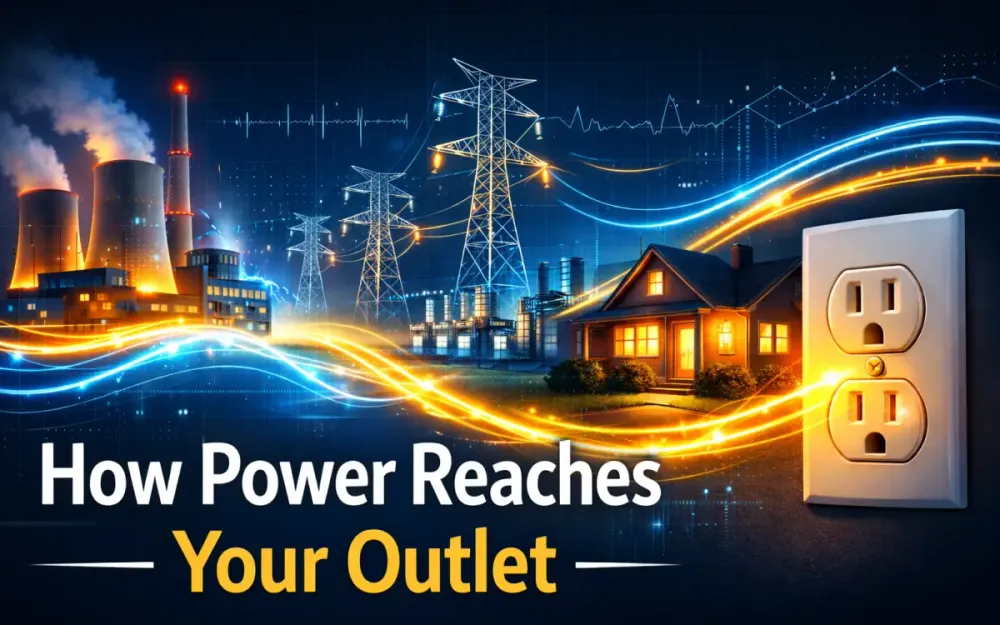
1 The Invisible Speed of Light: Introduction to the Grid
Electricity feels instant. You flip a switch, and the light turns on with no noticeable delay. What makes that possible isn’t stored energy waiting in the wire, but a tightly coordinated system that reacts almost immediately to changes in demand. The power grid works because generators, transmission lines, substations, control systems, and loads all stay synchronized in real time, even though they may be separated by hundreds or thousands of miles.
This section explains what actually happens inside the wires, how the grid is organized as a system, and why today’s grid no longer behaves like a simple one-way delivery pipeline. Understanding these fundamentals makes everything else—from blackouts to renewable integration—much easier to follow.
1.1 The “Just-in-Time” Miracle: Why Electricity Isn’t Stored in the Wires
It’s common to picture electricity flowing through wires like water through pipes. That analogy helps at first, but it quickly breaks down. Wires don’t store electricity the way pipes store water. The electrons are already inside the conductor, and when you turn something on, they respond to an electric field that propagates through the circuit.
Here’s the important distinction. The signal—the electromagnetic wave that tells electrons to start moving—travels through the conductor at a significant fraction of the speed of light, typically around 60–70% of light speed depending on the material and geometry. The electrons themselves, however, drift very slowly, often only millimeters per second. What reaches your light bulb almost instantly is the signal, not a specific electron that left a distant power plant.
Because of this, the grid cannot rely on energy stored in the wires. Transmission and distribution lines hold only tiny amounts of energy in their electric and magnetic fields. They are designed to move energy generated elsewhere, at that moment, to wherever it’s needed.
Real storage exists, but it lives outside the wires. Grid operators use dedicated storage technologies such as batteries, pumped hydro reservoirs, flywheels, supercapacitors, and thermal storage systems. Each serves a different role. Batteries and pumped hydro provide energy over minutes to hours. Flywheels and supercapacitors respond extremely fast—milliseconds—making them valuable for frequency control and shock absorption. None of these replace the need for real-time balancing; they only buy time.
This just-in-time nature is why grid operators are constantly matching supply to demand. If demand rises faster than generation, system frequency drops. If generation overshoots demand, frequency rises. Even small deviations matter. Left uncorrected, they can damage equipment or trigger automatic shutdowns. The grid behaves less like a warehouse and more like a live conveyor belt that must never speed up or slow down too much.
1.2 Defining the “Machine”: The Five Pillars of the Modern Grid
The power grid is best understood as a single, massive machine made up of five tightly coupled pillars. In earlier decades, four were enough. In 2026, control and communication are just as critical as the physical infrastructure.
Generation
Generation is where electrical energy originates. This includes nuclear plants, gas turbines, coal units still in operation, wind farms, solar arrays, hydroelectric dams, geothermal plants, and grid-scale storage facilities. Generators convert mechanical, thermal, or chemical energy into electrical energy synchronized to the grid’s frequency.
Transmission
Transmission moves large amounts of power over long distances. High-voltage lines—often operating between 115kV and 765kV AC, or ±320kV to ±800kV DC—connect generation centers to load centers. High voltage keeps current low, which reduces losses and makes long-distance transport practical.
Distribution
Distribution is the local delivery network. It steps voltage down from transmission levels to medium voltages, typically 4kV–35kV, and routes power through neighborhoods. Local transformers then reduce it further for homes, offices, and small businesses.
Load
Load is everything that consumes electricity: lighting, motors, electronics, data centers, industrial equipment, heat pumps, and EV chargers. Loads change constantly and unpredictably. A cloud passing over a solar neighborhood or thousands of EVs plugging in at night can reshape demand in minutes.
Control and Communication
This fifth pillar ties everything together. Sensors, protection relays, control centers, fiber links, radio networks, and software platforms monitor grid conditions and issue commands. Frequency control, voltage regulation, fault isolation, dispatch decisions, and demand response all depend on fast, reliable communication. Without this layer, a modern grid with millions of distributed resources simply wouldn’t function.
These five pillars operate as a single system. A change in load propagates upstream through physics and control logic. A generator failure triggers protective actions and rerouting. Control systems coordinate responses in fractions of a second. Stability depends on constant feedback across all layers.
1.3 The 2026 Context: Moving from a “One-Way Street” to a Multidirectional Web
For most of the 20th century, the grid worked like a one-way street. Power flowed from large, centralized plants through transmission and distribution networks to passive consumers. That model no longer describes reality.
By 2026, distributed energy resources are a significant part of the system. In the United States, roughly one in five new single-family homes includes rooftop solar, and in some states like California, residential solar penetration exceeds 30% of suitable homes. More than 4 million US households now have rooftop PV. At the same time, EV adoption has accelerated, with over 40 million EVs globally and rapidly growing vehicle-to-home and vehicle-to-grid capability.
This changes how feeders behave. A neighborhood that consumed power all morning may export power at midday when solar output peaks. In the evening, that same feeder may draw heavily as people return home and charge vehicles. Power now flows in multiple directions, sometimes reversing several times a day.
Several trends define this shift:
- Residential solar and batteries regularly export energy into local networks
- EVs act as both large loads and mobile storage assets
- Smart inverters and meters provide near-real-time visibility at the edge
- Distributed energy resources respond to price signals and grid conditions
- Forecasting systems increasingly rely on AI to predict weather-driven output
In 2026, utilities no longer treat neighborhoods as passive endpoints. They are active participants in balancing the grid. Managing this multidirectional web requires bidirectional protection, fast communications, and digital control systems layered on top of traditional infrastructure. The result is a grid that is more flexible and resilient, but also far more complex than the one it replaced.
2 Generation and the Dispatch Revolution
For most of the grid’s history, generation was predictable. Large power plants ran at steady output, and operators adjusted a small number of controls as demand rose and fell through the day. That approach worked when electricity mostly flowed from a few big plants to millions of passive users. It no longer does.
Today’s grid must respond to fast-changing renewable output, electric vehicle charging, and distributed energy resources scattered across neighborhoods. Generation has become a real-time coordination problem. Instead of reacting after the fact, grid operators now forecast demand and supply minutes to hours ahead and continuously adjust resources to keep the system balanced.
2.1 The Energy Mix: Baseload, Flexible Generation, and Variable Renewables
A modern grid relies on a mix of generation types, each serving a different purpose. No single resource can do everything well, which is why diversity matters.
Baseload and Flexible Thermal Sources
Baseload plants are designed to run for long periods with high reliability:
- Nuclear: Nuclear plants provide large amounts of steady, carbon-free power. Traditional nuclear units were designed to operate at constant output and are relatively slow to ramp. However, newer designs and updated operating practices allow some plants to vary output more than before, especially in grids with high renewable penetration.
- Combined-cycle natural gas: These plants are more flexible. They can ramp output up or down faster than nuclear and are commonly used to balance daily changes in demand and renewable generation.
These resources provide the backbone of the grid, especially overnight or during periods when wind and solar output is low.
Fast-Response Thermal Generation (Peaker Plants)
Not all gas plants are designed to run continuously. Simple-cycle gas turbines, often called peaker plants, are built for speed rather than efficiency. They can start and reach full output in minutes.
Peaker plants are expensive to operate and emit more CO₂ per unit of energy than combined-cycle plants. Even so, they remain critical. When demand spikes suddenly or renewable output drops unexpectedly, peakers provide immediate backup. In many regions, they are still the fastest large-scale source of controllable power available.
Variable Renewable Energy (VRE)
- Solar: Produces predictable daily patterns but drops rapidly with cloud cover or at sunset.
- Wind: Can generate power day or night but varies with weather systems that may change over hours or minutes.
Renewables reduce fuel costs and emissions, but their variability means the grid must always have flexible resources ready to respond.
Storage as a Core Grid Resource
Grid-scale storage has moved from a niche role to a central one. Batteries, in particular, now handle tasks once dominated by peaker plants:
- Frequency regulation
- Short-duration peak shaving
- Rapid response to sudden generation loss
- Smoothing solar and wind output
Storage does not replace baseload generation, but it fills the gaps between prediction and reality, often within milliseconds.
2.2 The Dispatch Center: How Forecasting and AI Shape Real-Time Decisions
The dispatch center is the grid’s coordination hub. Operators don’t wait for frequency to drift before acting; they work ahead of it. The better the forecast, the fewer emergency actions are needed later.
Modern dispatch systems combine several data sources:
- Satellite imagery tracking cloud movement
- Doppler radar estimating wind speed and direction
- Weather station data across wide regions
- Real-time telemetry from solar inverters, wind turbines, and substations
These inputs feed forecasting models that estimate generation and load minutes to hours into the future. In 2026, many utilities use machine-learning approaches such as LSTM (Long Short-Term Memory) neural networks for time-series prediction, gradient-boosted decision trees for short-term load forecasting, and ensemble models that blend multiple techniques to reduce error.
For example, a forecasting system may detect a fast-moving cloud bank expected to reduce regional solar output by 4,000MW in the next 10–15 minutes. Based on that prediction:
- Battery fleets are scheduled to discharge immediately.
- Peaker turbines are prepared to start.
- Combined-cycle gas units receive ramp-up commands.
Operators monitor the system and intervene when needed, but much of the response happens automatically. The goal is to avoid large frequency deviations rather than react to them after they occur.
2.3 Spinning Reserve and Inertia: The Grid’s Built-In Shock Absorbers
Even with good forecasts, the grid must handle surprises. Equipment trips, transmission faults, and sudden load changes still happen. That’s where inertia and reserve come in.
Spinning Reserve
Spinning reserve is generation already online but operating below its maximum output. Because it’s synchronized to the grid, it can increase power almost instantly.
For example:
- A combined-cycle gas plant might run at 75–80% capacity.
- If a generator trips elsewhere, it can ramp toward full output within seconds.
Spinning reserve buys time for slower resources to respond.
Inertia
Inertia comes from the physical mass of rotating machines. When load increases suddenly, turbines slow slightly, releasing stored kinetic energy into the grid. This response happens in milliseconds, before control systems even issue commands.
As inverter-based resources replace traditional generators, physical inertia declines. To compensate, grids deploy:
- Synchronous condensers, which provide inertia without producing power
- Virtual inertia, where inverters mimic the response of spinning machines
- Fast battery systems, which inject power almost instantly
Inertia remains critical. Without it, frequency can fall too quickly for other controls to react.
2.4 Practical Example: What Happens When Millions of Kettles Switch On at Once?
This scenario is well known in the UK and parts of Europe and is often called a “TV pickup.” After a popular sports match or television event, viewers tend to boil kettles at the same time.
A million kettles drawing about 2kW each creates a 2GW load increase, which falls squarely within the typical 1–3GW range observed during large UK TV pickup events. The change happens within seconds.
Here’s how the grid responds:
1 Load rises sharply
The sudden demand increases electrical torque on generators across the system.
2 Frequency begins to fall
As turbines slow slightly, grid frequency drops from its nominal 50Hz. During normal operation, frequency is typically kept within about 49.8–50.2Hz. A drop below 49.5Hz signals a serious imbalance and can trigger load shedding if not corrected.
3 Inertia responds first
The rotating mass of turbines releases kinetic energy, slowing the rate of frequency decline.
4 Automatic controls activate
Automatic Generation Control increases output from gas plants, hydro units, and battery systems within seconds.
5 Fast-start resources engage
Peaker plants and fast reserve units may start or ramp within 30–60 seconds if needed.
6 Balance is restored
Within one to two minutes, generation matches the new load and frequency returns to nominal.
The key point is that no power plant “knows” about kettles. The system responds to measurable changes in frequency and power flow. The grid stays stable not because it predicts every action, but because it is designed to react quickly and proportionally to whatever happens.
3 High-Voltage Transmission: The Energy Highways
Once electricity is generated, it has to travel—often hundreds of miles—before it reaches a city or industrial center. Transmission lines are the grid’s highways, designed to move huge amounts of power efficiently and reliably. Every design choice in transmission engineering is shaped by physics. High voltage isn’t a preference or a convention; it’s the only practical way to move large amounts of energy without wasting most of it as heat.
3.1 The Physics of Efficiency: Why We Use Hundreds of Thousands of Volts to Move Power
The dominant source of energy loss on transmission lines is resistive heating. That loss depends on the square of the current:
Loss = I² × RDoubling the current increases losses by a factor of four. This is why engineers focus so heavily on reducing current in long-distance lines.
Electrical power is commonly written as:
P = V × IThis expression assumes a purely resistive load. In real AC power systems, voltage and current are not always perfectly aligned. The more complete relationship is:
P = V × I × cos(φ)Here, cos(φ) is the power factor, which accounts for phase differences caused by inductance and capacitance in lines and loads. For transmission planning, power factor matters because reactive power increases current without delivering useful energy, which raises losses.
The basic strategy remains the same: increase voltage so the same real power can be delivered with less current. If voltage increases by a factor of ten, current can drop by roughly the same factor, dramatically reducing losses, heating, and conductor size requirements.
This is why long-distance transmission lines operate at 230kV, 345kV, 500kV, or even 765kV. At these voltages, power can move across regions efficiently enough to justify the infrastructure investment.
3.2 Step-Up Transformers: The Engineering Behind Magnetic Induction
Transformers make high-voltage transmission possible. They change voltage levels without changing frequency, using magnetic induction rather than moving parts.
In a step-up transformer at a power plant:
- Alternating current in the primary winding creates a changing magnetic field in the core.
- That magnetic field induces a voltage in the secondary winding.
- The ratio of turns between the windings sets the voltage increase.
For example, a generator producing electricity at around 20kV may feed a transformer that steps the voltage up to 345kV. Because power remains roughly constant (minus small losses), the current on the transmission side drops sharply.
Although transformers look simple from the outside, they are among the most carefully engineered components in the grid. They must withstand enormous electromagnetic forces, continuous thermal stress, lightning impulses, and decades of operation. Modern transmission transformers include internal temperature sensors, dissolved gas monitors, and online diagnostics that warn operators of insulation breakdown long before a failure occurs.
3.3 HVAC vs. HVDC: Choosing the Right Tool for Long Distances
Most transmission networks use high-voltage alternating current (HVAC). AC integrates naturally with generators, loads, and transformers, making it well suited for interconnected grids over short to moderate distances.
However, alternating current has drawbacks. Over long distances, reactive power, line capacitance, and synchronization constraints limit efficiency and controllability. This is where high-voltage direct current (HVDC) becomes attractive.
HVAC Strengths
- Direct compatibility with existing AC grids
- Voltage changes using simple transformers
- Decades of operational experience
HVDC Strengths
- Lower losses over long distances
- No reactive power flow
- Precise control of power transfer
- Ability to connect asynchronous grids
The distance at which HVDC becomes more economical than HVAC depends on terrain, capacity, and technology. As a rule of thumb—based on industry studies and real-world projects—HVDC often becomes competitive beyond roughly 500–800 km for overhead lines and 50–100 km for underground or submarine cables. These are approximate breakeven ranges, not hard thresholds. Each project requires detailed economic analysis.
HVDC is widely used to move offshore wind power to shore, connect remote renewable resources to cities, and link grids operating at different frequencies. Converter stations at each end convert AC to DC and back using power electronics. While these stations are expensive, their controllability and efficiency make them the preferred option for many modern transmission projects.
3.4 Managing “Line Loss”: The Ongoing Battle Against Resistance and Heat
Even at very high voltages, transmission lines are not lossless. Engineers work continuously to minimize losses and manage heat.
Resistive Losses (I²R)
All conductors resist current flow. As current increases, resistive heating rises sharply. Utilities reduce these losses by:
- Increasing transmission voltage
- Using large-diameter conductors
- Selecting efficient conductor designs
Most overhead lines use ACSR (Aluminum Conductor Steel Reinforced) cables. Aluminum carries current efficiently and is lightweight, while the steel core provides mechanical strength. In newer projects, utilities increasingly deploy HTLS (High-Temperature Low-Sag) conductors, which can operate safely at higher temperatures with less sag, allowing more power to flow on existing corridors.
Corona Losses
At high voltages, especially above about 230kV, the electric field around conductors can ionize surrounding air. This effect, known as corona, causes:
- A faint hissing or buzzing sound
- Energy loss
- Radio and communication interference
Corona losses increase during rain, fog, or high humidity because water droplets intensify electric fields. To reduce corona, engineers use bundled conductors—multiple wires per phase—which spread the electric field over a larger area.
Thermal Expansion and Sag
As conductors heat up, they expand and sag. Excessive sag can violate safety clearances or increase the risk of contact with vegetation. Operators monitor line temperature and tension, especially during heat waves or high-load conditions.
Environmental Effects and Dynamic Ratings
Weather plays a major role in line performance. Wind cools conductors and reduces sag, while still air and high temperatures increase it. In 2026, many utilities use dynamic line rating systems that adjust allowable power flow in real time based on weather sensors. This allows operators to safely carry more power when conditions permit and back off when they don’t.
4 The Substation: The Grid’s Gatekeeper
Substations sit at the boundary between bulk power movement and local delivery. They don’t generate electricity, and they don’t consume much of it either. Instead, they reshape, route, measure, and protect power as it moves through the grid. Every kilowatt that reaches a home or business passes through multiple substations along the way.
Modern substations operate continuously with very little human presence on site. Sensors, protection relays, breakers, and control systems handle most events automatically. Operators supervise remotely, stepping in only when conditions fall outside expected ranges. As the grid becomes more dynamic, substations increasingly act as decision points, not just electrical junctions.
4.1 Stepping It Down: Transforming Transmission Voltage to Neighborhood-Safe Levels
Transmission lines carry electricity at extremely high voltages, far beyond what distribution equipment or consumer devices can handle. Substations use large step-down transformers to reduce these voltages in stages. A transmission-level voltage such as 345kV might be reduced to 138kV or 115kV for regional networks, then stepped down again to sub-transmission or distribution levels.
Substation transformers are very different from the pole-mounted units serving homes. They often handle hundreds of megavolt-amperes (MVA) and must operate continuously under heavy electrical and thermal stress. To manage heat, they use standardized cooling methods such as:
- ONAN (Oil Natural, Air Natural) for lighter loads
- ONAF (Oil Natural, Air Forced) when fans assist cooling
- OFAF (Oil Forced, Air Forced) for high-load conditions
These systems allow transformers to carry varying loads without overheating.
Voltage reduction is only part of a substation’s job. Many substations also include capacitor banks and shunt reactors to manage reactive power. Capacitors help support voltage during heavy load conditions, while reactors absorb excess reactive power on lightly loaded lines. Together, they keep voltage within acceptable limits as power flows change throughout the day.
Because grid conditions change constantly, many transformers include on-load tap changers. These devices adjust the transformer’s effective turns ratio while energized, allowing voltage to be fine-tuned without interrupting service. This is especially important in areas with high solar penetration, where local voltage can rise quickly during midday exports.
4.2 Circuit Breakers, Reclosers, and Protection: How the Grid Isolates Trouble
Substations are also protection hubs. High-voltage circuit breakers act as industrial-scale safety switches, interrupting fault currents that can reach tens of thousands of amps. Unlike household breakers, which simply trip and stay open, substation breakers must extinguish powerful electrical arcs in a controlled way. They do this using vacuum interrupters or insulating gases such as SF₆ alternatives.
Protection systems rely on precise measurement. Instrument transformers—current transformers (CTs) and potential transformers (PTs or VTs)—scale down high currents and voltages to safe levels for relays and control equipment. These measurements allow protective relays to determine whether a condition is normal, abnormal, or dangerous.
Downstream, on distribution feeders, reclosers handle many common disturbances. A lightning strike or a branch brushing a line may cause a temporary fault. The recloser opens the circuit, waits a fraction of a second, and then recloses it. If the fault has cleared, power is restored almost instantly. If not, the recloser may attempt several times before locking out.
This layered protection prevents small problems from becoming large outages. In fire-prone regions, utilities may disable automatic reclosing during high-risk periods to avoid re-energizing a damaged line. These settings can be adjusted remotely, allowing protection behavior to change with weather and environmental conditions.
4.3 Solid-State Transformers (SSTs): An Emerging Tool, Not Yet the Norm
Traditional power transformers rely on electromagnetic induction and have changed little in principle over the past century. Solid-state transformers (SSTs) take a different approach, using power electronics to convert and regulate voltage through intermediate high-frequency stages.
In 2026, SSTs are not yet widely deployed across transmission or standard distribution networks. Instead, they are being piloted in specialized applications such as microgrids, traction systems, data centers, and locations with unusually demanding power-quality requirements.
Their appeal lies in flexibility. SSTs can:
- Regulate voltage very precisely
- Handle bidirectional power flow naturally
- Integrate reactive power control and harmonic filtering
- Interface easily with DC systems and batteries
They are also smaller and lighter than traditional transformers of similar capacity.
However, SSTs come with trade-offs. They are more expensive, introduce additional electronic complexity, and must prove long-term reliability comparable to conventional transformers that routinely operate for 40–60 years. For now, utilities treat SSTs as a complementary technology rather than a replacement, using them where their advanced control capabilities provide clear value.
4.4 Real-Life Scenario: From Transmission Line to the Feeder on Your Street
Imagine driving past a set of tall transmission towers carrying high-voltage lines—say 345kV. Those lines move bulk power across long distances. Nearby, a fenced substation receives the lines. Inside, disconnect switches and breakers allow operators to isolate equipment safely for maintenance or during faults.
The first transformer might step voltage down from 345kV to 138kV or 115kV. In some regions, the next stage could be 69kV; in others, it might go directly to 34.5kV or 46kV. The exact voltage path varies by region, depending on historical design and local load density.
From there, power flows to a distribution substation closer to neighborhoods. At that point, another transformer reduces voltage to a medium level such as 12kV, 13.2kV, or 13.8kV. These feeders leave the substation along overhead lines or underground ducts, running through main streets and branching toward residential areas.
When a feeder reaches your block, a pole-mounted or pad-mounted transformer performs the final step-down before power enters your home. By the time electricity reaches your service panel, it has passed through multiple substations, dozens of protection devices, and layers of monitoring and control. Each stage exists to ensure that power arrives safely, reliably, and at the right voltage—no matter what the rest of the grid is doing.
5 Distribution and the “Last Mile”
Distribution is where the grid becomes personal. This is the part people see outside their windows and notice when something goes wrong. Distribution networks take power that has already traveled long distances and deliver it safely to homes, schools, offices, and factories. They must handle constant load changes, increasing two-way power flow, and local environmental challenges, all while operating close to where people live.
5.1 The Primary and Secondary Lines: Those “Trash Cans” on Poles
Primary distribution lines carry medium-voltage power from substations into cities and neighborhoods. While they’re often described as operating between 4kV and 35kV, utilities typically use a small set of standard voltages such as 4.16kV, 12.47kV, 13.2kV, 13.8kV, 23kV, and 34.5kV. The choice depends on local load density, historical design, and how far the feeder must travel.
These primary lines supply pole-mounted or pad-mounted transformers—the cylindrical “cans” you see on utility poles or the green boxes in yards. Each transformer serves a group of nearby customers, stepping voltage down to usable levels. In residential areas, one transformer may serve a handful of homes; in denser neighborhoods, several transformers may share the load.
Secondary lines leave the transformer at low voltage and run directly to buildings. In hot weather, when air conditioners run continuously, these transformers work hard. Modern units increasingly include sensors that track temperature, loading, and power quality. Utilities use this data to spot overloaded equipment early and to manage reverse power flow in neighborhoods with high rooftop solar adoption.
5.2 The Split-Phase System: How Power Enters a Home (US and Beyond)
In the United States, most homes receive 120/240V split-phase service. The distribution transformer has a center-tapped secondary winding. This creates two 120V legs that are electrically opposite each other. Using one leg and the neutral provides 120V for outlets and lighting. Using both legs together provides 240V for larger loads like ovens, dryers, heat pumps, and EV chargers.
Inside the service panel, single-pole breakers connect to one leg, while double-pole breakers span both legs. This setup balances load across the transformer and keeps neutral currents lower. If most of the home’s load sits on one leg, the transformer becomes unbalanced, which reduces efficiency and increases heating. Modern energy monitors and smart panels help homeowners and electricians see and correct these imbalances.
It’s important to note that this split-phase arrangement is specific to North America. In much of Europe and many other regions, homes typically receive 230V single-phase service, while larger buildings may use 400/415V three-phase systems. The underlying goal is the same everywhere: deliver usable power efficiently and safely, even though the voltage standards differ.
5.3 Underground vs. Overhead: Cost, Reliability, and Trade-Offs
Overhead distribution lines are common because they’re relatively inexpensive and easy to maintain. Crews can see damage immediately and make repairs quickly after storms. However, overhead lines are exposed to wind, ice, falling trees, and wildlife. In many regions, these factors dominate outage statistics.
Underground distribution avoids many of these problems. Cables are insulated and buried in conduits, protecting them from weather and vegetation. Neighborhoods with underground lines often experience fewer outages. The downside is cost. In suburban areas, underground distribution typically costs five to ten times more than overhead construction. Repairs also take longer because crews must locate faults and excavate before work can begin.
As a result, many utilities use hybrid designs. New subdivisions may have underground laterals fed by overhead main lines. In wildfire-prone or storm-exposed areas, utilities increasingly bury lines selectively to reduce risk. The decision is always a balance between upfront cost, long-term reliability, safety, and local conditions.
5.4 Microgrids: Local Power That Can Stand Alone
Microgrids are localized energy systems that can operate either connected to the main grid or independently. They combine generation—such as solar panels, natural gas generators, fuel cells, or diesel units—with batteries and intelligent controllers. Under normal conditions, they exchange power with the wider grid. When trouble occurs, they disconnect and supply themselves.
Hospitals are a common example. A hospital microgrid might include rooftop solar, battery storage, and backup generators. If the main grid experiences a fault or severe voltage disturbance, the microgrid controller isolates the facility. Advanced microgrids can achieve sub-cycle islanding (less than 16 milliseconds), fast enough that sensitive equipment never notices the transition. Simpler systems may take 100–200 milliseconds, still quick enough to keep essential loads running with the help of batteries or UPS systems.
Data centers use similar designs, often with multiple layers of redundancy. Community microgrids are also emerging in areas with frequent outages or high renewable penetration. These systems don’t just provide backup power; they support the larger grid by reducing peak load and absorbing local renewable generation. As controls, inverters, and communication systems improve, microgrids are becoming an important part of how the distribution system stays resilient.
6 The Digital Edge: Smart Meters and Prosumers
By the time electricity reaches the edge of the grid, it is no longer managed only by physical equipment. Software, data, and communication now play an equal role. Homes, businesses, EVs, and rooftop solar systems constantly exchange information with utilities. This digital layer allows the grid to react faster, operate closer to its limits, and accommodate millions of small, distributed energy resources without losing stability.
6.1 Beyond the Dial: How Smart Meters (AMI) Communicate in Near Real Time
Advanced Metering Infrastructure (AMI) meters have replaced the old mechanical dials with digital measurement and communication. Early smart meters reported usage every 15 minutes. Many utilities later moved to 5-minute intervals. Today, depending on the use case, meters may provide data every 1 minute, and in some pilot programs even sub-second or 1-second measurements for voltage and power-quality monitoring.
Meters transmit this data wirelessly to neighborhood collectors, which forward it to utility data systems. This gives operators visibility into how load changes street by street rather than only at substations. Voltage drops, overloads, and phase imbalances can be detected long before customers notice a problem.
AMI systems also send event-based messages. When power goes out, meters report the loss immediately. When power returns, they report restoration. Utilities no longer rely on customer phone calls to identify outages. In many areas, meters also support remote connects and disconnects, reducing truck rolls and speeding up service changes. The result is a distribution system that is measured continuously rather than inspected occasionally.
6.2 The Prosumer Era: Managing Two-Way Power Flow Safely
Prosumers are customers who both consume and produce electricity. Rooftop solar, home batteries, and EVs turn houses into small power plants. This fundamentally changes how distribution feeders behave. Circuits that once carried power in one direction now see frequent reversals, especially on sunny afternoons.
Smart inverters help manage this complexity. They can absorb or supply reactive power, limit export when voltage rises, and disconnect quickly during abnormal conditions. Utilities may also impose export caps or dynamic limits to keep voltage within bounds when many homes generate at once.
EVs add another layer. With vehicle-to-home (V2H) and vehicle-to-grid (V2G), a single car battery can rival or exceed the capacity of a stationary home battery. Aggregated across thousands of vehicles, this becomes a significant grid resource. However, bidirectional connections also introduce cybersecurity risks. Vehicles and chargers must authenticate securely, encrypt communications, and prevent unauthorized control, since a compromised charger could disrupt a home or even a local feeder. As V2G expands, securing these interfaces is becoming just as important as managing the power flow itself.
6.3 Edge Computing: Decisions Made at the Meter, Not the Control Room
Edge computing moves intelligence closer to where electricity is actually used and produced. Modern meters and inverters contain processors capable of analyzing conditions locally and acting immediately. This reduces reliance on central commands and shortens response time.
Concrete examples are already in use. Some meters analyze high-frequency voltage and current data to detect arc-fault signatures, helping identify dangerous wiring conditions before they cause fires. Others look for tampering patterns, such as magnetic interference or abnormal load profiles, and flag them automatically. Inverters may identify unstable grid conditions and adjust output within a single electrical cycle.
By filtering and summarizing data locally, edge devices also reduce communication bandwidth and latency. Only meaningful events or aggregated values are sent upstream. Utilities still rely on centralized SCADA systems, but those systems increasingly coordinate rather than micromanage. This layered approach is essential when millions of devices are active at once.
6.4 Practical Example: Using Your EV to Power Your House Safely (Vehicle-to-Home)
Consider a home with a bidirectional EV charger and a time-of-use pricing plan. Overnight, the homeowner charges the EV when electricity is cheap. A modern EV may store 60–80kWh, far more than most dedicated home batteries. The next afternoon, when prices rise, the system switches to V2H mode.
Power flows from the EV through the charger’s inverter into the home’s main panel, supplying lighting, appliances, and even air conditioning. Smart meters track both grid import and EV discharge. If rooftop solar is present, solar generation may power the home first, charge the EV second, and export any remaining energy only if limits allow.
A critical safety requirement here is anti-islanding protection. If the grid goes down, the V2H system must disconnect from the utility instantly to prevent feeding power back onto a de-energized line. Certified bidirectional chargers include isolation relays and controls that ensure the home operates as a closed system during outages. When grid power returns and stabilizes, the system reconnects automatically.
As pricing programs evolve, utilities are beginning to reward customers who allow V2H systems to support the grid during peak periods. Done correctly, this setup lowers energy bills, improves resilience, and turns parked vehicles into flexible grid assets—without compromising safety or reliability.
7 The Great Balancing Act: Grid Stability and Demand Response
By the time electricity reaches homes and businesses, the grid has already performed thousands of tiny corrections to stay stable. This balancing act isn’t optional. The grid only works when supply and demand stay matched from moment to moment. As renewables, EVs, and distributed resources increase, that balance becomes harder to maintain and more dependent on coordination between machines and software.
This section explains how the grid keeps time, how thousands of small devices can act like a single power plant, where demand response succeeds and fails, and how engineers use software tools to test these systems before they are deployed.
7.1 Frequency Control: Why the Grid Must Stay at Exactly 60Hz (or 50Hz)
Grid frequency is the clearest real-time indicator of system balance. When generation and load are equal, frequency stays steady. When load exceeds generation, frequency falls. When generation exceeds load, frequency rises. In North America, the target is 60Hz; in much of the rest of the world, it is 50Hz.
Normal operation allows only small deviations. In many systems, frequency is kept within roughly ±0.1 to ±0.2 Hz during routine operation. If frequency strays too far, protective systems intervene. Generators are typically set to trip offline at around 57–59.5 Hz on the low end and 60.5–61.5 Hz on the high end, depending on the unit and grid rules. Falling below these thresholds risks mechanical damage and loss of synchronism.
To prevent this, grids rely on layered controls. Primary frequency control responds automatically within seconds, using turbine governors or inverter logic. Secondary control, often called automatic generation control (AGC), restores frequency to its exact setpoint over tens of seconds to minutes. Tertiary control adjusts generator schedules and reserves over longer periods to prepare for upcoming conditions. These layers overlap deliberately, ensuring that no single failure causes instability.
A common disturbance illustrates this. If a large industrial motor starts unexpectedly, frequency begins to dip almost immediately. Inertia and primary controls slow the decline. AGC then brings additional resources online. If renewable output happens to drop at the same time, batteries and fast gas units respond. The goal is simple: keep frequency within safe limits so users never notice the event.
7.2 Virtual Power Plants: When Thousands of Small Devices Act as One
Virtual power plants, or VPPs, aggregate many small resources into a single controllable asset. Individually, a home battery or EV charger doesn’t matter much. Together, they can provide meaningful capacity.
Consider a concrete example. Suppose a VPP coordinates 10,000 residential batteries, each capable of delivering 5 kW of power. Aggregated, that’s 50 MW of dispatchable capacity. That’s comparable to a small peaking plant or a utility-scale battery installation. While energy duration may be limited, the power response is immediate.
VPP software tracks device availability, state of charge, and customer constraints. When the grid needs support, it sends a dispatch signal. Some batteries discharge, others hold back, and the total response matches the requested output. To homeowners, this often goes unnoticed, provided minimum charge limits are respected.
VPPs also absorb excess renewable energy. During midday solar peaks, thousands of batteries charge simultaneously, preventing voltage problems on feeders. In the evening, they discharge to meet rising demand. This flexibility reduces reliance on fossil-fuel peakers and helps grids integrate higher levels of renewables without sacrificing stability.
7.3 Demand Response: Useful, but Not a Silver Bullet
Demand response shifts or reduces load instead of increasing generation. In theory, it’s elegant. In practice, it’s mixed.
Smart appliances make demand response possible at scale. Water heaters can delay heating cycles. Commercial HVAC systems can pre-cool buildings. Industrial motors can stagger startups. Each action is small, but together they can reduce peak demand by hundreds of megawatts.
However, demand response comes with real challenges. Customer fatigue is common. If events happen too often or savings are unclear, participation drops. Opt-out rates can rise sharply during heat waves when comfort matters most. Some programs fail entirely because incentives don’t match inconvenience, or automation isn’t reliable.
Successful programs are carefully designed. They limit event frequency, automate responses so users don’t have to act manually, and pay participants fairly. When done well, demand response reduces grid stress and lowers costs. When done poorly, it delivers far less than planners expect. Utilities now model opt-out behavior explicitly instead of assuming full participation.
7.4 Software Tools for Modeling a Complex Grid
Before any of these strategies are deployed, engineers test them in software. Modern grids are too complex to manage by intuition alone.
Several widely used tools support this work:
- PyPSA (Python for Power System Analysis, v0.24+) is used for large-scale transmission and generation modeling. It handles unit commitment, storage optimization, and renewable integration using Python-based workflows.
- GridLAB-D (v4.x) focuses on distribution systems, modeling individual homes, inverters, transformers, and appliances in detail.
- OpenDSS, developed by EPRI, is widely used by utilities for distribution analysis, especially voltage regulation and DER studies.
- MATPOWER and PowerWorld are commonly used for transmission power flow, contingency analysis, and operator training.
These tools let engineers simulate events that are hard or risky to test in real life. For example, they can examine how a feeder behaves if 40% of homes install solar, or how frequency responds when a large generator trips. By combining physical models with behavioral assumptions, planners can identify weak points before they become outages.
8 Engineering Challenges and the Future Grid
By 2026, the grid is operating closer to its limits than at any point in its history. Digital control has improved efficiency, but it has also expanded the attack surface. Climate-driven extremes push equipment beyond assumptions made decades ago. Renewable energy reshapes demand curves faster than infrastructure can be rebuilt. These challenges are not theoretical—they already shape daily grid operations.
This section looks at where the grid is most vulnerable today, how engineers are responding, and what technologies are likely to shape the next phase of grid evolution.
8.1 Cybersecurity: Protecting the Grid’s Control Systems
As substations, meters, inverters, and dispatch centers become digitally connected, cybersecurity becomes inseparable from reliability. Modern grids depend on operational technology (OT) networks that were never designed to face internet-era threats. Attackers no longer need physical access to cause disruption.
Utilities now operate under strict standards. In North America, NERC CIP (Critical Infrastructure Protection) requirements govern how bulk power systems are secured, audited, and monitored. Internationally, standards such as IEC 62351 define encryption and authentication for power system communications, while IEEE 1686 specifies cybersecurity capabilities for substation intelligent electronic devices (IEDs). These standards shape how equipment is designed and deployed.
The risk is real. The 2015 and 2016 Ukraine grid attacks demonstrated coordinated cyber operations that remotely opened breakers and disrupted service to hundreds of thousands of customers. The Triton/TRISIS malware targeted safety systems in industrial facilities, showing that attackers may aim not just for outages but for physical damage. These incidents changed how utilities think about segmentation, monitoring, and incident response.
Modern defenses focus on layered protection. Control networks are segmented from corporate IT systems. Commands are authenticated and logged. Intrusion detection systems watch for abnormal traffic patterns. Field devices verify firmware integrity before updates are applied. Just as importantly, utilities train staff to recognize phishing and social engineering attacks, which remain a common entry point. Cybersecurity is now treated as a continuous operational process, not a one-time upgrade.
8.2 Extreme Weather Resilience: Designing for Heat, Fire, and Flood
Electrical equipment is built to specific thermal limits. Power transformers, for example, are typically designed for a 65°C average winding temperature rise above ambient, with hotspot limits around 80–90°C depending on insulation class. Exceeding these limits accelerates insulation aging and shortens equipment life. During prolonged heat waves, many transformers operate uncomfortably close to these thresholds.
Climate volatility challenges these assumptions. Higher ambient temperatures reduce cooling margins. Wildfires threaten overhead lines and substations. Flooding endangers low-lying equipment. Utilities now plan for conditions that once fell outside design envelopes.
Hardening strategies are increasingly targeted. In fire-prone areas, utilities deploy covered conductors, increase vegetation clearance, and adjust protection settings to reduce ignition risk. In flood zones, substations are elevated and switchgear sealed against water intrusion. Transformers may be oversized or equipped with additional cooling to handle sustained high temperatures.
Forecasting has become part of resilience. Weather data feeds into operational planning so utilities can derate equipment proactively, shift load, or pre-position crews. Dynamic line ratings allow more power flow when conditions are favorable and safer limits when they are not. Resilience now depends as much on anticipation as on physical strength.
8.3 The Duck Curve: A Solar-Driven Shape That Changed Grid Planning
The term “duck curve” was coined by the California Independent System Operator (CAISO) to describe a distinctive net-load profile caused by high solar penetration. When plotted over a day, net demand dips sharply at midday as solar generation rises, then ramps steeply upward in the early evening as the sun sets and people return home. The curve resembles the outline of a duck: a deep belly at noon and a tall neck at sunset.
This shape creates two challenges. Midday oversupply can push net load toward zero or even negative values. The evening ramp requires large amounts of fast, flexible power in a short time window. Traditional baseload plants are not designed for this pattern.
Grid operators address the duck curve with a mix of strategies. Batteries absorb midday solar and discharge during the evening ramp. Flexible loads, such as EV charging and commercial cooling, are shifted into midday hours. Transmission expansion allows surplus solar to flow to neighboring regions. Curtailment remains a tool of last resort when other options are exhausted.
The duck curve has reshaped how planners think about generation mix, storage duration, and ramping capability. It also highlights why flexibility, not just capacity, is now a core grid requirement.
8.4 Conclusion: Where the Grid Is Headed Next
The electric grid has always evolved, but the pace is accelerating. Looking ahead, several technologies are likely to play a defining role.
Grid-forming inverters are emerging as a way to provide stability without relying on traditional rotating machines. Instead of following grid frequency, these inverters actively establish it, which becomes critical as inverter-based resources dominate generation.
Long-duration storage technologies, such as iron-air batteries, flow batteries, and advanced thermal systems, aim to bridge gaps measured in days rather than hours. These systems could reduce reliance on fossil backup during extended low-renewable periods.
Hydrogen integration is being explored as both a storage medium and a fuel for dispatchable generation, especially where excess renewable energy would otherwise be curtailed.
At the infrastructure level, superconducting cables and advanced power electronics promise higher capacity in dense urban corridors where new rights-of-way are difficult to obtain.
Through all of this, the grid remains what it has always been: a coordinated system that must respond instantly to human behavior. Every light switch, EV charger, and data center participates in that system. Understanding how electricity travels—from a generator to an outlet in milliseconds—reveals why reliability depends on physics, engineering discipline, and careful coordination. The tools will change, but the mission remains constant: deliver power safely, continuously, and predictably.
Further Reading and References
- NERC. Critical Infrastructure Protection (CIP) Standards
- CAISO. What the Duck Curve Tells Us About Managing a Green Grid
- IEC 62351. Power Systems Management and Associated Information Exchange – Data and Communications Security
- IEEE 1686. Cybersecurity Capabilities of Substation Intelligent Electronic Devices
- U.S. Department of Energy. Grid Modernization and Resilience Reports
- EPRI. Distribution System Planning with High DER Penetration