
Sudhir Mangla
Sudhir Mangla is the Sr. Director of Technology at SVAM International and the founder of Developers Voice | The Software Architects Hub. With over 22 years of hands-on experience, he has built, designed, and scaled enterprise software solutions spanning from legacy C++/Visual C++ systems to modern cloud-native, AI-powered .NET ecosystems.
His technical expertise covers the full modern stack: .NET 8/9, ASP.NET Core, Blazor, Web API, Azure Functions, Angular, React, SQL Server, Oracle, Entity Framework Core, Azure DevOps, Apache Solr, Kafka, and more. Sudhir has architected solutions across diverse paradigms—from N-tier monoliths to microservices and cutting-edge serverless architectures—always prioritizing robustness, security (OWASP Top 10), and clean-code principles like SOLID, DRY, and YAGNI.
Sudhir is a pioneer in leveraging AI-assisted development tools, including Claude Code, GitHub Copilot, and Cursor AI, to accelerate software design, refactoring, and documentation. His work increasingly integrates data analytics and intelligent automation using AI APIs such as OpenAI, Claude, and Gemini, revolutionizing how teams approach system insights, architectural validation, and developer productivity.
At Developers Voice, Sudhir’s mission is to empower software architects and developers with clear, actionable insights on architecture patterns, design principles, and real-world implementation strategies. His daily content includes comprehensive guides on:
- Software & Cloud Architecture Patterns (CQRS, Event Sourcing, FinOps, Polyglot Persistence, Edge-Native, Micro-Frontends)
- .NET and C# Best Practices (Clean Code, Performance Tuning, API Security, SOLID Principles)
- Enterprise Cloud Solutions (Azure, AWS, AI Integration, DevSecOps, Power Platform)
- Cutting-Edge Technologies (GenAI, Prompt Engineering, WASM, eBPF, React Server Components, .NET MAUI)
Sudhir bridges theory with hands-on guidance, helping engineers design and deliver high-quality, maintainable, secure, and scalable software systems. His goal is to keep architects and developers at the leading edge of architectural thinking with practical, in-depth knowledge tailored for real-world success.
Connect: sudhirmangla [at] gmail [dot] com
Microfrontends That Don’t Hurt: Module Federation, Web Components, and BFF Contracts on ASP.NET Core
- Sudhir Mangla
- Frontend Development , .NET
- 27 Oct, 2025
1 Set the Stage: Microfrontends That Don’t Hurt Microfrontends are one of those architectural ideas that sound deceptively simple: “split the frontend by business domain, let teams deploy independ
Read More
Error Handling That Scales: Railway-Oriented Programming, Result Types, and Exceptions in .NET
- Sudhir Mangla
- .NET , Design Principles
- 26 Oct, 2025
1 Why Error Handling Must Scale Modern distributed systems rarely fail in clean, predictable ways. In small prototypes, an exception stack trace is often “good enough” to debug issues. But under r
Read More
Building Dropbox in .NET: From Chunked Uploads to Merkle Trees - A Production Architecture for Petabyte-Scale File Sync
- Sudhir Mangla
- Practical Design , Cloud Architecture
- 25 Oct, 2025
1 Problem framing: what “Dropbox-class” sync really entails File synchronization at petabyte scale isn’t about copying bytes between disks — it’s about making distributed state converge efficien
Read More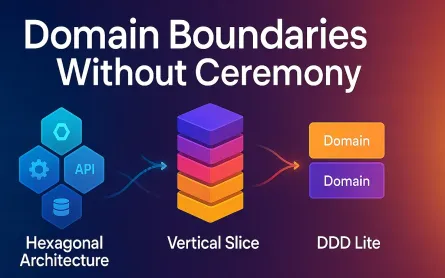
Domain Boundaries Without Ceremony: Hexagonal, Vertical Slice, and DDD Lite for Pragmatic Teams
- Sudhir Mangla
- Software Architecture , Domain Driven Design
- 24 Oct, 2025
1 Domain Boundaries Without Ceremony In modern software development, you often find teams drowned in architecture meetings, heavy frameworks, rigid layers, and complex abstractions—only to discove
Read More
From Single Agents to Agentic Systems: A Practical Blueprint for Senior Engineers
- Sudhir Mangla
- AI & Machine Learning , Generative AI
- 23 Oct, 2025
1 Foundations: Agents vs. Agentic Systems In this opening section, we’re going to lay the conceptual groundwork for the shift from single agents to agentic systems. If you’re a senior engineer, te
Read More
Practical OOP : Composition Over Inheritance, Records, and Pattern Matching in Modern C#
- Sudhir Mangla
- Design Principles , C#
- 22 Oct, 2025
1 Why “Practical OOP” in Modern C# Modern C# is a different language than it was a decade ago. Between records, pattern matching, primary constructors, and the shift toward functional-style immuta
Read More
ClickHouse vs. Cassandra vs. ScyllaDB: Choosing a High-Ingest Database for Real-Time Analytics
- Sudhir Mangla
- Data Engineering , Database
- 22 Oct, 2025
1 Why high-ingest real-time analytics is hard (and worth it) In today’s world of digital services, sensors, user interactions, and complex systems, the demand isn’t just for storing massive volume
Read More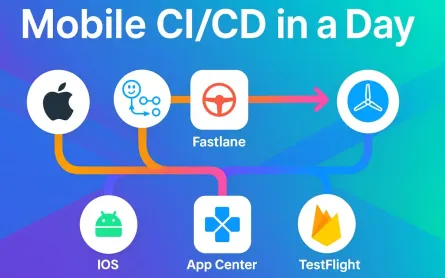
Mobile CI/CD in a Day: GitHub Actions + Fastlane + App Center
- Sudhir Mangla
- DevOps & CI/CD , Mobile Development
- 21 Oct, 2025
1 Why “Mobile CI/CD in a Day” (and what changed in 2025) In simply one workday you’ll go from a code push → to build → test → sign → distribute → store-submit a mobile app. That’s the promise: **M
Read More
Reactive + Functional UI Patterns in TypeScript and F#: RxJS, Signals, and Elmish for Real-Time Apps
- Sudhir Mangla
- Frontend Development , Real Time Systems
- 20 Oct, 2025
1 Why reactive + functional UIs now (and what this article delivers) Real-time apps no longer feel “advanced.” They’re expected. Users assume dashboards refresh instantly, collaborative editors sy
Read More
React vs. Vue vs. Angular for Enterprise Architects: Signals, Server Components, and DX at Scale
- Sudhir Mangla
- Frontend Development , Software Architecture
- 17 Oct, 2025
1 Executive summary and decision framework Frontend frameworks have never evolved faster—or diverged more sharply. React 19, Angular 19, and Vue 3.5 each embrace a different philosophy about where
Read More