1 The Paradigm Shift from Inline Autocomplete to Agentic SDLC
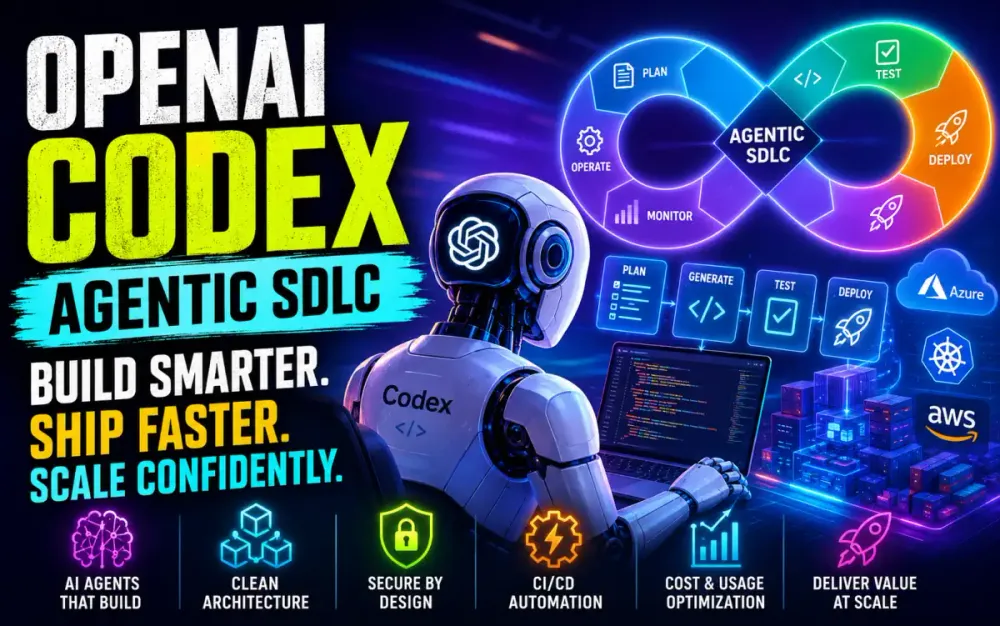
AI-assisted development has moved beyond inline suggestions. The older model was simple: the developer typed, the tool predicted the next line, and the developer stayed fully responsible for navigation, edits, tests, and debugging. Agentic SDLC changes that contract. The agent can inspect the repository, plan a change, edit multiple files, run commands, read failures, and iterate until the implementation passes agreed validation gates.
The core question for architects is no longer “Can AI write code?” It is “How do we safely give an AI coding agent enough context, tools, and permissions to make useful changes without weakening engineering controls?” This article covers the practical architecture behind that workflow: Codex surfaces, repository context insertion, MCP integration, sandboxing, approval modes, and deterministic hooks.
1.1 Evolution of AI in Software Engineering: From Inline Completions to Autonomous Terminal Agents
Inline autocomplete works well when the developer already knows the file, the design, and the next few lines. It fails when the task requires repository-wide reasoning: tracing a feature flag across services, updating a DTO and its consumers, fixing a migration, or validating behavior through integration tests.
Agentic coding tools work differently. A terminal-first agent can:
- read project files;
- search symbols and tests;
- apply patches;
- run build and test commands;
- summarize diffs;
- ask for approval before risky actions;
- continue from tool output.
OpenAI describes Codex CLI as a local terminal coding agent that can read, change, and run code in the selected directory; it is open source and built in Rust. That matters architecturally because the terminal is already the control plane for builds, package managers, migrations, linters, Git, test runners, and deployment scripts.
The trade-off is clear. A terminal agent is more powerful than autocomplete, but also more dangerous if it has unbounded file, shell, or network access. Good enterprise adoption therefore starts with constrained execution, repeatable prompts, explicit repository rules, and automated checks.
1.2 Deconstructing the OpenAI Codex Ecosystem as of Mid-2026
Codex now spans multiple surfaces: CLI, IDE extension, web/cloud tasks, GitHub workflows, desktop app, and automation entry points. OpenAI’s Codex documentation describes the CLI, IDE, web, app, GitHub, Slack, Linear, MCP, hooks, subagents, and security-related capabilities as part of the broader product documentation set.
A useful mental model is:
Developer intent
   -> Codex thread
      -> model reasoning
      -> tools: file read, patch, shell, MCP, browser, Git
      -> sandbox and approvals
      -> test/build evidence
      -> diff or pull request
For local work, the CLI and IDE extension are best when the developer wants tight control. For background work, cloud tasks are better because the agent can operate in isolated OpenAI-managed environments and report back with logs, diffs, and test results.
1.2.1 Core Capabilities of Frontier Coding Models
Use current public model names carefully. OpenAI’s Codex model page currently describes GPT-5.5 as the newest frontier model available in Codex and recommends it for most complex coding, computer-use, knowledge-work, and research workflows. It also lists lighter or older Codex-related models, including deprecated gpt-5.3-codex in some contexts.
So, instead of assuming a separate undocumented “GPT-5.5-Codex” model ID, a production article should say: GPT-5.5 in Codex is the current high-capability default for complex agentic coding work. For security work, OpenAI documents Codex Security and cyber-safety safeguards, not a generally documented “GPT-5.5-Cyber” model name. OpenAI’s cybersecurity safety documentation says GPT-5.3-Codex and newer models, including GPT-5.4 and GPT-5.5, are classified as high cybersecurity capability under its Preparedness Framework.
1.2.2 Interface Topology: CLI, IDE Extensions, and Cloud Environments
The CLI is the lowest-friction interface for architects because it sits close to the repo and build system. The IDE extension is better for short iterative edits because it can use open files and selected code as context. Cloud tasks are better for longer-running work, parallel tasks, and asynchronous implementation.
OpenAI states that Codex works in the terminal, IDE, web, GitHub, and mobile, and that GPT-5-Codex was purpose-built for Codex CLI, IDE extension, cloud environment, and GitHub workflows. The implementation lesson is to select the surface based on the failure cost. Local CLI for controlled refactoring. IDE for pair-programming. Cloud for isolated implementation branches. CI automation for repeatable review or analysis.
1.3 Structural Differences: OpenAI Codex vs. GitHub Copilot Workspace
OpenAI Codex is strongest when treated as a terminal-first, tool-using agent. It can operate inside a local workspace, execute commands under sandbox policies, and use MCP or hooks to extend behavior.
GitHub Copilot Workspace and Copilot cloud workflows are more repository and pull-request centered. GitHub describes Copilot Workspace as a Copilot-native development environment where developers can work from an issue, pull request, template repository, or ad-hoc task. GitHub’s newer coding-agent flow also allows assigning an issue to Copilot, running work in the background with GitHub Actions, and submitting a pull request.
A practical comparison:
Codex pattern:
Prompt -> inspect repo -> edit files -> run tests -> produce diff

Copilot Workspace / coding agent pattern:
Issue/task -> plan -> branch/workspace -> implementation -> pull request
Neither pattern is universally better. Codex fits architects who want programmable local workflows, custom hooks, and controlled tool execution. Copilot’s GitHub-native flow fits teams that already drive work through issues, branches, PRs, and repository policies.
1.4 The Architectural Core: Reasoning, Tools, Context, and Sandbox Instructions
An agentic SDLC workflow has four architectural layers.
First, the model reasons over the task, repository state, instructions, and tool output. Second, tools give it controlled access to the real environment: file system, shell, search, Git, MCP systems, and test runners. Third, context stitching decides what the model sees: current file, related symbols, previous failures, AGENTS.md rules, issue text, architecture notes, and API docs. Fourth, sandbox instructions define what the agent may do without asking.
A good Codex instruction file is short and operational:
# AGENTS.md

## Build and test
- Use `dotnet build ./src/Platform.sln`.
- Use `dotnet test ./tests/Platform.Tests.sln`.
- Do not modify generated EF migration files unless the task asks for schema changes.

## Architecture rules
- Keep API contracts in `src/Contracts`.
- Use MediatR handlers for commands and queries.
- Do not introduce direct DbContext access from controllers.

## Validation
- Before final response, run build and impacted tests.
- Summarize changed files and remaining risks.
The point is not to write long prompts. It is to give the agent durable engineering constraints.
2 Architectural Blueprint for Enterprise Context Insertion
Context insertion is the difference between a useful coding agent and a risky code generator. Large repositories exceed any practical context window. The solution is not dumping the whole repo into the model. The solution is retrieval, structure, pruning, and verification.
2.1 Breaking the Context Window Barrier in Massive Repositories
In enterprise systems, a single feature may touch controllers, handlers, validation rules, database migrations, API contracts, infrastructure adapters, CI pipelines, and documentation. The agent needs enough context to avoid breaking dependencies, but not so much that it drowns in stale files.
A working pattern is:
Task -> identify bounded scope
     -> retrieve related files
     -> inspect call graph and tests
     -> edit minimal set
     -> run targeted validation
     -> expand only if failures prove missing context
This avoids the common failure mode where the model edits broadly because the prompt is vague.
2.1.1 Intelligent Local Context Indexing with Tree-Sitter and Code Graphs
Tree-sitter is useful because it can parse source code into concrete syntax trees and incrementally update those trees as files change. For a coding-agent workflow, this enables symbol extraction, dependency maps, and targeted retrieval.
A lightweight internal indexer can store:
{
  "symbol": "CreateInvoiceCommandHandler",
  "file": "src/Billing/Application/CreateInvoiceCommandHandler.cs",
  "dependsOn": [
    "IInvoiceRepository",
    "InvoiceCreatedEvent",
    "Money"
  ],
  "tests": [
    "tests/Billing.Tests/CreateInvoiceCommandHandlerTests.cs"
  ]
}
The agent should retrieve this graph before editing. That is how it learns the difference between “change this method” and “change this behavior across command handler, validation, persistence, event publishing, and tests.”
2.1.2 Utilizing Import Systems for Repositories, Documentation, and APIs
OpenAI’s Codex docs include “Import to Codex” as part of the Codex use-case navigation, and the broader App Server architecture supports clients that can integrate Codex threads and external context. In practice, an import system should be treated as curated retrieval, not a random attachment dump.
Recommended import targets:
- current repository
- architecture decision records
- API contracts / OpenAPI specs
- Jira or Linear issue
- Confluence design note
- service ownership map
- production incident summary
The rule is simple: import the smallest authoritative source that explains the change.
2.2 Model Context Protocol Integration
MCP gives Codex a standard way to access third-party tools and context. OpenAI’s Codex MCP documentation says Codex supports MCP servers in the CLI and IDE extension, including STDIO servers and streamable HTTP servers.
A project-scoped MCP setup might look like this:
# .codex/config.toml
[mcp_servers.context7]
command = "npx"
args = ["-y", "@upstash/context7-mcp"]

[mcp_servers.internal-docs]
url = "https://mcp.company.example/docs"
bearer_token_env_var = "INTERNAL_DOCS_TOKEN"
enabled_tools = ["search_docs", "read_page"]
default_tools_approval_mode = "prompt"
The approval setting matters. An MCP server that only reads documentation can often run with lower friction. A server that comments on Jira, modifies Confluence, or posts to Slack should require approval.
2.2.1 How Codex Activates STDIO MCP Servers per Thread
OpenAI’s MCP docs show that STDIO MCP servers are configured by command, args, environment, working directory, and optional remote execution settings. The June 2026 Codex changelog also notes that selected executor plugins can activate their STDIO MCP servers per thread.
Architecturally, this means MCP should be scoped. Do not expose every enterprise tool to every thread. A billing-service thread may need billing docs, Jira, and schema registry access. It probably does not need HR, finance, or production shell access.
2.2.2 Connecting Jira, Confluence, Linear, and Slack
Enterprise connectors should be read-first. The safest initial pattern is:
Jira: read issue, acceptance criteria, linked defects
Confluence: read architecture pages
Linear: read task metadata and status
Slack: read approved incident channel summary
Write operations should be rare and explicit. For example, let Codex draft a Jira comment, but require a human approval before posting it.
2.3 Multi-File Code Synthesis Strategies
Multi-file synthesis fails when the agent edits files in isolation. A better strategy is to force the agent to declare the change set before implementation:
Expected change set:
1. Contract: Add `discountCode` to CreateInvoiceRequest.
2. Validation: Reject expired discount codes.
3. Domain: Apply discount before tax calculation.
4. Persistence: Store discount audit record.
5. Tests: Add unit tests and one integration test.
This gives reviewers a simple way to detect scope drift.
2.3.1 Managing Context Bloat
Context bloat usually comes from logs, generated files, old docs, and unrelated search hits. The fix is selective token allocation:
High priority:
- target files
- immediate dependencies
- failing tests
- architecture rules

Medium priority:
- nearby implementations
- public API docs
- migration history

Low priority:
- generated code
- long logs
- unrelated modules
Codex supports context compaction and longer sessions, and OpenAI notes that compacting conversation state helps manage longer CLI sessions. The architect’s job is to decide what must survive compaction: requirements, constraints, current plan, changed files, and validation results.
2.3.2 Managing Dynamic Dependency Mappings in Microservice Monorepos
In a monorepo, dependencies change by service boundary. A payment change might touch Payments.Api, Ledger.Worker, shared contracts, Helm charts, and consumer tests. The agent should generate a dependency map before editing:
codex exec "Map the files and tests likely impacted by changing invoice discount calculation. Do not edit files yet."Then run implementation as a second step:
codex exec --sandbox workspace-write \
  "Implement the approved discount calculation change using the mapped files only. Run targeted tests."
This two-step pattern is slower, but it reduces accidental broad edits.
3 Establishing Deterministic Safeguards and Local Sandboxing
Agentic coding becomes enterprise-ready only when the controls are deterministic. A policy that depends on “the model being careful” is not a policy. Use sandboxing, approval gates, network restrictions, hooks, CI checks, and human review.
3.1 Mitigating the Risks of Autonomous System Interactions
The main risks are straightforward:
- destructive file edits
- secret exposure
- unwanted network calls
- dependency poisoning
- prompt injection from external content
- tests skipped or misread
- broad refactors outside task scope
OpenAI’s Codex security documentation says Codex runs with network access off by default, uses OS-enforced local sandboxing, and combines sandbox mode with approval policy. That is the correct baseline: least privilege first, then expand only for a specific task.
3.2 Local and Remote Sandboxing Architecture
A safe local profile starts like this:
# ~/.codex/config.toml
approval_policy = "untrusted"
sandbox_mode = "read-only"
allow_login_shell = false
For active implementation inside a Git workspace:
# ~/.codex/workspace.config.toml
approval_policy = "on-request"
sandbox_mode = "workspace-write"

[sandbox_workspace_write]
network_access = false
OpenAI’s docs show the same core settings and explain that workspace-write can be configured with network access, but network remains off unless explicitly enabled.
3.2.1 OS-Level Isolation
Use the native isolation stack that fits the workstation or runner. Docker is usually enough for repeatable builds. gVisor adds a stronger container isolation layer by providing a Linux-compatible sandbox that works with existing container tooling. Windows Sandbox supports .wsb configuration files for networking, mapped folders, logon commands, clipboard, memory, and other isolation settings. Microsoft warns that networking and mapped folders can increase exposure when running untrusted applications.
For high-risk repositories, prefer an ephemeral container or VM that is destroyed after the task.
3.2.2 Remote Execution and Encrypted Relay Channels
Remote execution is useful when developers need Codex to work on another machine or managed environment. The June 2026 Codex changelog states that remote executors use authenticated, end-to-end encrypted Noise relay channels.
That should not be treated as a reason to relax policy. Keep repository credentials scoped, keep secrets out of the agent phase when possible, and log all remote actions.
3.3 Configuring Agent Access Authorization Modes
The practical access model is three-tiered.
3.3.1 Suggest Mode: Non-Destructive Diff Proposals
Use this for architecture review, unfamiliar repos, production hotfix planning, and security-sensitive code.
codex exec --sandbox read-only \
  "Review this repository for the safest implementation plan. Do not edit files."
3.3.2 Auto-Edit Mode: Workspace Writes with Validation Gates
Use this for normal feature work inside a branch.
codex exec --sandbox workspace-write \
  "Implement the change, run targeted tests, and summarize modified files."
Codex can automatically read files, edit, and run commands in the working directory under the Auto-style workspace preset, while asking for approval outside the workspace or for network access.
3.3.3 Full-Auto Mode: Ephemeral Autonomy
Use full autonomy only in disposable environments, such as a clean CI runner or throwaway container.
docker run --rm -v "$PWD:/workspace" -w /workspace mcr.microsoft.com/dotnet/sdk:9.0 \
  codex exec --sandbox danger-full-access \
  "Fix failing tests and stop after the first successful full test run."
This is useful for repair loops, but it must not run on a developer machine with broad credentials.
3.4 Implementing Automated Pre-Commit and Post-ToolUse Hooks
Hooks turn policy into code. OpenAI documents Codex hooks such as PreToolUse, PermissionRequest, PostToolUse, PreCompact, SubagentStart, and Stop, and notes that hooks can run scripts during the agent lifecycle.
Example:
# .codex/config.toml
[[hooks.PreToolUse]]
matcher = "^Bash$"

[[hooks.PreToolUse.hooks]]
type = "command"
command = "python3 .codex/hooks/pre_tool_use_policy.py"
timeout = 20
statusMessage = "Checking command policy"

[[hooks.PostToolUse]]
matcher = "^Bash$"

[[hooks.PostToolUse.hooks]]
type = "command"
command = "python3 .codex/hooks/post_tool_use_review.py"
timeout = 30
statusMessage = "Reviewing command output"
A simple pre-tool policy can block risky commands:
# .codex/hooks/pre_tool_use_policy.py
import json
import re
import sys

payload = json.load(sys.stdin)
command = payload.get("tool_input", {}).get("command", "")

blocked = [
    r"\brm\s+-rf\s+/",
    r"\bgit\s+push\b",
    r"\bkubectl\s+delete\b",
    r"\bterraform\s+apply\b",
    r"\b(printenv|env)\b.*(SECRET|TOKEN|KEY)"
]

for pattern in blocked:
    if re.search(pattern, command, re.IGNORECASE):
        print(json.dumps({
            "decision": "block",
            "reason": f"Blocked risky command: {pattern}"
        }))
        sys.exit(0)

print(json.dumps({"decision": "approve"}))
4 Real-World Deep Dive: Scaffolding a Distributed .NET Architecture
The safest way to use an agentic coding workflow is to give it a real architecture problem, not a vague instruction like “build the service.” For this section, assume a distributed .NET platform with separate services for Orders, Billing, Inventory, and Notifications. Each service uses ASP.NET Core, vertical slice architecture, MediatR-style request handling, EF Core for persistence, MassTransit for messaging, and Serilog for structured logs.
The goal is not to let the agent invent the architecture. The goal is to make the architecture explicit, then let the agent scaffold consistent code inside those boundaries.
4.1 Project Scenario: Microservices Ecosystem with Vertical Slice Architecture and Clean Coding Patterns
A vertical slice structure keeps feature code close together. Instead of organizing by technical layer only, each feature owns its command, query, validation, handler, response model, and tests. This works well with agents because the scope is visible and bounded.
A typical service layout may look like this:
src/
  Orders.Api/
    Features/
      CreateOrder/
        CreateOrderCommand.cs
        CreateOrderHandler.cs
        CreateOrderValidator.cs
        CreateOrderEndpoint.cs
      GetOrder/
        GetOrderQuery.cs
        GetOrderHandler.cs
    Domain/
      Order.cs
      OrderLine.cs
      Money.cs
    Infrastructure/
      OrdersDbContext.cs
      OutboxMessage.cs
      Messaging/
        OrderCreatedConsumer.cs
tests/
  Orders.UnitTests/
  Orders.IntegrationTests/
This structure gives the agent a predictable map. When asked to add a CancelOrder feature, it should create a vertical slice, update domain behavior, add persistence configuration, publish an event if required, and write tests in the matching test project.
A useful prompt is specific about boundaries:
codex exec "Add a CancelOrder feature to Orders.Api. Follow the existing vertical slice pattern. Do not introduce a new service layer. Use domain methods for state changes. Add unit tests for domain rules and one integration test for the endpoint."The instruction “do not introduce a new service layer” matters. Without it, an agent may generate generic abstractions that conflict with the existing style.
4.2 Prompt Orchestration for Domain-Driven Design Blueprinting
DDD works with agents only when the domain language is clear. The prompt should describe invariants, state transitions, and event boundaries before requesting code. Otherwise, the agent may produce valid C# that does not represent the business rules.
For an order service, the blueprint can be written as a small domain contract:
Domain rules:
- An order starts in Draft status.
- An order can be submitted only when it has at least one line.
- A submitted order cannot be edited.
- A submitted order can be cancelled only before billing starts.
- Cancellation must record a reason and timestamp.
- Cancelling an order publishes OrderCancelled.
Then ask the agent to implement the model from those rules:
codex exec "Using the domain rules in docs/order-lifecycle.md, implement the Order aggregate and tests. Keep the aggregate persistence-ignorant. Use immutable value objects for Money and OrderId."The important design choice is to generate the domain first, then application handlers. If the handler is generated first, the agent may push business rules into procedural application code.
4.2.1 Generating Complete Core Domains, Aggregate Roots, and Immutable Value Objects
A good aggregate protects its own invariants. The handler should not check whether a submitted order can be modified; the Order aggregate should refuse the operation.
public sealed class Order
{
    private readonly List<OrderLine> _lines = new();

    public OrderId Id { get; }
    public OrderStatus Status { get; private set; } = OrderStatus.Draft;
    public DateTimeOffset? CancelledAt { get; private set; }
    public string? CancellationReason { get; private set; }

    public IReadOnlyCollection<OrderLine> Lines => _lines.AsReadOnly();

    private Order(OrderId id)
    {
        Id = id;
    }

    public static Order Create(OrderId id) => new(id);

    public void AddLine(ProductId productId, int quantity, Money unitPrice)
    {
        if (Status != OrderStatus.Draft)
            throw new DomainException("Only draft orders can be modified.");

        if (quantity <= 0)
            throw new DomainException("Quantity must be greater than zero.");

        _lines.Add(new OrderLine(productId, quantity, unitPrice));
    }

    public void Submit()
    {
        if (_lines.Count == 0)
            throw new DomainException("Order must contain at least one line.");

        Status = OrderStatus.Submitted;
    }

    public OrderCancelled Cancel(string reason, DateTimeOffset now)
    {
        if (Status != OrderStatus.Submitted)
            throw new DomainException("Only submitted orders can be cancelled.");

        if (string.IsNullOrWhiteSpace(reason))
            throw new DomainException("Cancellation reason is required.");

        Status = OrderStatus.Cancelled;
        CancelledAt = now;
        CancellationReason = reason.Trim();

        return new OrderCancelled(Id.Value, CancellationReason, now);
    }
}

public readonly record struct OrderId(Guid Value);
public readonly record struct ProductId(Guid Value);

public sealed record Money(decimal Amount, string Currency)
{
    public static Money Zero(string currency) => new(0m, currency);

    public Money Add(Money other)
    {
        if (Currency != other.Currency)
            throw new DomainException("Currency mismatch.");

        return new Money(Amount + other.Amount, Currency);
    }
}
This is the kind of code an agent should be guided toward: small, explicit, and testable. It avoids an anemic model where every rule is scattered across handlers.
4.2.2 Writing Command and Query Handlers with MediatR
Once the aggregate is stable, the agent can generate the application slice. The command handler coordinates dependencies; it should not become the place where business rules live.
public sealed record CancelOrderCommand(
    Guid OrderId,
    string Reason
) : IRequest<CancelOrderResult>;

public sealed record CancelOrderResult(Guid OrderId, string Status);

public sealed class CancelOrderHandler
    : IRequestHandler<CancelOrderCommand, CancelOrderResult>
{
    private readonly IOrdersRepository _orders;
    private readonly IPublishEndpoint _publisher;
    private readonly IClock _clock;

    public CancelOrderHandler(
        IOrdersRepository orders,
        IPublishEndpoint publisher,
        IClock clock)
    {
        _orders = orders;
        _publisher = publisher;
        _clock = clock;
    }

    public async Task<CancelOrderResult> Handle(
        CancelOrderCommand request,
        CancellationToken cancellationToken)
    {
        var order = await _orders.GetByIdAsync(
            new OrderId(request.OrderId),
            cancellationToken);

        if (order is null)
            throw new NotFoundException("Order was not found.");

        var @event = order.Cancel(request.Reason, _clock.UtcNow);

        await _orders.SaveChangesAsync(cancellationToken);
        await _publisher.Publish(@event, cancellationToken);

        return new CancelOrderResult(order.Id.Value, order.Status.ToString());
    }
}
This is also where review discipline matters. The agent may produce a working handler but forget transaction boundaries, idempotency, or outbox behavior. For production systems, event publishing should usually be coordinated through an outbox pattern instead of publishing directly after SaveChangesAsync.
4.3 Automating Multi-Layer Code Generation via Goal-Oriented Threads and Multi-Agent Coordination
For multi-layer scaffolding, do not ask one agent thread to create everything in a single pass. Split the work into coordinated goals: domain, persistence, API endpoint, tests, and integration wiring. Codex subagent workflows are useful here because codebase exploration, implementation planning, and test generation can run as separate focused tasks.
A practical orchestration prompt looks like this:
codex exec "Create an implementation plan for CancelOrder across domain, API, persistence, messaging, and tests. Do not edit files. Identify exact files to add or modify."After review, run the implementation:
codex exec "Implement the approved CancelOrder plan. Keep changes limited to the listed files. Run build and impacted tests. Stop if schema changes require a migration."The stop condition is important. Database schema changes should not be silently generated and applied without review.
4.3.1 Generating EF Core DbContexts, Migrations, and Infrastructure Adapters
EF Core mapping should stay explicit. Agents often default to attributes because they are easy to generate, but fluent configuration keeps persistence rules separate from the domain model.
public sealed class OrdersDbContext : DbContext
{
    public DbSet<Order> Orders => Set<Order>();

    public OrdersDbContext(DbContextOptions<OrdersDbContext> options)
        : base(options)
    {
    }

    protected override void OnModelCreating(ModelBuilder modelBuilder)
    {
        modelBuilder.Entity<Order>(entity =>
        {
            entity.ToTable("orders");
            entity.HasKey(x => x.Id);

            entity.Property(x => x.Id)
                .HasConversion(id => id.Value, value => new OrderId(value));

            entity.Property(x => x.Status)
                .HasConversion<string>()
                .HasMaxLength(32);

            entity.Property(x => x.CancellationReason)
                .HasMaxLength(500);

            entity.OwnsMany<OrderLine>("_lines", line =>
            {
                line.ToTable("order_lines");
                line.WithOwner().HasForeignKey("order_id");
                line.Property<ProductId>("ProductId")
                    .HasConversion(id => id.Value, value => new ProductId(value));
            });
        });
    }
}
For migrations, ask the agent to generate scripts, not apply them directly:
dotnet ef migrations add AddOrderCancellation \
  --project src/Orders.Api \
  --startup-project src/Orders.Api

dotnet ef migrations script \
  --project src/Orders.Api \
  --startup-project src/Orders.Api \
  --idempotent \
  --output artifacts/sql/AddOrderCancellation.sql
The reviewable SQL script becomes the handoff point for DBAs, CI approval gates, or release management.
4.3.2 Handling Cross-Cutting Concerns: MassTransit and Serilog
Cross-cutting concerns should be added through consistent platform wiring, not repeated inside every feature. For messaging, keep event contracts small and stable.
public sealed record OrderCancelled(
    Guid OrderId,
    string Reason,
    DateTimeOffset CancelledAt
);

builder.Services.AddMassTransit(config =>
{
    config.AddConsumer<OrderCancelledConsumer>();

    config.UsingRabbitMq((context, cfg) =>
    {
        cfg.Host(builder.Configuration.GetConnectionString("RabbitMq"));
        cfg.ConfigureEndpoints(context);
    });
});
For logging, prefer structured properties over string concatenation:
Log.Information(
    "Order {OrderId} cancelled with reason {Reason}",
    request.OrderId,
    request.Reason);
The agent should be told not to log personally identifiable information, access tokens, raw request bodies, or payment details. A simple instruction in the repository rules prevents many unsafe logging changes.
5 Multi-Agent Coordination for Comprehensive Testing and Quality Assurance
Testing is where agentic workflows become measurable. A coding agent can produce code quickly, but quality comes from running the right tests, reading failures correctly, and limiting fix loops. The goal is not “generate many tests.” The goal is to generate tests that prove the domain behavior, integration contracts, and operational assumptions.
5.1 Orchestration Patterns: Centralized Manager vs. Peer-to-Peer Handoffs
The centralized manager pattern works best for enterprise teams. One controlling thread owns the plan and delegates focused tasks: one agent reviews domain rules, another writes tests, another inspects integration risks, and another reviews security-sensitive changes. The manager merges the results into a single implementation path.
Peer-to-peer handoffs can work for exploratory work, but they are harder to audit. Agents may pass assumptions forward without enough evidence. For production code, keep a visible task ledger:
Manager thread:
- Domain agent: validate aggregate invariants.
- Test agent: generate unit and integration tests.
- Infra agent: review EF Core mapping and migration impact.
- QA agent: run build, tests, and summarize failures.
The manager should decide what changes are accepted. Do not let every subagent edit the same files concurrently unless the repository has strong merge isolation.
5.2 Autonomous Unit and Integration Test Generation
Unit tests should focus on rules that do not need infrastructure. Integration tests should prove that the system works through real boundaries: HTTP endpoint, database, broker, external API mock, and serialization. The agent should be asked to generate both, but with different constraints.
A good test-generation prompt is precise:
codex exec "Generate tests for CancelOrder. Unit tests must cover domain state transitions and invalid reasons. Integration tests must call the API endpoint and verify persisted status. Do not mock the DbContext."This avoids a common mistake: mocking everything until the tests only verify the mock setup.
5.2.1 Injecting Dependencies and Creating Complex Data Mocks
Use mocks for true collaborators, not for the domain model itself. Moq is useful for interfaces such as clocks, repositories, and external clients. Bogus is useful when test data needs realistic variation without hand-writing every object.
public sealed class CancelOrderHandlerTests
{
    [Fact]
    public async Task Handle_cancels_submitted_order()
    {
        var order = Order.Create(new OrderId(Guid.NewGuid()));
        order.AddLine(new ProductId(Guid.NewGuid()), 2, new Money(25m, "USD"));
        order.Submit();

        var repository = new Mock<IOrdersRepository>();
        repository
            .Setup(x => x.GetByIdAsync(order.Id, It.IsAny<CancellationToken>()))
            .ReturnsAsync(order);

        var publisher = new Mock<IPublishEndpoint>();
        var clock = new Mock<IClock>();
        clock.Setup(x => x.UtcNow).Returns(DateTimeOffset.Parse("2026-06-19T10:00:00Z"));

        var handler = new CancelOrderHandler(
            repository.Object,
            publisher.Object,
            clock.Object);

        var result = await handler.Handle(
            new CancelOrderCommand(order.Id.Value, "Customer request"),
            CancellationToken.None);

        Assert.Equal("Cancelled", result.Status);
        publisher.Verify(x => x.Publish(
            It.Is<OrderCancelled>(e => e.OrderId == order.Id.Value),
            It.IsAny<CancellationToken>()),
            Times.Once);
    }
}
For external HTTP dependencies, prefer WireMock.NET over fragile test doubles when request shape matters:
var server = WireMockServer.Start();

server
    .Given(Request.Create()
        .WithPath("/billing/status/*")
        .UsingGet())
    .RespondWith(Response.Create()
        .WithStatusCode(200)
        .WithHeader("Content-Type", "application/json")
        .WithBody("""{ "billingStarted": false }"""));
This lets the agent test behavior against realistic HTTP contracts without calling a real billing system.
5.2.2 Writing Resilient Integration Test Suites with Testcontainers
Integration tests should use disposable infrastructure. Testcontainers makes this practical because the database or broker starts with the test run and disappears afterward.
public sealed class OrdersApiFactory : WebApplicationFactory<Program>, IAsyncLifetime
{
    private readonly PostgreSqlContainer _postgres =
        new PostgreSqlBuilder()
            .WithImage("postgres:16-alpine")
            .WithDatabase("orders")
            .WithUsername("postgres")
            .WithPassword("postgres")
            .Build();

    public async Task InitializeAsync()
    {
        await _postgres.StartAsync();
    }

    public new async Task DisposeAsync()
    {
        await _postgres.DisposeAsync();
    }

    protected override void ConfigureWebHost(IWebHostBuilder builder)
    {
        builder.ConfigureAppConfiguration((_, config) =>
        {
            config.AddInMemoryCollection(new Dictionary<string, string?>
            {
                ["ConnectionStrings:OrdersDb"] = _postgres.GetConnectionString()
            });
        });
    }
}
The integration test should exercise the API, not the handler directly:
[Fact]
public async Task CancelOrder_returns_ok_and_persists_status()
{
    await using var factory = new OrdersApiFactory();
    var client = factory.CreateClient();

    var response = await client.PostAsJsonAsync(
        "/orders/9f1b3a25-86c1-4c23-bc5d-4f8a6d76c111/cancel",
        new { reason = "Customer request" });

    response.EnsureSuccessStatusCode();
}
This test is slower than a unit test, but it catches routing, JSON binding, dependency injection, migrations, and database behavior.
5.3 The Agentic Self-Healing Code Loop
The self-healing loop is useful when the agent is fixing compile errors or failing tests. It becomes risky when the agent keeps changing code without understanding the failure. Set a strict loop policy: run, inspect, fix the smallest cause, rerun, and stop after a small number of attempts.
codex exec "Run dotnet test. If tests fail, fix only the smallest confirmed cause. Stop after three fix attempts and summarize remaining failures."This prevents uncontrolled refactoring disguised as debugging.
5.3.1 Executing Build Pipelines and Parsing Compiler Diagnostics
Compiler output is often noisy. Ask the agent to group failures by root cause before editing.
dotnet build ./src/Platform.sln --no-restore
dotnet test ./tests/Orders.Tests.sln --logger "trx;LogFileName=orders.trx"
A good agent response should say:
Root cause:
CancelOrderHandler constructor changed, but DI registration and tests still use the old signature.

Files requiring updates:
- src/Orders.Api/Features/CancelOrder/CancelOrderHandler.cs
- src/Orders.Api/Program.cs
- tests/Orders.UnitTests/CancelOrderHandlerTests.cs
This is much better than immediately applying broad patches across the solution.
5.3.2 Regulating the Bug-Fix Loop with Context Resets
Long debugging threads accumulate stale assumptions. After a few failed attempts, reset the context with only the facts that survived validation.
Context reset summary:
- Goal: CancelOrder endpoint should cancel submitted orders before billing starts.
- Build status: solution builds.
- Failing test: CancelOrder_returns_ok_and_persists_status.
- Confirmed failure: HTTP 500 caused by missing OrdersDbContext migration.
- Do not change domain rules.
- Next action: inspect migration setup and test database initialization only.
This gives the next agent iteration a clean state. The discipline is simple: preserve evidence, discard speculation, and keep the fix path narrow. That is how agentic testing becomes an engineering control instead of an uncontrolled code-generation loop.
6 Continuous Deployment, Infrastructure as Code, and Cloud Operations
Once the agent can implement features and validate tests, the next control point is delivery. The same agentic workflow can generate deployment assets, CI pipelines, release gates, and cloud operations scripts, but it must not be allowed to treat infrastructure as disposable application code. A bad controller can be rolled back quickly. A bad Terraform plan can expose a database, replace a cluster, or destroy a shared network.
The safe pattern is to let the agent draft infrastructure, explain the intended state, and produce reviewable plans. Humans and policy engines approve the changes before anything reaches production.
6.1 Translating Application Specifications into Declarative Infrastructure Architecture
Application requirements should be translated into declarative infrastructure requirements before YAML or HCL is generated. For the Orders service, the agent should first identify runtime needs: CPU, memory, secrets, database connectivity, ingress path, health probes, scaling rules, and environment-specific configuration.
A useful prompt is direct:
codex exec "Create an infrastructure plan for Orders.Api. Do not create files yet. Include Kubernetes resources, Terraform module inputs, secrets required, health checks, scaling rules, and deployment risks."The expected output should look like an architecture checklist, not raw manifests:
Orders.Api deployment plan:
- Container: orders-api:{git_sha}
- Runtime: ASP.NET Core on port 8080
- Health: /health/live and /health/ready
- Config: ASPNETCORE_ENVIRONMENT, connection strings, RabbitMQ host
- Secrets: database password, broker password
- Scaling: minimum 2 replicas, HPA from 2 to 8
- Exposure: internal ClusterIP service, ingress path /orders
- Release risk: migration must run before traffic is shifted
This extra planning step reduces a common failure mode: the agent generates syntactically valid deployment files that miss operational details like readiness probes or secret boundaries.
6.2 Generating and Optimizing Cloud Native Deployments
Cloud native deployment files should be boring and predictable. The agent should follow platform conventions already used by the organization: naming, labels, namespace structure, observability annotations, and resource limits. Do not let each service invent its own deployment style.
The recommended instruction is:
codex exec "Generate Kubernetes manifests for Orders.Api using the platform conventions in deploy/platform-rules.md. Include Deployment, Service, ConfigMap, HPA, and Ingress. Do not include raw secret values."The review should focus on blast radius. Check whether the deployment has resource limits, whether probes point to real endpoints, whether ingress paths conflict with existing services, and whether the image tag is immutable.
6.2.1 Scaffolding Kubernetes Manifests, Helm Charts, and Multi-Stage Dockerfiles
A minimal production-ready Deployment should not omit probes or resource controls:
apiVersion: apps/v1
kind: Deployment
metadata:
  name: orders-api
  labels:
    app: orders-api
spec:
  replicas: 2
  selector:
    matchLabels:
      app: orders-api
  template:
    metadata:
      labels:
        app: orders-api
    spec:
      containers:
        - name: orders-api
          image: registry.example.com/orders-api:__IMAGE_TAG__
          ports:
            - containerPort: 8080
          envFrom:
            - configMapRef:
                name: orders-api-config
          readinessProbe:
            httpGet:
              path: /health/ready
              port: 8080
            initialDelaySeconds: 10
            periodSeconds: 10
          livenessProbe:
            httpGet:
              path: /health/live
              port: 8080
            initialDelaySeconds: 20
            periodSeconds: 20
          resources:
            requests:
              cpu: "250m"
              memory: "256Mi"
            limits:
              cpu: "1000m"
              memory: "768Mi"
For .NET services, a multi-stage Dockerfile should restore, build, publish, and run from a smaller runtime image:
FROM mcr.microsoft.com/dotnet/sdk:9.0 AS build
WORKDIR /src

COPY src/Orders.Api/Orders.Api.csproj src/Orders.Api/
RUN dotnet restore src/Orders.Api/Orders.Api.csproj

COPY . .
RUN dotnet publish src/Orders.Api/Orders.Api.csproj \
    -c Release \
    -o /app/publish \
    --no-restore

FROM mcr.microsoft.com/dotnet/aspnet:9.0 AS runtime
WORKDIR /app

ENV ASPNETCORE_URLS=http://+:8080
EXPOSE 8080

COPY --from=build /app/publish .
ENTRYPOINT ["dotnet", "Orders.Api.dll"]
The agent should not add SDK images to production runtime stages, copy local secrets into images, or use mutable tags like latest for production.
6.2.2 Designing Declarative Infrastructure-as-Code Modules Using Terraform or Pulumi
Terraform modules are useful when infrastructure should be standardized across services. The module should expose intentional inputs and hide repetitive resource wiring.
module "orders_api" {
  source = "../modules/container_service"

  name          = "orders-api"
  environment   = var.environment
  image         = var.orders_api_image
  cpu_request   = "250m"
  memory_request = "256Mi"

  ingress = {
    host = var.platform_host
    path = "/orders"
  }

  secrets = {
    db_password     = var.orders_db_password_secret_name
    rabbit_password = var.rabbit_password_secret_name
  }
}
Pulumi is a better fit when the organization wants infrastructure abstractions written in general-purpose languages. For example, a platform team can publish a reusable component that creates deployment, service, ingress, and monitoring resources together.
const orders = new PlatformService("orders-api", {
  image: config.require("ordersImage"),
  port: 8080,
  replicas: 2,
  path: "/orders",
  environment: stack,
  health: {
    live: "/health/live",
    ready: "/health/ready"
  }
});
The trade-off is governance. Terraform is easier to review as declarative configuration. Pulumi gives richer abstraction but requires stronger code review discipline because infrastructure behavior is expressed through program logic.
6.3 Continuous Integration and Delivery Automation
CI/CD files are high leverage because every generated change flows through them. The agent should generate pipelines that are explicit about restore, build, test, scan, package, publish, and deploy. Avoid pipelines where a single vague job performs everything.
6.3.1 Authoring GitHub Actions and GitLab CI/CD Pipelines from Scratch
A GitHub Actions workflow should use short-lived cloud credentials through OIDC where possible, rather than long-lived deployment secrets.
name: orders-api-ci

on:
  pull_request:
    paths:
      - "src/Orders.Api/**"
      - "tests/Orders.*Tests/**"
      - ".github/workflows/orders-api-ci.yml"

permissions:
  contents: read
  id-token: write
  security-events: write

jobs:
  build-test-scan:
    runs-on: ubuntu-latest

    steps:
      - uses: actions/checkout@v4

      - uses: actions/setup-dotnet@v4
        with:
          dotnet-version: "9.0.x"

      - name: Restore
        run: dotnet restore src/Platform.sln

      - name: Build
        run: dotnet build src/Platform.sln --configuration Release --no-restore

      - name: Test
        run: dotnet test tests/Orders.Tests.sln --configuration Release --no-build

      - name: CodeQL analysis
        uses: github/codeql-action/analyze@v3
For GitLab, split stages so artifacts and approvals are visible:
stages:
  - build
  - test
  - scan
  - package

build_orders:
  stage: build
  image: mcr.microsoft.com/dotnet/sdk:9.0
  script:
    - dotnet restore src/Platform.sln
    - dotnet build src/Platform.sln -c Release --no-restore
  artifacts:
    paths:
      - src/Orders.Api/bin/Release/
    expire_in: 1 day

test_orders:
  stage: test
  image: mcr.microsoft.com/dotnet/sdk:9.0
  script:
    - dotnet test tests/Orders.Tests.sln -c Release
The agent should be asked to explain why each stage exists. If it cannot explain a pipeline step, that step should be reviewed carefully.
6.3.2 Orchestrating Multi-Environment Routing
Production routing often fails in small details: wrong base path, incorrect MIME type, missing SPA fallback, or stale cache headers. For applications deployed under subfolders, the agent should generate explicit routing rules.
server {
    listen 8080;
    root /usr/share/nginx/html;

    location /orders/ {
        try_files $uri $uri/ /orders/index.html;
    }

    location ~* \.wasm$ {
        add_header Content-Type application/wasm;
    }

    location ~* \.(js|css)$ {
        add_header Cache-Control "public, max-age=31536000, immutable";
    }

    location /orders/api/ {
        proxy_pass http://orders-api:8080/;
    }
}
This kind of configuration should be tested in a staging environment with the same subfolder path used in production. Local root-path testing does not catch these errors.
7 Enterprise Security Audit, Compliance, and Vulnerability Mitigation
Security review should be integrated into the agentic workflow, not added after the pull request is complete. The agent can help find patterns, explain findings, and propose fixes, but scanners and policy gates should remain authoritative. The model is a reviewer, not the control system.
7.1 Integrating Automated Static Analysis into the Agentic Pipeline
Static analysis should run at three points: before agent edits, after agent edits, and inside CI. The first scan establishes baseline risk. The second catches newly introduced issues. The CI scan enforces the policy for the team.
A practical security job can combine CodeQL, Semgrep, dependency scanning, and secret scanning:
security:
  stage: scan
  image: python:3.12
  script:
    - pip install semgrep
    - semgrep scan --config auto --json --output semgrep.json
    - dotnet list src/Platform.sln package --vulnerable --include-transitive
  artifacts:
    when: always
    paths:
      - semgrep.json
The agent should not simply “fix all findings.” Some findings are false positives, some require design changes, and some require dependency upgrades that may break compatibility. A better prompt is:
codex exec "Review semgrep.json and dependency scan output. Group findings by confirmed risk, likely false positive, and needs human decision. Propose minimal fixes only for confirmed risks."This keeps remediation grounded in evidence.
7.2 Interfacing with Advanced Cybersecurity Toolsets
Security tooling should be connected through controlled interfaces, not through unrestricted shell access. The agent can read SARIF files, SAST results, SBOM reports, container scan summaries, and dependency graphs. It should produce a fix plan that references file paths, functions, and exploit conditions.
7.2.1 Running Deep Code Scans Using Specialized Reasoning Models
If an enterprise environment exposes a specialized cyber model, use it through an approved security-review workflow. If not, use the current frontier Codex model and make the prompt security-specific. Do not hard-code undocumented public model names in automation.
codex exec "Perform a security review of the Orders.Api change set. Focus on authorization bypass, injection risk, unsafe deserialization, data leakage in logs, and tenant isolation. Do not edit files. Produce findings with evidence."The expected output should be structured:
{
  "finding": "Missing authorization check on CancelOrder endpoint",
  "severity": "high",
  "evidence": "CancelOrderEndpoint maps POST /orders/{id}/cancel without RequireAuthorization.",
  "exploit_condition": "Any authenticated user can cancel another tenant's order if route ID is known.",
  "recommended_fix": "Require policy Orders.Cancel and verify tenant ownership before handler execution."
}
That format makes it easier to convert model findings into Jira tickets, pull request comments, or policy exceptions.
7.2.2 Real-Time Detection of SQL Injection, XSS, and Memory Leak Hazards
The best security prompts are concrete. Ask the agent to inspect specific risk classes and prove whether the code is vulnerable.
Incorrect:
var sql = $"select * from orders where customer_id = '{customerId}'";
var orders = await db.Orders.FromSqlRaw(sql).ToListAsync();
Recommended:
var orders = await db.Orders
    .FromSqlInterpolated($"select * from orders where customer_id = {customerId}")
    .ToListAsync();
For XSS, the agent should distinguish safe framework encoding from dangerous raw rendering:
@* Incorrect *@
@Html.Raw(Model.CustomerSuppliedMessage)

@* Better *@
<span>@Model.CustomerSuppliedMessage</span>
For memory leaks, long-lived subscriptions are a common .NET issue:
public sealed class InventoryWatcher : IAsyncDisposable
{
    private readonly ChannelReader<InventoryEvent> _reader;
    private readonly CancellationTokenSource _stop = new();

    public InventoryWatcher(ChannelReader<InventoryEvent> reader)
    {
        _reader = reader;
    }

    public async Task RunAsync()
    {
        await foreach (var item in _reader.ReadAllAsync(_stop.Token))
        {
            // process event
        }
    }

    public ValueTask DisposeAsync()
    {
        _stop.Cancel();
        _stop.Dispose();
        return ValueTask.CompletedTask;
    }
}
The agent should verify fixes with tests where possible. For injection, add a test with hostile input. For XSS, add rendering tests. For leaks, use cancellation and disposal checks.
7.3 Intellectual Property Protections and Governance
Agentic SDLC introduces a governance question: where did the code come from, what license obligations apply, and who approved the generated change? The answer should not depend on memory or trust. It should be enforced through repository policy, dependency review, SBOM generation, and audit logs.
A repository policy can be explicit:
agent_policy:
  allowed_sources:
    - internal repositories
    - approved documentation
    - vendor documentation
  blocked_license_families:
    - AGPL
    - GPL
  require_human_review:
    - security-sensitive code
    - authentication changes
    - cryptography
    - database migrations
    - infrastructure changes
This policy gives the agent a clear boundary and gives reviewers something concrete to enforce.
7.3.1 Mitigating Public Code Poisoning and License Risk
Public code poisoning is not only a model issue. It also happens when agents copy snippets from untrusted blogs, outdated packages, or abandoned repositories. The safer pattern is to tell the agent to use official documentation and existing internal code as the first source.
License detection should run on dependencies and copied source. A simple package policy check can fail the build for blocked licenses:
import json
import sys

blocked = {"AGPL-3.0-only", "AGPL-3.0-or-later", "GPL-3.0-only", "GPL-3.0-or-later"}

with open("sbom.spdx.json", "r", encoding="utf-8") as f:
    sbom = json.load(f)

violations = []

for package in sbom.get("packages", []):
    name = package.get("name", "unknown")
    license_id = package.get("licenseConcluded") or package.get("licenseDeclared")

    if license_id in blocked:
        violations.append(f"{name}: {license_id}")

if violations:
    print("Blocked licenses detected:")
    for item in violations:
        print(f"- {item}")
    sys.exit(1)

print("License policy passed.")
This is not a replacement for legal review, but it prevents obvious policy violations from entering the main branch unnoticed.
7.3.2 Implementing RBAC, Scoped Tokens, and Auditable Workspace Governance Logs
Agent permissions should be scoped by role, repository, environment, and action. A developer agent may read code and run tests. A release agent may create deployment pull requests. A production agent should not exist unless the organization has very strong controls.
A useful audit record captures intent, actor, tools, files, and validation:
{
  "workspace": "orders-platform",
  "thread_id": "codex-2026-06-19-1842",
  "actor": "developer@example.com",
  "mode": "workspace-write",
  "task": "Implement CancelOrder feature",
  "tools_used": ["file_edit", "bash", "mcp:internal-docs"],
  "files_changed": [
    "src/Orders.Api/Features/CancelOrder/CancelOrderHandler.cs",
    "tests/Orders.UnitTests/CancelOrderHandlerTests.cs"
  ],
  "validation": {
    "build": "passed",
    "unit_tests": "passed",
    "security_scan": "passed_with_warnings"
  },
  "approval": {
    "reviewer": "techlead@example.com",
    "status": "approved"
  }
}
This is the enterprise line: agents can accelerate delivery, but ownership remains with the engineering organization. Every generated change needs traceability, review, and a reproducible path from requirement to code to deployment.
8 Enterprise Cost Optimization, Telemetry, and Scaling Strategies
Agentic SDLC becomes expensive when every developer thread behaves like an unlimited background worker. The cost driver is not only model price. It is repeated context loading, long-running debugging loops, duplicated agents, failed builds, unnecessary tool calls, and using frontier models for work that cheaper models or deterministic scripts can handle.
The goal is to manage agent usage like any other production engineering platform: measure it, set budgets, route work by complexity, and review outcomes against delivery value.
8.1 Demystifying the Financial Architecture of High-Throughput Developer Environments
A useful cost model separates usage into task classes. Architecture planning, security review, and cross-service debugging may justify a high-capability model. Formatting, test naming, simple documentation, and mechanical refactoring usually do not.
A practical chargeback record can be stored per agent task:
{
  "workspace": "orders-platform",
  "task_type": "feature_implementation",
  "model_tier": "frontier",
  "input_tokens": 182000,
  "output_tokens": 19000,
  "tool_calls": 42,
  "tests_run": 18,
  "result": "merged_pr",
  "pull_request": 4812
}
This lets engineering leaders compare cost against actual outcomes. A costly thread that produces a merged production fix may be acceptable. A costly thread that loops through failed edits is a governance issue.
8.2 Designing Strategies to Mitigate Rate Limiting Bottlenecks
Rate limiting is usually a workflow design problem before it is a quota problem. If twenty agents start full repository scans every morning, the platform will slow down even if the individual prompts are reasonable. The fix is scheduling, caching, task routing, and backoff.
Agents should also degrade gracefully. A security review can wait for a high-capability model. A documentation cleanup can move to a cheaper tier or batch queue.
8.2.1 Architecting Enterprise Token-Banking Schemes and Token Reuse Optimization Patches
Token banking means assigning a budget before the task starts. The agent receives a maximum spend, expected validation commands, and stop rules. It should summarize and ask for continuation when the budget is nearly exhausted.
public sealed record AgentBudget(
    string Workspace,
    string TaskId,
    int MaxInputTokens,
    int MaxOutputTokens,
    decimal MaxEstimatedCost,
    int MaxFixAttempts);

public static bool ShouldContinue(AgentBudget budget, AgentUsage usage)
{
    return usage.InputTokens < budget.MaxInputTokens
        && usage.OutputTokens < budget.MaxOutputTokens
        && usage.EstimatedCost < budget.MaxEstimatedCost
        && usage.FixAttempts < budget.MaxFixAttempts;
}
The second optimization is context reuse. Store stable summaries for architecture rules, service maps, dependency graphs, and test commands. The agent should reuse those summaries instead of repeatedly re-reading the same repository structure.
8.2.2 Programmatically Interrogating Unified Cost APIs
Cost telemetry should be pulled into the same dashboard as build health and deployment metrics. Where the provider exposes organization usage or cost endpoints, normalize the response into an internal cost table.
import requests
from datetime import datetime, timezone

def fetch_costs(api_key: str, start_time: int):
    response = requests.get(
        "https://api.openai.com/v1/organization/costs",
        headers={"Authorization": f"Bearer {api_key}"},
        params={
            "start_time": start_time,
            "bucket_width": "1d",
            "group_by": ["project_id"]
        },
        timeout=30
    )
    response.raise_for_status()
    return response.json()

costs = fetch_costs(
    api_key="REPLACE_WITH_ORG_ADMIN_KEY",
    start_time=int(datetime(2026, 6, 1, tzinfo=timezone.utc).timestamp())
)

print(costs)
Do not expose this key to agent workspaces. The cost collector should run as a controlled platform service with read-only finance visibility.
8.3 Establishing Engineering KPIs for Generative Software Pipelines
The right KPI is not “lines of code generated.” That metric rewards noise. Better measures connect agent usage to code quality, cycle time, reliability, and review burden.
Track KPIs at repository and team level:
- cost per merged pull request
- agent fix attempts per task
- build failure rate after agent changes
- percentage of agent PRs requiring major rework
- escaped defects linked to agent-assisted changes
- average review time for agent-generated code
These metrics keep the discussion grounded. The question becomes whether agentic SDLC improves throughput without weakening maintainability.
8.3.1 Measuring Code Quality Metrics
Quality gates should remain tool-driven. Use code coverage, cyclomatic complexity, maintainability index, duplication, and static analysis trends. The agent can explain changes, but the gate should come from CI.
dotnet test tests/Orders.Tests.sln \
  /p:CollectCoverage=true \
  /p:CoverletOutputFormat=opencover

reportgenerator \
  -reports:**/coverage.opencover.xml \
  -targetdir:artifacts/coverage
If coverage rises but complexity also rises, the change may still be poor. Review both together.
8.3.2 Calculating Enterprise ROI
ROI should compare before and after delivery behavior. Measure mean time to resolution, feature lead time, review time, defect reopen rate, and production incident frequency. Then compare those gains against model, tooling, platform, and governance cost.
ROI signal:
- MTTR reduced from 14 hours to 9 hours
- average feature PR cycle reduced from 4.2 days to 3.1 days
- agent platform cost increased by $18,000/month
- escaped defect rate remained flat
That is a defensible result. Agentic SDLC is successful when it improves delivery speed and engineering quality at a cost the organization can explain.