1 Introduction: The Distributed Data Dilemma in Microservices
1.1 The Allure of Microservices
Microservices have revolutionized software architecture, offering scalability, flexibility, and ease of deployment. Imagine your application as a bustling city, with each microservice as an independent building, easily scalable and maintainable without disturbing the entire infrastructure. Developers can deploy updates to specific services without risking widespread disruption. But with great power comes the inherent complexity of managing distributed data consistency.
1.2 The ACID Test We Can’t Always Pass
Traditional database systems rely heavily on ACID properties: Atomicity, Consistency, Isolation, and Durability. These properties guarantee reliability in traditional monolithic applications. However, in a distributed environment, ensuring ACID compliance becomes impractical. The classic two-phase commit protocol, while reliable in theory, struggles with issues like increased latency, reduced scalability, and higher risk of blocking resources across services.
1.3 Introducing the Hero: The Saga Pattern
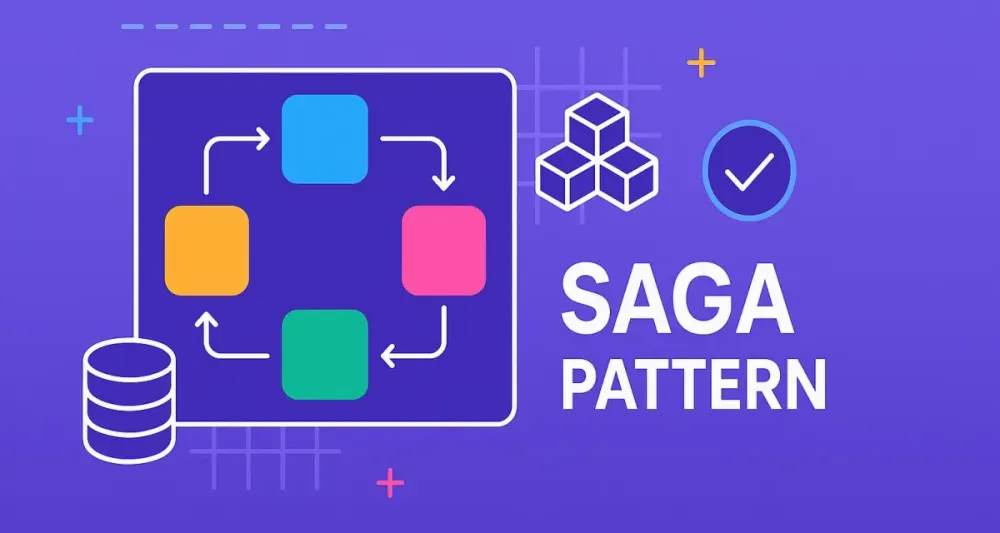
Enter the Saga Pattern—a robust approach to managing distributed transactions. It offers a compelling solution to the challenge of maintaining consistency across distributed microservices by breaking large transactions into smaller, manageable local transactions with associated compensating transactions. Picture a relay race, where each runner represents a service completing their segment (local transaction). If a runner trips (fails), the previous runners perform compensating actions (reverse their part of the relay).
1.4 What This Article Will Cover
This guide dives deeply into the Saga Pattern, covering:
- Core concepts behind the Saga pattern
- Types of sagas: choreography vs. orchestration
- Practical examples and C# code snippets
- Trade-offs and best practices for implementation
2 Deconstructing the Saga Pattern: Core Concepts
2.1 What is a Saga?
A saga is a sequence of local transactions coordinated to achieve an overall transaction across multiple services. Each local transaction updates data within a single service and publishes messages or events to trigger subsequent transactions in other services.
Consider booking a trip involving flights, hotels, and car rentals. Each booking is a separate transaction within its respective service. If any transaction fails (like the car rental), compensating transactions (canceling the flight and hotel bookings) occur.
2.2 Local Transactions: The Building Blocks of a Saga
Local transactions within each microservice ensure localized consistency. They follow traditional ACID guarantees within their bounded context but communicate asynchronously using messages or events.
Here’s a simplified C# example using the latest features in .NET 8:
public async Task BookFlightAsync(BookingRequest request)
{
    using var transaction = await _dbContext.Database.BeginTransactionAsync();

    var flightBooking = new FlightBooking
    {
        UserId = request.UserId,
        FlightDetails = request.FlightDetails,
        Status = BookingStatus.Pending
    };

    _dbContext.FlightBookings.Add(flightBooking);
    await _dbContext.SaveChangesAsync();

    await transaction.CommitAsync();

    // Publish event
    await _messageBus.PublishAsync(new FlightBookedEvent(flightBooking.Id));
}
2.3 Compensating Transactions: The Safety Net
Compensating transactions undo the effects of previously successful transactions when a later step fails. Unlike traditional rollback mechanisms, compensating transactions are explicit and must be designed thoughtfully to avoid unexpected side effects.
Example of compensating transaction:
public async Task CancelFlightBookingAsync(Guid bookingId)
{
    using var transaction = await _dbContext.Database.BeginTransactionAsync();

    var booking = await _dbContext.FlightBookings.FindAsync(bookingId);
    booking.Status = BookingStatus.Cancelled;

    await _dbContext.SaveChangesAsync();
    await transaction.CommitAsync();

    // Publish compensating event
    await _messageBus.PublishAsync(new FlightBookingCancelledEvent(bookingId));
}
2.4 The “Point of No Return”: Pivot and Retryable Transactions
Certain transactions within a saga might not be easily reversible, marking a critical “pivot” point. Handling pivot transactions involves special considerations such as confirmation, retries, or user intervention.
For instance, charging a customer’s credit card might be irreversible or costly to undo. Therefore, pivot transactions often require additional checks and safeguards:
if (await paymentGateway.ChargeCustomerAsync(paymentDetails))
{
    // Continue saga
}
else
{
    // Trigger compensating transactions
}
2.5 Guarantees and Trade-offs
The Saga pattern guarantees eventual consistency but sacrifices immediate consistency. The state might temporarily be inconsistent until all transactions successfully complete or compensating actions finish. It’s essential to design your application to handle these intermediate states gracefully, providing clear user feedback.
3 Choreography vs. Orchestration: The Two Faces of Saga
3.1 Choreography: A Decentralized Dance of Events
3.1.1 How it Works
In choreography, each service autonomously reacts to events published by other services. There’s no central orchestrator.
3.1.2 Pros
- Loose coupling
- Easy setup for simple sagas
- No single point of failure
3.1.3 Cons
- Difficulty tracking saga state
- Potential circular dependencies
- Challenging debugging and monitoring
3.1.4 When to Choose Choreography
Choreography excels in simpler scenarios involving fewer services and straightforward processes.
3.2 Orchestration: A Central Conductor
3.2.1 How it Works
Orchestration uses a central coordinator service to direct and manage saga steps explicitly.
Here’s an example of orchestrator logic:
public async Task ExecuteSagaAsync(OrderRequest request)
{
    try
    {
        await _flightService.BookFlightAsync(request);
        await _hotelService.BookHotelAsync(request);
        await _carRentalService.RentCarAsync(request);

        await CompleteSagaAsync();
    }
    catch (Exception)
    {
        await _carRentalService.CancelRentalAsync(request);
        await _hotelService.CancelHotelBookingAsync(request);
        await _flightService.CancelFlightBookingAsync(request);
    }
}
3.2.2 Pros
- Explicit control flow
- Easier debugging and state tracking
- Suitable for complex workflows
3.2.3 Cons
- Centralized orchestrator risk (single point of failure)
- Tighter coupling to orchestrator logic
3.2.4 When to Choose Orchestration
Orchestration is ideal for managing complex sagas involving numerous services or intricate conditional logic.
4 Implementing Sagas in C# and .NET
Designing and building sagas is both a technical and architectural challenge. You need more than just theoretical understanding—you need to make pragmatic technology choices and adopt proven patterns. In this section, we’ll guide you through the essential building blocks and introduce leading .NET libraries that help bring sagas to life in production environments.
4.1 Gearing Up: Essential .NET Technologies
Before you can implement a robust saga, it’s vital to understand the supporting infrastructure required to coordinate distributed transactions across microservices.
4.1.1 The Role of Message Brokers
Sagas depend on asynchronous communication to coordinate distributed transactions. That’s where message brokers shine. Rather than relying on fragile HTTP requests or direct service calls, a message broker allows microservices to publish events and send commands reliably, decoupling the sender from the receiver.
The most commonly used message brokers in .NET-based architectures include:
- RabbitMQ: A widely adopted open-source broker supporting complex routing and delivery guarantees. Its .NET client libraries are mature and widely supported.
- Azure Service Bus: A fully managed, cloud-native broker for the Microsoft Azure ecosystem. It offers enterprise-grade reliability, features like dead-letter queues, scheduled delivery, and at-least-once delivery.
- Apache Kafka: A distributed streaming platform optimized for high-throughput event streaming and data pipelines. Although a bit more complex to manage, it’s a solid choice for large-scale, high-availability scenarios.
Why are message brokers essential for sagas?
- Reliability: They ensure that events are delivered, even if a consumer is temporarily offline.
- Decoupling: Producers and consumers operate independently, making the architecture more resilient and flexible.
- Scalability: Services can scale independently, processing events as capacity allows.
A simple configuration for RabbitMQ in .NET might look like this:
services.AddMassTransit(x =>
{
    x.UsingRabbitMq((context, cfg) =>
    {
        cfg.Host("rabbitmq://localhost");
    });
});
4.1.2 The Importance of a Persistent Data Store for Saga State
While the message broker coordinates communication, the saga pattern also requires persistent storage to track the current state of each saga instance. Why is this crucial? Because sagas are long-running and span multiple service boundaries. If a service or server crashes midway, you don’t want to lose track of which steps have completed or failed.
Best practices for saga state persistence:
- Use a relational database (SQL Server, PostgreSQL, etc.) or a NoSQL store (like MongoDB) to store the state, depending on your scale and consistency requirements.
- The saga’s state should be uniquely identifiable, allowing correlation with incoming events.
- Choose storage mechanisms that align with your existing stack and operational requirements.
Here’s a minimal saga state record in C#:
public class TripBookingSagaState
{
    public Guid CorrelationId { get; set; }
    public BookingStatus FlightStatus { get; set; }
    public BookingStatus HotelStatus { get; set; }
    public BookingStatus CarStatus { get; set; }
    public DateTime LastUpdated { get; set; }
}
4.2 Out-of-the-Box and Emerging .NET Support
As distributed architectures have matured, the .NET ecosystem has developed strong native and community-supported solutions for implementing sagas.
4.2.1 Wolverine: Built-in Stateful Saga Capabilities
Wolverine is a modern .NET library focused on high-performance messaging, CQRS, and event-driven architectures. One of its strengths is built-in saga support that integrates state management and message handling with minimal boilerplate.
Key Features:
- Automatic correlation of messages to saga instances using a CorrelationId.
- Built-in persistence adapters for popular databases.
- Simple attribute-driven approach.
Concise Code Example:
Suppose you have a saga for a trip booking process.
public record StartTripBooking(Guid TripId, string UserId);
public record FlightBooked(Guid TripId);
public record HotelBooked(Guid TripId);

public class TripBookingSaga : Saga
{
    public Guid TripId { get; set; }
    public bool FlightBooked { get; set; }
    public bool HotelBooked { get; set; }

    [Start]
    public void Handle(StartTripBooking cmd)
    {
        TripId = cmd.TripId;
        // Initiate flight booking...
    }

    public void Handle(FlightBooked evt)
    {
        FlightBooked = true;
        // Proceed to hotel booking...
    }

    public void Handle(HotelBooked evt)
    {
        HotelBooked = true;
        // Saga complete
        MarkCompleted();
    }
}
Wolverine abstracts much of the infrastructure, letting you focus on business logic.
4.2.2 The Outbox Pattern: Reliable Message Publishing
Distributed systems have to deal with the classic “lost update” or “lost event” problem. What if your service commits a transaction, but crashes before publishing an event? The outbox pattern solves this by ensuring messages and business data are stored atomically.
How it works:
- Persist both the business change and the outgoing message in the same local transaction.
- A background process (or message relay) reads from the outbox table and reliably publishes messages to the broker.
C# Example (with Entity Framework):
public class OutboxMessage
{
    public Guid Id { get; set; }
    public string Payload { get; set; }
    public string Type { get; set; }
    public DateTime OccurredOn { get; set; }
}

public async Task SaveBookingAndEventAsync(Booking booking, OutboxMessage message)
{
    _dbContext.Bookings.Add(booking);
    _dbContext.OutboxMessages.Add(message);
    await _dbContext.SaveChangesAsync();
}
A background service then reads unprocessed messages and sends them to the message broker, ensuring reliable event delivery even after a crash or failure.
4.3 Popular .NET Libraries for Building Sagas
Let’s take a closer look at two of the most mature, enterprise-ready saga implementations in the .NET ecosystem: MassTransit and NServiceBus.
4.3.1 MassTransit: Power and Flexibility
4.3.1.1 Introduction to MassTransit and Its State Machine Saga Implementation
MassTransit is a widely used open-source distributed application framework for .NET, supporting multiple message brokers (RabbitMQ, Azure Service Bus, Amazon SQS, and Kafka). It has native support for sagas, including robust state machines for orchestrated workflows.
Key features:
- Declarative state machines using Automatonymous.
- Persistence options: Entity Framework, MongoDB, and more.
- Automatic correlation and saga instance management.
- Built-in support for compensating actions.
4.3.1.2 Code Example: Orchestrated Saga in MassTransit
Here’s a step-by-step guide to building an orchestrated saga for order processing.
1. Define State and Events:
public class OrderState : SagaStateMachineInstance
{
    public Guid CorrelationId { get; set; }
    public string CurrentState { get; set; }
    public Guid OrderId { get; set; }
    public DateTime CreatedAt { get; set; }
}

public record SubmitOrder(Guid OrderId, string CustomerId);
public record PaymentCompleted(Guid OrderId);
public record PaymentFailed(Guid OrderId);
2. Implement the State Machine:
public class OrderStateMachine : MassTransitStateMachine<OrderState>
{
    public State Submitted { get; private set; }
    public State Paid { get; private set; }
    public State Cancelled { get; private set; }

    public Event<SubmitOrder> OrderSubmitted { get; private set; }
    public Event<PaymentCompleted> PaymentSucceeded { get; private set; }
    public Event<PaymentFailed> PaymentFailed { get; private set; }

    public OrderStateMachine()
    {
        InstanceState(x => x.CurrentState);

        Event(() => OrderSubmitted, x => x.CorrelateById(ctx => ctx.Message.OrderId));
        Event(() => PaymentSucceeded, x => x.CorrelateById(ctx => ctx.Message.OrderId));
        Event(() => PaymentFailed, x => x.CorrelateById(ctx => ctx.Message.OrderId));

        Initially(
            When(OrderSubmitted)
                .Then(ctx => ctx.Instance.OrderId = ctx.Data.OrderId)
                .TransitionTo(Submitted)
                .Send(new Uri("queue:payment-service"), ctx => new ProcessPayment(ctx.Data.OrderId))
        );

        During(Submitted,
            When(PaymentSucceeded)
                .TransitionTo(Paid),
            When(PaymentFailed)
                .ThenAsync(async ctx =>
                {
                    // Compensating action: cancel the order
                    await CancelOrderAsync(ctx.Instance.OrderId);
                })
                .TransitionTo(Cancelled)
        );
    }
}
3. Configure Saga Persistence:
services.AddMassTransit(x =>
{
    x.AddSagaStateMachine<OrderStateMachine, OrderState>()
        .EntityFrameworkRepository(r =>
        {
            r.ConcurrencyMode = ConcurrencyMode.Pessimistic;
            r.AddDbContext<DbContext, SagaDbContext>((provider, options) =>
            {
                options.UseSqlServer(configuration.GetConnectionString("DefaultConnection"));
            });
        });

    x.UsingRabbitMq((context, cfg) =>
    {
        cfg.ConfigureEndpoints(context);
    });
});
This concise configuration handles event correlation, state transitions, and compensation logic with minimal ceremony.
4.3.2 NServiceBus: Enterprise-Grade Messaging and Sagas
4.3.2.1 Overview of NServiceBus Sagas and Their Features
NServiceBus is another heavyweight in the .NET messaging space, widely used for mission-critical enterprise workloads. Its saga framework focuses on message correlation, consistency, and automatic retries.
NServiceBus sagas provide:
- Automatic correlation of messages to saga instances based on configurable properties.
- Out-of-the-box support for timeouts and long-running workflows.
- Support for compensating transactions and complex state transitions.
- Multiple persistence mechanisms, including SQL, Azure Table Storage, and RavenDB.
4.3.2.2 Code Example: Creating a Saga with NServiceBus
Let’s build a simplified payment saga:
1. Define Saga Data:
public class PaymentSagaData : ContainSagaData
{
    public Guid PaymentId { get; set; }
    public string OrderNumber { get; set; }
    public bool PaymentReceived { get; set; }
}
2. Implement the Saga:
public class PaymentSaga : Saga<PaymentSagaData>,
    IAmStartedByMessages<SubmitPayment>,
    IHandleMessages<PaymentConfirmed>,
    IHandleTimeouts<PaymentTimeout>
{
    protected override void ConfigureHowToFindSaga(SagaPropertyMapper<PaymentSagaData> mapper)
    {
        mapper.MapSaga(saga => saga.PaymentId)
              .ToMessage<SubmitPayment>(msg => msg.PaymentId)
              .ToMessage<PaymentConfirmed>(msg => msg.PaymentId);
    }

    public async Task Handle(SubmitPayment message, IMessageHandlerContext context)
    {
        Data.PaymentId = message.PaymentId;
        Data.OrderNumber = message.OrderNumber;

        // Start payment process...
        await context.Send(new ProcessPaymentCommand(message.PaymentId));
        await RequestTimeout<PaymentTimeout>(context, TimeSpan.FromMinutes(15));
    }

    public Task Handle(PaymentConfirmed message, IMessageHandlerContext context)
    {
        Data.PaymentReceived = true;
        // Complete the saga
        MarkAsComplete();
        return Task.CompletedTask;
    }

    public Task Timeout(PaymentTimeout state, IMessageHandlerContext context)
    {
        if (!Data.PaymentReceived)
        {
            // Compensating action: flag payment as failed, notify stakeholders, etc.
        }
        MarkAsComplete();
        return Task.CompletedTask;
    }
}
3. Correlation and Reliability:
NServiceBus ensures that incoming messages are routed to the correct saga instance using mappings defined in ConfigureHowToFindSaga. If a message arrives that doesn’t match an existing instance, it can start a new saga or be rejected according to business rules.
4. Handling Timeouts:
Timeouts are a powerful saga feature. If a step is not completed in time, the saga can execute compensating logic—crucial for real-world business processes.
5 Architecting for Resilience: Handling Failures and Ensuring Consistency
Distributed systems are, by their nature, unpredictable. Network partitions, service outages, and unexpected bugs are not exceptions—they’re the rule. To build sagas that are reliable in production, you must design for resilience from the very start. Let’s explore the fundamental principles and techniques to ensure your sagas behave correctly, even in the face of chaos.
5.1 Idempotency: The “Do-Over” That Doesn’t Break Things
One of the hardest realities of distributed systems is that messages are not guaranteed to be delivered just once. Network retries, temporary disconnects, or broker redeliveries can all lead to the same message being handled multiple times. If your saga’s participants are not idempotent—meaning, they don’t handle repeated invocations gracefully—you risk data corruption and cascading failures.
Why is idempotency essential?
Imagine a payment microservice. What happens if a “charge customer” command is received twice? Charging the customer twice is unacceptable. The correct implementation recognizes the duplicate and only processes it once.
Strategies for achieving idempotency in C#:
- Track processed message IDs: Store a record of processed message or event IDs in your database, rejecting duplicates.
- Use natural idempotency keys: For example, transaction IDs or booking references that are unique for each request.
- Design operations to be naturally idempotent: For example, setting a record to a specific status rather than incrementing or performing cumulative updates.
Idempotent Handler Example:
public async Task Handle(PaymentCommand command)
{
    if (await _dbContext.Payments.AnyAsync(p => p.TransactionId == command.TransactionId))
    {
        // Already processed
        return;
    }

    var payment = new Payment
    {
        TransactionId = command.TransactionId,
        Amount = command.Amount,
        Status = PaymentStatus.Completed
    };
    _dbContext.Payments.Add(payment);
    await _dbContext.SaveChangesAsync();
}
With this approach, even if the message is delivered twice, the database check ensures it only has an effect once.
5.2 Failure Scenarios and Compensation Logic
Sagas are built to deal with failure, but handling those failures requires careful, deliberate design.
5.2.1 Designing Robust Compensating Transactions
A compensating transaction should undo the effect of a prior local transaction as closely as possible. But not every operation can be perfectly reversed. For example, you might cancel a booking, but if the cancellation window has closed or the external system is unavailable, you must handle these exceptions gracefully.
Design recommendations:
- Design compensating actions at the time you design the forward transaction.
- Document side effects and limitations: For example, some refunds might be partial.
- Communicate failures: If a compensating action cannot be performed, alert stakeholders and provide a manual remediation path.
Example Compensation Logic:
public async Task CompensateFlightBookingAsync(Guid bookingId)
{
    var booking = await _flightService.GetBookingAsync(bookingId);
    if (booking == null || booking.Status == BookingStatus.Cancelled)
        return;

    try
    {
        await _flightService.CancelBookingAsync(bookingId);
    }
    catch (ExternalServiceException ex)
    {
        // Log failure, trigger manual intervention
        _logger.LogError(ex, "Failed to cancel booking {BookingId}", bookingId);
        await _alertService.NotifyOpsAsync($"Manual cancellation required for booking {bookingId}");
    }
}
5.2.2 Handling Failures in Compensating Transactions (the “Saga of Sagas”)
Sometimes, the compensating transaction itself fails. This can lead to a “saga of sagas,” where a secondary process (or even a human) is needed to resolve the inconsistency.
Key techniques:
- Retry logic with backoff: Automatically retry compensating actions a reasonable number of times.
- Escalation workflows: After repeated failures, escalate to support or trigger a manual review process.
- Audit and monitoring: Always track failed compensations for later investigation.
5.3 Timeouts and Dead-Letter Queues: Strategies for Dealing with Non-Responsive Services
Not every service will respond in a timely fashion—or at all. Robust sagas use timeouts to prevent indefinite waiting, and dead-letter queues (DLQs) to capture messages that cannot be processed.
Timeout management:
- Set reasonable timeouts for each saga step.
- If a service does not respond, trigger compensation or alert support.
- Store timeout events as part of the saga state for auditability.
Dead-letter queues:
- Most brokers (e.g., RabbitMQ, Azure Service Bus) support DLQs for messages that are retried beyond a limit.
- Design your system to monitor and act on dead-lettered messages promptly.
C# Example (MassTransit Timeout):
public class OrderSaga : MassTransitStateMachine<OrderState>
{
    // ... state/event definitions

    public OrderSaga()
    {
        During(Submitted,
            When(PaymentRequested)
                .ThenAsync(ctx => /* initiate payment */)
                .TransitionTo(PaymentInProgress)
                .Schedule(PaymentTimeout, ctx => DateTime.UtcNow.AddMinutes(10))
        );

        During(PaymentInProgress,
            When(PaymentTimeout.Received)
                .Then(ctx => /* handle timeout, possibly compensate */)
                .TransitionTo(Cancelled)
        );
    }
}
5.4 Observability: Gaining Insight into In-Flight Sagas
When your architecture is spread across dozens of services, tracing the state and progress of individual sagas is critical—not just for debugging, but for supporting business operations.
5.4.1 The Necessity of Correlation IDs for End-to-End Tracing
Every saga instance must have a unique identifier (correlation ID) that’s passed along with every related message and persisted at every step. This makes it possible to reconstruct the saga’s journey across service boundaries, even after the fact.
How to use correlation IDs:
- Generate a new GUID for each saga instance at creation.
- Include this ID as part of every event or command message.
- Ensure logs and traces include the correlation ID for every related action.
5.4.2 Visualizing Saga State and Progress with Dashboards
Operational dashboards are invaluable. Tools like OpenTelemetry, Prometheus, Grafana, or custom dashboards can visualize:
- Which sagas are in progress or have completed.
- The current step/state for each saga.
- Rates of success, failure, and compensation.
Example:
- Use OpenTelemetry for instrumenting distributed traces and metrics.
- Export saga metrics (active, failed, completed) to Grafana dashboards for live monitoring.
5.4.3 Business-Level Monitoring: Alerting on Failed or Long-Running Sagas
Automate alerts for business stakeholders—not just engineers. If a saga fails or takes too long, the business needs to know:
- Integrate with incident management tools (PagerDuty, ServiceNow, Teams).
- Define SLAs for saga completion and trigger alerts if they’re breached.
- Log all compensating transactions and unresolved failures for postmortem analysis.
6 Choosing Your Saga Strategy and Best Practices
Choosing the right approach for your sagas—and implementing them well—can make or break your distributed application.
6.1 A Practical Decision Framework
How do you decide between choreography and orchestration? Here’s a simple guide:
-
Choreography:
- Works best for simple, linear processes with few participants.
- Preferable when you want to avoid introducing a central coordinator.
- Use when each service can act independently on domain events.
-
Orchestration:
- Better for complex workflows, especially with conditional logic or many participants.
- Easier to track, manage, and visualize the overall saga.
- Preferable when central error handling or business monitoring is needed.
Questions to ask:
- How complex is the business process?
- Do you need fine-grained tracking and control?
- Are you comfortable with a single orchestrator service as a potential bottleneck or point of failure?
6.2 Best Practices for Designing Sagas in .NET
The following principles will help you avoid common pitfalls:
6.2.1 Keep Sagas Small and Focused
- Each saga should represent one business process, not an entire domain.
- Limit the number of participants and the scope of each saga.
6.2.2 Design for Failure from the Outset
- Assume every step can fail. Explicitly define compensation and escalation paths.
- Regularly test failure scenarios in non-production environments.
6.2.3 Ensure Clear Ownership of Saga Logic
- Assign responsibility for each saga to a specific team or service owner.
- Document the process for updating and reviewing saga logic as business requirements evolve.
6.2.4 Document Your Sagas Thoroughly
- Maintain up-to-date diagrams, flowcharts, and state definitions.
- Document all compensating transactions, known limitations, and business exceptions.
- Share documentation with both technical and business stakeholders.
7 Advanced Architectural Considerations & Real-World Challenges
Designing sagas isn’t a “set and forget” endeavor. As your distributed system evolves, your saga implementation will face new technical and organizational challenges—testing complexity, version upgrades, scaling, cloud-native patterns, human-in-the-loop workflows, and enterprise-grade security. Let’s explore each of these advanced topics with an architect’s lens.
7.1 Comprehensive Testing Strategies for Sagas
Testing sagas is fundamentally different from testing simple service methods or single-database transactions. Here’s how mature teams approach testing across layers.
7.1.1 Unit Testing: State Machines in Isolation
Begin by unit testing saga logic: state transitions, event handling, and compensation rules. Focus on the pure business logic, using mocks or stubs for external dependencies.
Example:
[Fact]
public void ApproveExpense_ShouldTransitionToApproved()
{
    var saga = new ExpenseApprovalSaga();
    var state = new ExpenseState { CorrelationId = Guid.NewGuid(), Status = "Submitted" };

    saga.Transition(state, new ExpenseApproved { ExpenseId = state.CorrelationId });

    Assert.Equal("Approved", state.Status);
}
By isolating the state machine, you can quickly validate transitions and compensating behaviors without involving a message bus or database.
7.1.2 Integration Testing: Broker & Database
Unit tests alone are not enough. Integration tests verify that the saga works as expected when connected to a real message broker and data store. Use lightweight options such as in-memory databases (e.g., SQLite in-memory mode) and containerized message brokers via Docker Compose.
- MassTransit and NServiceBus both support in-memory transport for fast, isolated tests.
- Test containers allow spinning up RabbitMQ or SQL Server for integration tests as part of your CI pipeline.
Tips:
- Reset the environment before each test to ensure repeatability.
- Automate creation and cleanup of saga state in the test database.
7.1.3 End-to-End (Component) Testing
Real confidence comes from simulating the full saga workflow—sending in a command and verifying that all downstream services react as expected. This means orchestrating the entire flow, often substituting real dependencies with test doubles or mocks to avoid side effects.
- Simulate failures and retries: Intentionally break steps to ensure compensation logic is triggered.
- Validate state transitions: Query the saga state to ensure it reflects the expected outcome after each step.
- Monitor outputs: Capture emitted events and notifications to verify downstream integration.
Practical note: Flaky integration tests are a sign of fragile system boundaries. Invest in test isolation and robust retry mechanisms.
7.2 Performance Tuning and Scalability
Sagas introduce their own performance considerations—especially as system load grows.
7.2.1 Analyzing Message Broker Throughput and Backpressure
A slow message broker can bottleneck the entire saga process. Monitor metrics like queue length, delivery latency, and consumer lag. Set up alerts for unexpected backlogs.
- Backpressure: If consumers can’t keep up, brokers will start to buffer or drop messages. Scale consumers horizontally or optimize handler efficiency.
- Concurrency controls: Most .NET libraries allow tuning of concurrency and prefetch settings per consumer.
7.2.2 Scaling the Saga Orchestrator
A single orchestrator can become a bottleneck, especially for orchestrated sagas. To scale out:
- Partition sagas by correlation ID, allowing multiple orchestrator instances to process non-overlapping saga instances.
- Ensure saga state persistence supports concurrent access (e.g., pessimistic or optimistic concurrency controls).
7.2.3 Database Contention on Saga State Log
High saga volumes can lead to hot spots in your state table. To mitigate:
- Use row-level locking and indexed correlation IDs.
- Batch updates where possible.
- Offload infrequently accessed saga state to cheaper storage or archiving mechanisms.
7.3 Saga Versioning and Evolution
No business process stays the same forever. Updating a saga’s logic or state schema without disrupting in-flight transactions is a non-trivial challenge.
7.3.1 The Challenge: In-Flight Sagas
When a new saga version is deployed, existing sagas may still be mid-flight using old logic or state shapes. Mismatches can result in failures, data loss, or unhandled compensation.
7.3.2 Strategies for Safe Saga Upgrades
- Side-by-side deployment: Run old and new saga versions in parallel. Route new transactions to the new version while letting old sagas complete naturally.
- Versioned events and messages: Include a version number in message contracts. Each saga instance processes only messages matching its version.
- Schema evolution: Design saga state with forward and backward compatibility. Use nullable fields and avoid removing columns abruptly.
7.3.3 Handling Data Schema Changes
- Apply additive schema changes (new columns, tables) where possible.
- Use migration scripts for complex transitions, and never delete a column until all in-flight sagas are complete.
- Version state classes in .NET and map older data as needed.
7.4 Integrating Sagas with Other Cloud Patterns
Distributed systems rarely use a single pattern. Sagas must coexist and integrate with modern cloud-native patterns for full effect.
7.4.1 Saga and CQRS
Command Query Responsibility Segregation (CQRS) separates the write (command) and read (query) paths. Sagas often serve as the command orchestrator, coordinating state changes across aggregate roots. Use events to keep query models up to date.
7.4.2 Saga and Event Sourcing
Event sourcing captures every state change as an event. A saga can use the event stream as its source of truth, replaying events to rebuild state and offering a complete, auditable history.
- Implement sagas as event consumers.
- Persist saga state as an aggregate built from the event log.
7.4.3 Interaction with API Gateways
Many sagas are triggered by user actions via API Gateways. To ensure a good user experience:
- Initiate sagas from HTTP calls and return a correlation ID.
- Provide endpoints to query saga progress by correlation ID.
- Use webhooks or async notifications to update clients when the saga completes or fails.
7.5 Handling Human Interaction in Sagas
Not all workflows are fully automated. Sometimes, a human needs to review, approve, or intervene before the process can continue.
7.5.1 Designing for Human Steps
- Represent manual steps as special saga states.
- Pause the saga and await a new event (e.g., ManagerApproved).
- Resume processing when the event arrives.
7.5.2 Using Timeouts and Escalation Paths
- Set deadlines for human actions.
- If not completed in time, trigger escalations (e.g., notify a supervisor or cancel the request).
- Record all manual interventions for auditability.
7.5.3 Practical Example: Expense Report Approval
Imagine an expense approval process:
- Employee submits an expense.
- Saga transitions to “AwaitingManagerApproval.”
- Manager approves or rejects (saga receives event and proceeds or compensates).
- Timeout triggers escalation if manager doesn’t respond in time.
C# Snippet:
public class ExpenseSaga : MassTransitStateMachine<ExpenseState>
{
    public State AwaitingApproval, Approved, Rejected, Escalated;

    public Event<ExpenseSubmitted> Submitted;
    public Event<ManagerApproved> ApprovedEvent;
    public Event<ApprovalTimeout> ApprovalTimeoutEvent;

    public ExpenseSaga()
    {
        InstanceState(x => x.CurrentState);

        Initially(
            When(Submitted)
                .TransitionTo(AwaitingApproval)
                .Schedule(ApprovalTimeoutEvent, context => DateTime.UtcNow.AddDays(2))
        );

        During(AwaitingApproval,
            When(ApprovedEvent)
                .TransitionTo(Approved),
            When(ApprovalTimeoutEvent.Received)
                .TransitionTo(Escalated)
        );
    }
}
7.6 Security Considerations Across a Saga
Distributed transactions must be secure end-to-end.
7.6.1 Propagating Security Contexts
- Pass user identities and claims through the saga workflow.
- Use tokens or signed claims to authenticate and authorize actions in each participant service.
- Ensure that only authorized actors can trigger compensation or sensitive operations.
7.6.2 Securing the Message Bus
- Require authentication and role-based authorization on the message broker.
- Encrypt sensitive data in messages (e.g., using TLS, payload encryption).
- Audit message access and consumption.
8 Conclusion: Embracing Eventual Consistency with Confidence
8.1 Recap of Key Takeaways
The Saga Pattern provides a robust, battle-tested solution for managing distributed data consistency in microservices. By coordinating local transactions, leveraging compensating actions, and embracing eventual consistency, you can decouple services while preserving business integrity. Effective saga implementations rely on message brokers, persistent saga state, reliable idempotency, and thoughtful observability.
8.2 The Future of Sagas in .NET
.NET’s ecosystem for building sagas continues to mature. Libraries like MassTransit, NServiceBus, and Wolverine are evolving with better state management, cloud integration, and native observability. Emerging standards like OpenTelemetry and cloud-native message brokers are making large-scale saga orchestration more manageable and transparent.
8.3 Final Thoughts
Eventual consistency is not a compromise—it’s an enabler of resilience and scale. With the Saga Pattern and .NET’s rich tooling, architects can confidently design cloud-native systems that are both robust and agile. Invest in testing, monitoring, and security, and make sagas a first-class part of your distributed architecture. In doing so, you’ll unlock the true potential of microservices—without sacrificing consistency, reliability, or peace of mind.