Design Multi-Agent Systems and Orchestration Strategies
CCAR-P Domain 1 — Solution Design & Architecture Exam Guide
Target objective: Design multi-agent systems and orchestration strategies Domain: Domain 1 — Solution Design & Architecture (17%) Exam: Claude Certified Architect – Professional (CCAR-P)
1 What You Need to Know for the Exam
For this objective, don’t study multi-agent systems as simply:
“Many Claude agents working together.”
That definition is too shallow for CCAR-P.
Think like an architect:
A multi-agent architecture deliberately decomposes a problem across multiple independently operating agents because separation of context, capability, responsibility, verification, or parallel work provides enough value to justify the additional coordination, cost, latency, security, and operational complexity.
Anthropic describes its production Research architecture as an orchestrator-worker pattern: a lead agent analyzes the request, develops a strategy, creates specialized subagents, receives their findings, synthesizes results, and may launch additional work if gaps remain.
The important exam question is therefore rarely:
“Can we use multiple agents?”
It is usually:
“Why do we need multiple agents, and how should they coordinate?”
2 The First Rule: Don’t Use Multi-Agent by Default
This may be the single most important exam principle.
Anthropic recommends beginning with the simplest solution possible and increasing complexity only when needed. Workflows offer predictability for well-defined tasks, while agents become useful when flexibility and model-driven decisions are genuinely needed.
Your supplied practice exams follow exactly this reasoning:
- Fixed three-step process → workflow
- Simple retrieval + answer → augmented LLM
- Dynamic next step → agent
- Multiple genuinely independent/specialized subtasks → potentially multi-agent
Exam decision ladder
Can one Claude call solve it reliably?
        │
        ├── YES → Single / Augmented LLM
        │
        ▼
Are the steps known beforehand?
        │
        ├── YES → Workflow
        │
        ▼
Must the next action depend on intermediate findings?
        │
        ├── YES → Agent
        │
        ▼
Does splitting work provide meaningful:
   • parallelism?
   • context isolation?
   • specialization?
   • independent verification?
        │
        ├── YES → Multi-Agent
        │
        └── NO → Single Agent
Memorize
Multi-agent is an architectural optimization for particular problem shapes—not the “advanced version” of every Claude solution.
3 When Multi-Agent Architecture Is Actually Appropriate
Four signals should make you consider it.
3.1 Independent work can run in parallel
Example:
A market-intelligence request asks:
“Assess a company from financial, competitive, technical, and regulatory perspectives.”
Those research tracks are mostly independent.
Instead of:
Financial → Competitors → Technology → Regulation → Synthesisyou can use:
                 ┌─ Financial Agent ─────┐
                 ├─ Competitor Agent ────┤
Request → Lead ──┼─ Technology Agent ────┼→ Synthesis
                 └─ Regulation Agent ────┘
This is fan-out / fan-in orchestration.
Anthropic reports that its Research architecture particularly benefits breadth-first problems containing multiple independent directions that can be investigated simultaneously.
Exam signal
Look for words such as:
- independently
- simultaneously
- different domains
- multiple sources
- several distinct areas
- broad investigation
These often suggest parallelization.
4 Context Isolation: A Major Reason for Subagents
Multi-agent systems aren’t useful only because several things happen simultaneously.
They can also solve a context-management problem.
The Claude Agent SDK documentation explains that subagents have their own isolated context windows and can return only the information relevant to the orchestrator instead of sending their entire working context back.
Example:
Main Agent
Context:
  User request
  Business constraints
  Current synthesis
        │
        ├── Legal Agent
        │     └── 40K tokens of regulations
        │          returns 1K-token findings
        │
        ├── Financial Agent
        │     └── 30K tokens of filings
        │          returns 1K-token findings
        │
        └── Technical Agent
              └── 50K tokens of documentation
                   returns 1K-token findings
The coordinator does not need all 120K tokens of exploration.
It needs distilled results.
Exam takeaway
If the question says:
“The main agent’s context is becoming overloaded with large intermediate research results.”
A strong answer may be:
Delegate large investigations to context-isolated subagents and return concise structured findings.
Simply increasing the number of agents without context isolation does not solve the problem.
5 Specialization: Different Agents, Different Responsibilities
Another valid reason to decompose is specialization.
For example:
                 ┌─────────────────┐
                 │ Coordinator     │
                 └───────┬─────────┘
                         │
        ┌────────────────┼────────────────┐
        ▼                ▼                ▼
 Research Agent     Analysis Agent    Policy Agent
 Search tools       Data tools        RAG corpus
        │                │                │
        └────────────────┼────────────────┘
                         ▼
                  Synthesis Agent
                         │
                         ▼
                 Verification Agent
Each agent can have different:
- system instructions
- context
- tools
- permissions
- success criteria
- model requirements
- evaluation criteria
That is meaningful specialization.
Bad architecture
Agent A → all tools
Agent B → all tools
Agent C → all tools
Agent D → all tools
with nearly identical prompts.
You have multiplied cost and attack surface without gaining meaningful separation.
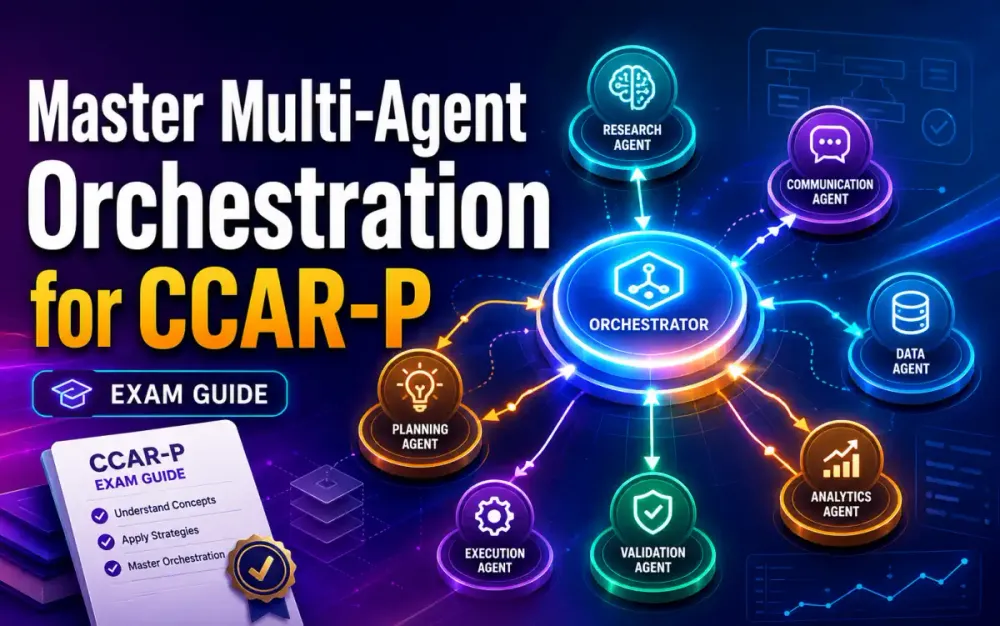
6 The Coordinator / Orchestrator Pattern
This is the architecture I would know cold for the exam.
                    USER
                      │
                      ▼
             ┌──────────────────┐
             │  ORCHESTRATOR    │
             │ / LEAD AGENT     │
             └────────┬─────────┘
                      │
          Analyze + Decompose
                      │
       ┌──────────────┼──────────────┐
       ▼              ▼              ▼
 ┌──────────┐   ┌──────────┐   ┌──────────┐
 │ Agent A  │   │ Agent B  │   │ Agent C  │
 │ Research │   │ Analysis │   │ Policy   │
 └────┬─────┘   └────┬─────┘   └────┬─────┘
      │              │              │
      └──────────────┼──────────────┘
                     ▼
             ┌────────────────┐
             │ Aggregation /  │
             │ Synthesis      │
             └───────┬────────┘
                     │
                Quality check
                     │
             ┌───────┴─────────┐
             │                 │
          Sufficient?         Gap?
             │                 │
            YES               NO
             │                 │
             ▼                 └──→ Re-delegate
          OUTPUT
Anthropic’s Research implementation follows this broad orchestrator-worker structure and allows the lead agent to launch additional research when existing results are insufficient.
7 What Exactly Does the Orchestrator Own?
This distinction is highly exam-relevant.
The orchestrator should typically own:
1 Understanding the request
Determine:
- intent
- complexity
- constraints
- success criteria
- which capabilities are actually required
2 Decomposition
Convert:
"Analyze whether we should acquire Company X"into something like:
1. Financial health
2. Market position
3. Product/technology
4. Legal/regulatory risk
5. Strategic fit
3 Delegation
Decide which agent receives which task.
Not:
Always invoke all 8 agents.Better:
Request requires finance + legal?
→ invoke Finance and Legal only.
Dynamic selection avoids unnecessary calls.
4 Dependency management
The orchestrator determines whether Agent B:
- can start immediately,
- needs Agent A’s output first,
- or doesn’t need to run at all.
This is exactly what the supplied practice exams emphasize: dependencies, sequencing, and aggregation requirements should drive orchestration.
5 Result aggregation
The orchestrator must know:
What did each agent discover?
Do findings conflict?
Is anything missing?
What belongs in the final response?
6 Error handling
For example:
Regulatory Agent → timeout
Financial Agent → success
Competitor Agent → success
Possible orchestration decisions:
Retry Regulatory Agent
       │
       ├─ success → continue
       │
       └─ failure
            │
            ├─ use alternative source/agent
            ├─ proceed with partial result
            └─ state coverage gap
Do not silently pretend every subtask succeeded.
7 Stopping
The coordinator needs a meaningful completion condition:
Required coverage achieved?
Evidence sufficient?
Verification passed?
Business task completed?
not merely:
We have already executed five agents.8 Core Orchestration Strategies
You should recognize at least these patterns.
Pattern 1 — Sequential orchestration
Agent A
   ↓
Agent B
   ↓
Agent C
   ↓
Final
Use when later work genuinely depends on earlier work.
Example
Document Extraction
       ↓
Risk Analysis
       ↓
Compliance Review
       ↓
Executive Summary
Risk analysis requires extracted facts.
Therefore parallel execution would be inappropriate.
Exam rule
Dependency → sequencing.
9 Pattern 2 — Parallel Fan-Out / Fan-In
              ┌→ Agent A ─┐
Coordinator ──┼→ Agent B ─┼→ Aggregator
              └→ Agent C ─┘
Use when subtasks are independent.
Benefits
- reduced elapsed time
- diverse investigation paths
- context isolation
- broader coverage
Anthropic uses parallel subagents in Research because different aspects of a problem can be investigated independently.
Exam rule
Independence → parallelize.
10 Pattern 3 — Router + Specialists
                    Request
                       │
                       ▼
                    Router
                       │
       ┌───────────────┼───────────────┐
       ▼               ▼               ▼
 Billing Agent   Technical Agent   Sales Agent
Not every request activates every agent.
Example:
“My card was charged twice.”
→ Billing Agent
“API returns HTTP 401.”
→ Technical Agent
This avoids unnecessary orchestration overhead.
Exam trap
“Send every request through every specialist”
is usually wrong unless every specialist is genuinely required.
11 Pattern 4 — Orchestrator-Worker
The orchestrator dynamically generates subtasks rather than routing into a completely predetermined set.
Complex Request
      │
      ▼
Orchestrator
      │
  creates tasks
      │
 ┌────┼─────┐
 ▼    ▼     ▼
W1   W2    W3
 └────┼─────┘
      ▼
Synthesis
This fits problems where the exact decomposition depends upon the request.
Anthropic describes this as useful when tasks cannot be cleanly predefined and their required subtasks vary based on the input.
12 Pattern 5 — Evaluator / Optimizer
Generator
    │
    ▼
Evaluator
    │
 ┌──┴──────────┐
 │ Pass        │ Fail
 ▼             ▼
Output      Feedback
               │
               └──→ Generator
Example:
Writer Agent drafts a customer report.
Evaluator checks:
- required sections
- unsupported claims
- policy compliance
- citation coverage
If it fails, return targeted feedback.
This is useful where outputs have measurable quality criteria.
Important distinction
This doesn’t automatically require two agents.
If deterministic validation can perform the evaluation:
Claude output
     ↓
JSON Schema Validator
use code instead.
Don’t replace deterministic validation with another LLM merely to create a multi-agent architecture.
13 Hybrid Orchestration Is Often the Best Production Design
Real solutions can combine patterns.
Example:
                          User
                            │
                            ▼
                       Coordinator
                            │
                ┌───────────┴──────────┐
                │                      │
           Is simple?              Is complex?
                │                      │
                ▼                      ▼
           Single Agent          Decompose
                                       │
                           ┌───────────┼───────────┐
                           ▼           ▼           ▼
                       Search A    Search B    Search C
                           └───────────┼───────────┘
                                       ▼
                                   Synthesis
                                       │
                                       ▼
                              Deterministic checks
                                       │
                              ┌────────┴────────┐
                              ▼                 ▼
                            Pass              Fail
                              │                 │
                           Output           Rework
This is architecturally stronger than declaring:
“Everything is multi-agent.”
14 The Critical Orchestration Question: Dependencies
The practice exams directly target this.
Imagine three subtasks:
A = Retrieve customer record
B = Determine refund eligibility
C = Draft explanation
Dependencies:
A → B → CRunning all three simultaneously is wrong.
Now imagine:
A = analyze financial risks
B = analyze regulatory risks
C = analyze technology risks
Dependencies:
A ─┐
B ─┼→ Synthesis
C ─┘
Parallel execution makes sense.
Exam shortcut
Before choosing orchestration, draw dependencies mentally.
If:
B needs A→ sequential.
If:
A ⟂ B ⟂ C→ parallel.
If:
We don't know which specialists are needed yet→ routing/orchestrator.
15 Decomposition Quality Determines Multi-Agent Quality
A complex architecture can fail before any agent executes.
Consider:
“Assess whether our organization should migrate a critical platform to a new cloud provider.”
Bad decomposition:
Agent 1 → Cloud pricing
Agent 2 → Cloud features
Agent 3 → Cloud documentation
Missing:
- migration effort
- security
- regulatory requirements
- architecture compatibility
- organizational capability
- operational risk
No amount of clever orchestration fixes a decomposition that never assigned those questions.
Your practice exams explicitly test this reasoning: when an entire category of cases is missing, the initial decomposition may have been too narrow, producing a design-time coverage gap.
Exam principle
Incomplete output may be a decomposition failure, not a model failure.
16 Good Task Boundaries for Subagents
Each delegated task should have:
Goal
+
Scope
+
Input
+
Allowed capabilities
+
Expected output
+
Completion criteria
Example:
ROLE
Regulatory Research Agent

GOAL
Identify regulations affecting the proposed transaction.

SCOPE
US federal financial regulations only.

INPUT
Company, transaction type, jurisdiction.

TOOLS
Approved regulatory search tools.

OUTPUT
Structured findings:
- regulation
- applicability
- evidence
- source
- confidence

STOP WHEN
All identified regulatory categories have either
supporting evidence or an explicit "not found" result.
This is substantially better than:
Research regulations.17 Context Passing Between Agents
This is another important distinction.
Do not assume that creating Agent B means it automatically knows everything Agent A or the coordinator knows.
Anthropic’s current Agent SDK guidance highlights isolated subagent context as a deliberate feature: subagents work separately and return relevant information to the orchestrator.
Architecturally:
Coordinator context
      │
      │ explicit task package
      ▼
Subagent context
      │
      │ structured result
      ▼
Coordinator context
Good approach
Pass only:
- goal
- relevant facts
- constraints
- required evidence
- expected output structure
Bad approach
Copy the complete coordinator conversation into every subagent.
That destroys much of the context-isolation advantage.
18 Use Structured Agent-to-Agent Contracts
Instead of returning:
“I looked into this and things generally seem okay, although there are a few concerns…”
prefer:
{
  "status": "completed",
  "findings": [
    {
      "claim": "...",
      "evidence": "...",
      "source": "...",
      "confidence": "high"
    }
  ],
  "gaps": [],
  "recommended_followup": null
}
Why?
The orchestrator can reliably reason about:
- completion
- evidence
- missing information
- errors
- conflicts
instead of interpreting vague prose.
For CCAR-P, focus on the architectural value of explicit contracts, not memorizing a particular JSON schema.
19 Agent-to-Agent Security: Don’t Forget Least Privilege
This is where Domain 1 overlaps strongly with Domain 3.
Your practice exams include a scenario where one agent can invoke another without any defined boundary on what it is permitted to request. The identified risk is that unrestricted agent-to-agent invocation creates unclear, overly broad effective authorization.
Consider:
Research Agent
      │
      ▼
Finance Agent
      │
      ▼
Payment Tool
Suppose Research Agent shouldn’t be able to initiate payments.
If it can indirectly manipulate Finance Agent into doing so, your apparent privilege separation is meaningless.
Correct architecture
Agent A
   │
   │ allowed: research_request
   ▼
Agent B
   │
   │ allowed: read_financial_data
   ▼
Financial System
Not:
Agent A → "Ask Agent B to do anything"Anthropic has also highlighted multi-agent trust escalation as an emerging security concern: output from a subagent should not automatically become trusted merely because another internal agent produced it.
Memorize
Agent boundaries must be capability boundaries, not merely prompt/persona boundaries.
20 Orchestration Should Include Failure Handling
A multi-agent architecture multiplies failure points.
Suppose:
Coordinator
 ├─ Market Agent       ✓
 ├─ Financial Agent    ✓
 ├─ Legal Agent        ✕ timeout
 └─ Technology Agent   ✓
The coordinator needs an explicit policy.
Possible response:
Legal failed
   │
   ├─ retry safely
   │
   ├─ use fallback source
   │
   ├─ re-delegate
   │
   └─ proceed with partial coverage
          +
      disclose missing legal analysis
Never:
Ignore failure → synthesize as though analysis were complete.Exam signals
Look for:
- partial results
- timeout
- failed subagent
- unavailable tool
- conflicting findings
Correct answers normally preserve:
visibility + recoverability + explicit limitations.
21 Aggregation Is Part of the Architecture
Multi-agent design doesn’t end when agents finish.
You must decide:
How do separate outputs become one result?
Common approaches:
Direct synthesis
A ─┐
B ─┼→ Synthesis Agent → answer
C ─┘
Deterministic aggregation
Best for structured outputs.
Agent outputs
     ↓
Programmatic merge
     ↓
Validation
Rank/select
Multiple agents propose alternatives:
Proposal A ─┐
Proposal B ─┼→ Evaluator → best proposal
Proposal C ─┘
Consensus
Useful only when genuine independent judgment adds value.
Don’t assume:
3 agents agreeing = truth.
Three agents can repeat the same bad assumption.
Evidence matters more than voting.
22 Sequential Multi-Agent Systems Can Destroy Latency
This appears directly in both supplied practice exams.
A design containing:
Coordinator
    ↓
Agent A
    ↓
Coordinator
    ↓
Agent B
    ↓
Coordinator
    ↓
Agent C
    ↓
Coordinator
creates several serial model round trips.
Your practice exams specifically flag this as an architectural problem when a tight p95 SLA exists; the architecture may need simplification or parallelization rather than merely prompt tuning.
Anthropic similarly cautions that agentic systems typically trade increased latency and cost for better task performance.
Exam formula
Strict latency SLA
        +
Many sequential agent hops
        =
Architecture mismatch
Don’t reflexively answer:
- faster model
- shorter prompt
- more caching
when the fundamental issue is excessive serialized orchestration.
23 Multi-Agent Systems Also Increase Cost
This is important because CCAR-P tests business alignment.
Anthropic’s published experience with Research notes that multi-agent architectures consume substantially more tokens than normal interactions and are therefore most defensible for sufficiently valuable tasks.
Your practice exams reinforce the architectural implication: if the business driver is cost reduction and the task is simple and well-defined, sending every request through a multi-agent system using the most capable model is over-engineered and misaligned.
So:
Higher architectural sophistication
≠
Higher business value
24 Choose Models Per Agent, Not Necessarily Per System
Suppose you have:
Coordinator
├── Routing
├── Document search
├── Deep legal analysis
└── Final synthesis
These workloads may not require the same reasoning capability.
Architecturally, think:
Routine / predictable task
      ↓
Cost-efficient model

Hard reasoning task
      ↓
More capable model
The exam guide separately expects architects to understand model selection as a trade-off, and multi-agent architecture creates an opportunity to apply that choice at the component level rather than blindly selecting one tier everywhere.
25 Observability Must Follow the Orchestration Graph
For a single Claude call, you might monitor:
Request → ResponseA multi-agent system requires more:
Request ID
   │
   ├─ coordinator decision
   ├─ decomposition
   ├─ agents invoked
   ├─ agent latency
   ├─ tool calls
   ├─ agent failures
   ├─ retries
   ├─ token/cost usage
   ├─ aggregation
   └─ final outcome
The official blueprint explicitly expects candidates to handle orchestration while also evaluating observability challenges, latency trade-offs, and tool/agent configuration.
Important operational metric
Do not optimize merely:
cost per agent call.
Think:
cost per successfully completed business task.
A “cheap” orchestration architecture needing repeated delegation may be expensive overall.
26 A Useful CCAR-P Multi-Agent Decision Matrix
| Situation | Best starting pattern |
|---|---|
| One simple transformation | Single Claude call |
| Retrieve knowledge + answer | Augmented LLM / RAG |
| Fixed sequence | Workflow |
| Dynamic unknown sequence | Agent |
| Several independent investigations | Parallel subagents |
| Large isolated contexts | Subagents |
| Different tool/permission domains | Specialized agents |
| Multiple results must combine | Fan-out / fan-in |
| B depends on A | Sequential orchestration |
| Agent selection depends on request | Router / coordinator |
| Output needs iterative qualitative improvement | Evaluator/optimizer |
| Simple task + strong latency/cost constraint | Avoid multi-agent |
27 A Production-Oriented Reference Architecture
For exam purposes, this is a useful mental model:
┌────────────────────────────────────────────────────┐
│                     USER / APP                     │
└───────────────────────┬────────────────────────────┘
                        ▼
┌────────────────────────────────────────────────────┐
│ INPUT / POLICY / AUTHORIZATION                     │
│ identity • validation • safety • request context   │
└───────────────────────┬────────────────────────────┘
                        ▼
┌────────────────────────────────────────────────────┐
│                 ORCHESTRATOR                       │
│                                                    │
│ classify → plan → decompose → delegate             │
│ budgets → dependencies → retries → stop criteria   │
└───────────────┬──────────────────┬─────────────────┘
                │                  │
      ┌─────────▼────────┐ ┌───────▼──────────┐
      │ Research Agent   │ │ Analysis Agent   │
      │ scoped tools     │ │ scoped tools     │
      │ isolated context │ │ isolated context │
      └─────────┬────────┘ └───────┬──────────┘
                │                  │
                └────────┬─────────┘
                         ▼
             ┌──────────────────────┐
             │ Synthesis / Merge    │
             └──────────┬───────────┘
                        ▼
             ┌──────────────────────┐
             │ Verification         │
             │ deterministic + AI   │
             └──────────┬───────────┘
                        │
               ┌────────┴────────┐
               ▼                 ▼
             PASS              FAIL
               │                 │
               ▼                 └──→ targeted rework
          FINAL OUTPUT
               │
               ▼
┌────────────────────────────────────────────────────┐
│ FEEDBACK / OBSERVABILITY                           │
│ quality • latency • cost • agent trace • failures  │
└────────────────────────────────────────────────────┘
You don’t need to memorize a vendor-specific framework.
Understand responsibility boundaries.
28 Worked Example — Enterprise Due-Diligence Assistant
Business problem
A corporate strategy team spends several days producing preliminary acquisition assessments.
They need:
- financial analysis
- market research
- regulatory research
- technology assessment
- sourced recommendations
The areas are largely independent.
Poor solution
One huge prompt:
"Research everything and recommend whether we should acquire Company X."Potential problems:
- overloaded context
- sequential search
- difficult provenance
- poor coverage
- weak specialization
Better architecture
                         User
                           │
                           ▼
                   Due-Diligence Lead
                           │
              Define analysis requirements
                           │
          ┌────────────────┼─────────────────┐
          ▼                ▼                 ▼
   Financial Agent   Market Agent      Regulatory Agent
          │                │                 │
          └────────────────┼─────────────────┘
                           ▼
                    Technology Agent
                           │
                           ▼
                     Synthesis Agent
                           │
                           ▼
                    Evidence Validator
                           │
                           ▼
                      Human Review
But should Technology necessarily wait for the others?
Probably not.
A better dependency design is:
                 ┌→ Financial ────┐
                 ├→ Market ───────┤
Lead Agent ──────┼→ Regulatory ───┼→ Synthesis → Verification
                 └→ Technology ───┘
This illustrates an exam principle:
Architecture should follow actual dependencies, not the visual neatness of a pipeline.
29 What If Agents Disagree?
Suppose:
Market Agent:
"Demand is growing strongly."

Financial Agent:
"Revenue growth is slowing."

Industry Agent:
"Market growth estimates vary considerably."
Wrong:
Coordinator selects whichever answer seems most confident.Better:
Preserve:
- claim
- evidence
- source
- confidence
- disagreement

Then synthesize:
"Market-level growth appears strong, but Company X is
currently underperforming that market."
The orchestrator’s role is reasoned aggregation, not flattening disagreement.
30 Multi-Agent Security Architecture
For each agent ask:
What data can it see?
What tools can it invoke?
Which other agents can it invoke?
Under whose identity does it act?
Can it perform irreversible actions?
Does its output cross a trust boundary?
A good system might look like:
Research Agent
Tools:
✓ search
✓ read approved documents
✗ write database
✗ send payment
✗ delete records

Finance Agent
Tools:
✓ read financial data
✓ calculate metrics
✗ issue payment

Transaction Agent
Tools:
✓ prepare transaction
Human approval required → execute
Exam rule
Different persona ≠ security boundary.
Authorization and capability restrictions must be enforced outside the model when they must reliably hold.
31 Common Exam Traps
Trap 1 — “More agents means better quality”
Wrong.
Use more agents only when decomposition gives real benefit.
Trap 2 — Multi-agent for a fixed workflow
Extract → Validate → SaveUsually a workflow, not three autonomous agents.
Trap 3 — Always invoke every specialist
Wasteful.
Use dynamic routing when only some capabilities are needed.
Trap 4 — Parallelize dependent work
If B requires A’s output, B cannot meaningfully execute first.
Trap 5 — Serialize independent work
Adds unnecessary latency.
Parallelize where independence permits.
Trap 6 — Solve decomposition failures by adding agents
If an entire problem category was never identified, adding capacity does not repair the missing decomposition.
Trap 7 — Give every agent every tool
Violates least privilege.
Trap 8 — Trust subagent output automatically
A subagent can still contain incorrect or maliciously influenced information. Anthropic specifically warns about trust escalation across agent boundaries.
Trap 9 — Use multi-agent despite tight latency requirements
Multiple serial round trips may make the architecture fundamentally incompatible with the SLA.
Trap 10 — Optimize technical sophistication instead of business value
If the business priority is:
reduce cost
then a very expensive multi-agent solution to a simple task is probably the wrong architecture.
32 The 8-Step Exam Method
When you see a multi-agent scenario, use this sequence.
Step 1 — Identify the business outcome
What exactly must improve?
cost?
speed?
accuracy?
coverage?
manual effort?
risk?
Step 2 — Ask whether multi-agent is even necessary
Could:
- one call,
- augmented LLM,
- workflow,
- or single agent
satisfy the requirement?
Step 3 — Decompose the task
Identify meaningful subtasks.
Step 4 — Map dependencies
A → B?
A || B?
Step 5 — Select orchestration
Dependencies determine:
- sequential
- parallel
- router
- orchestrator-worker
- evaluator/optimizer
- hybrid
Step 6 — Define boundaries
For every agent:
- context
- tools
- permissions
- responsibility
- output contract
Step 7 — Define aggregation and failure handling
How do results merge?
What if:
- an agent fails,
- agents disagree,
- evidence is missing?
Step 8 — Check NFRs
Does the architecture still satisfy:
- latency
- cost
- accuracy
- reliability
- security
- maintainability?
That last step frequently eliminates the attractive distractor.
33 Two Practical Exercises
You asked to skip the linked site’s Build Exercise. These exercises are more directly aligned to the CCAR-P architecture objective.
Exercise 1 — Design a Multi-Agent RFP Analysis Assistant
Scenario
Your organization receives a 150-page RFP containing:
- functional requirements
- architecture requirements
- security requirements
- contractual terms
- pricing instructions
The goal is to prepare a compliant proposal.
Your task
Design the architecture.
Start with:
RFP Intake
    │
    ▼
Coordinator
    │
    ├─ Functional Requirements Agent
    ├─ Technical Architecture Agent
    ├─ Security/Compliance Agent
    ├─ Contractual Risk Agent
    └─ Pricing Requirement Agent
Then answer:
- Which agents can run in parallel?
- What information should each receive?
- What structured output should each return?
- Who identifies contradictions between sections?
- How are mandatory requirements tracked?
- What happens when one agent finds an unresolved question?
- Which decisions require human review?
- How would you prevent every agent from receiving unnecessary tools?
- Where should deterministic compliance checks be used?
- What latency/cost trade-off justifies multi-agent processing?
Learning objective
Practice:
decomposition → parallelization → aggregation → verification → governance.
34 Exercise 2 — Customer Support Orchestration Challenge
Business problem
An assistant handles:
- order status
- returns
- refunds
- technical troubleshooting
- account problems
Design two versions
Version A
One agent with every tool.
Version B
                  Support Coordinator
                         │
        ┌────────────────┼────────────────┐
        ▼                ▼                ▼
 Order Agent       Returns Agent     Tech Agent
        │                │
        │          Refund approval
        │                │
        └────────────────┴──→ Human if required
Then compare:
| Dimension | Single Agent | Multi-Agent |
|---|---|---|
| Context complexity | ? | ? |
| Tool exposure | ? | ? |
| Latency | ? | ? |
| Cost | ? | ? |
| Observability | ? | ? |
| Specialization | ? | ? |
| Security | ? | ? |
| Maintenance | ? | ? |
Finally answer:
Does the multi-agent version create enough value to justify itself?
That final question is exactly the architectural judgment CCAR-P is trying to assess.
35 Five CCAR-P-Style Practice Questions
These are new practice questions created for study, not live exam questions.
Question 1 — Parallel vs Sequential
A financial-services company uses three specialist agents to prepare an investment report. One evaluates financial statements, one analyzes market conditions, and one reviews regulatory developments. Each analysis can be performed independently from the original request. The current coordinator invokes them sequentially, causing unacceptable response time.
What is the BEST architectural change?
A. Replace all three specialists with a single larger model. B. Run the three agents in parallel and aggregate their results after all required analyses complete. C. Add additional coordinator agents between each specialist. D. Increase the context window of each specialist.
Correct answer: B
Why: The subtasks have no dependency on each other. The orchestration should therefore exploit their independence through fan-out/fan-in execution.
Why A is wrong: A might reduce orchestration overhead but sacrifices the stated specialization without first showing specialization is the problem.
Why C is wrong: More coordinator hops worsen latency.
Why D is wrong: Context size doesn’t address serial execution.
Exam lesson
Independent subtasks → consider parallel execution.
36 Question 2 — Do You Even Need Multi-Agent?
An insurance company must extract fields from claim forms, validate required fields against deterministic rules, and save valid records to its claims system. The sequence is fixed and identical for every claim. An architect proposes an autonomous coordinator plus extraction, validation, and persistence agents.
What is the primary concern?
A. Claude cannot perform extraction tasks. B. Multi-agent systems cannot access enterprise APIs. C. The design is unnecessarily complex; a deterministic workflow better matches the known sequence. D. Every agent must use a different Claude model.
Correct answer: C
The workflow is known:
Extract → Validate → SaveThere is little architectural benefit from autonomous coordination.
This matches the repeated pattern found in both supplied practice exams: well-understood fixed processes are better served by workflows than by unnecessary agentic or multi-agent complexity.
Exam lesson
Do not confuse decomposition with the need for autonomous agents.
37 Question 3 — Decomposition Failure
A healthcare organization creates specialist agents for medication analysis, diagnostic-history analysis, and laboratory analysis. After deployment, clinicians discover that allergy-related risks are systematically absent from generated reviews.
Which action should the architect take FIRST?
A. Upgrade all agents to a more capable model. B. Increase the number of iterations available to the coordinator. C. Revisit the original problem decomposition and ensure allergy-related analysis is explicitly covered. D. Add another synthesis agent.
Correct answer: C
The missing category points to an architectural coverage problem.
This is consistent with the supplied practice exams, where an entire missing category indicates that initial decomposition was too narrow.
Exam lesson
Missing coverage → inspect decomposition before blaming execution.
38 Question 4 — Agent-to-Agent Least Privilege
A corporate assistant uses a Research Agent that can invoke a Finance Agent. The Finance Agent can access financial records and execute payment-related tools. The Research Agent may send unrestricted natural-language requests to the Finance Agent.
What is the MOST important architectural concern?
A. The Research Agent may use too many tokens. B. Agent-to-agent communication bypasses retrieval caching. C. Unrestricted delegation can expand the Research Agent’s effective privileges through the Finance Agent. D. Both agents should use the same system prompt.
Correct answer: C
If Agent A can request arbitrary actions from Agent B, Agent A can effectively inherit Agent B’s privileges.
The practice exams explicitly identify unrestricted agent-to-agent invocation as a least-privilege risk.
Correct architecture
Expose narrow delegated capabilities such as:
get_financial_summaryrather than:
ask_finance_agent_to_do_anythingExam lesson
Agent-to-agent boundaries need explicit authorization contracts.
39 Question 5 — Orchestration Strategy
A B2B research assistant has four subagents. Some user requests need only document analysis, others require simultaneous web and competitor research, while complex requests require those findings before a risk-analysis agent can operate.
Which orchestration strategy is BEST?
A. Always invoke all four subagents sequentially. B. Always invoke all four subagents in parallel. C. Let the coordinator dynamically select required subagents, parallelize independent work, sequence dependent work, and aggregate results. D. Remove the coordinator and let every agent invoke every other agent freely.
Correct answer: C
This is the closest expression of the central orchestration rule:
Dependencies + sequencing + aggregation needs determine orchestration.
Both supplied practice exams explicitly reinforce that principle.
Exam lesson
Don’t memorize:
Multi-agent = parallelMemorize:
Independent → parallel
Dependent → sequential
Conditional → route
Unknown decomposition → orchestrate dynamically
Mixed problem → hybrid
40 Final Exam Cheat Sheet
Know these almost word-for-word
| If the scenario says… | Think… |
|---|---|
| Fixed known sequence | Workflow, not multi-agent |
| Dynamic next action | Agentic |
| Several independent subtasks | Parallel subagents |
| B requires output from A | Sequential orchestration |
| Different requests need different specialists | Router / dynamic coordinator |
| Exact subtasks aren’t known beforehand | Orchestrator-worker |
| Large independent context | Context-isolated subagent |
| Need independent review | Evaluator / verifier |
| Entire category missing | Bad decomposition |
| All agents share every tool | Capability bloat |
| Agent can freely command privileged agent | Least-privilege failure |
| Tight SLA + several serial agents | Architecture/latency mismatch |
| Simple task + cost reduction goal | Multi-agent probably over-engineered |
| Subagent fails | Propagate error / retry / degrade explicitly |
| Agents disagree | Preserve evidence and disagreement; don’t blindly vote |
41 The One Mental Model to Remember
For CCAR-P, think:
BUSINESS PROBLEM
       │
       ▼
Can a simpler pattern solve it?
       │
       ├── YES ──→ USE IT
       │
       ▼
DECOMPOSE THE PROBLEM
       │
       ▼
MAP DEPENDENCIES
       │
       ├── Independent ──→ PARALLEL
       │
       ├── Dependent ────→ SEQUENTIAL
       │
       ├── Conditional ──→ ROUTE
       │
       └── Unknown ──────→ ORCHESTRATOR
       │
       ▼
DEFINE EACH AGENT'S
role • context • tools • permissions • output
       │
       ▼
AGGREGATE + VERIFY
       │
       ▼
HANDLE FAILURE / GAPS
       │
       ▼
CHECK
cost • latency • quality • security • business value
Maximum-marks takeaway
The exam is unlikely to reward “multi-agent because the problem is complex.”
The stronger architectural reasoning is:
Use multi-agent architecture only when decomposition creates meaningful benefits such as parallelism, context isolation, specialization, or independent verification. Then derive the orchestration strategy from actual subtask dependencies, required sequencing, routing conditions, and aggregation needs. Keep agent capabilities scoped, propagate failures explicitly, verify synthesized results, and ensure the additional cost and latency remain justified by the business outcome.
That aligns particularly well with the official Domain 1 objective, the supplied CCAR-P practice-question patterns, and Anthropic’s production guidance on orchestrator-worker and subagent architectures.