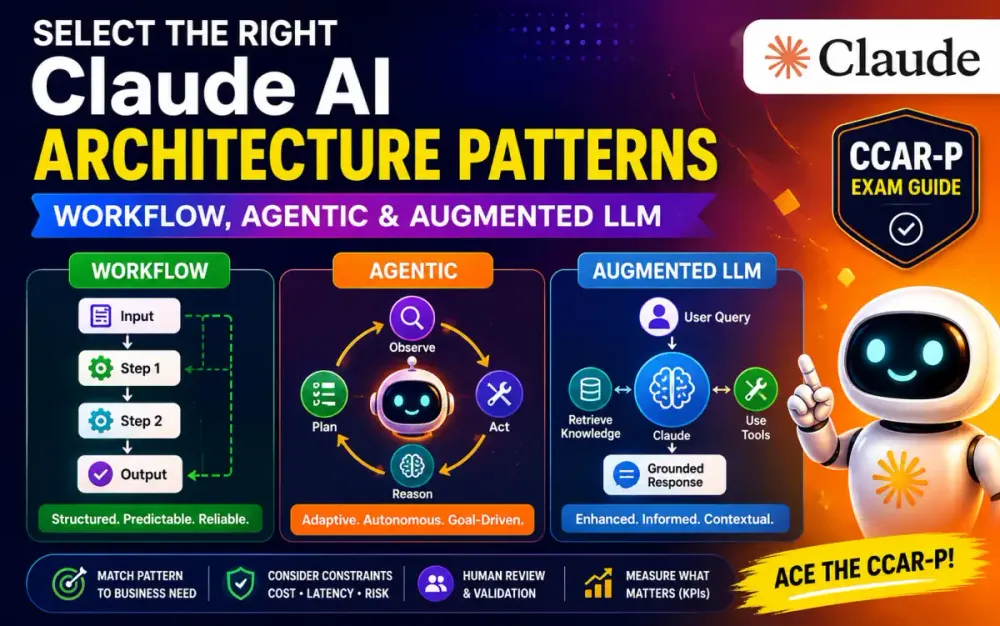
Select Appropriate Architectural Patterns: Workflow, Agentic, and Augmented LLM
CCAR-P Domain 1 — Solution Design & Architecture
Exam objective: Select appropriate architectural patterns (workflow, agentic, augmented LLM)
This objective sits inside Domain 1: Solution Design & Architecture, weighted at 17% of the CCAR-P exam. The official guide explicitly expects candidates to translate business problems into Claude-based solutions, choose among workflow/agentic/augmented-LLM patterns, design multi-agent orchestration, apply decomposition, and align the architecture to business value and SLAs.
The most important point for the exam is this:
Do not choose the most powerful architecture. Choose the simplest architecture that satisfies the business requirement and its constraints.
That framing is strongly reinforced by Anthropic’s own architecture guidance: start with the simplest solution that works, because agentic systems typically trade additional latency and cost for flexibility and task performance. Anthropic distinguishes workflows, where code defines the path, from agents, where the LLM dynamically controls the process and tool usage.
The two supplied practice exams reinforce exactly this pattern. They repeatedly test fixed processes → workflow, unpredictable paths → agent, simple retrieval-grounded answers → augmented LLM, and penalize unnecessary multi-agent complexity.
1 What You Need to Know for the Exam
You should be able to read a scenario such as:
“The customer wants an AI assistant that reviews applications.”
…and avoid immediately deciding:
“Use an agent.”
Instead, determine the structure of the problem.
| Question to ask | Why it matters |
|---|---|
| Is this one transformation or response? | Consider a simple/augmented LLM |
| Is the sequence known beforehand? | Strong workflow signal |
| Does the next step depend on what Claude discovers? | Strong agentic signal |
| Does the answer need external/current/domain knowledge? | Augment the LLM with retrieval/tools |
| Are several tasks independent? | Consider parallel workflow |
| Are subtasks unknown until execution begins? | Consider orchestrator/agentic approach |
| Is determinism or auditability critical? | Prefer more control in code |
| Is latency strict? | Avoid unnecessary serial agent loops |
| Is cost the primary business goal? | Avoid unnecessary agents/multi-agent designs |
| Are success criteria easily verifiable? | Workflow becomes especially attractive |
This reasoning is more important than memorizing product terminology.
2 The Core Mental Model
Think of the architectural patterns as a complexity ladder:
Plain LLM → Augmented LLM → Workflow → Agent → Multi-agent
Do not automatically move to the right.
Move right only when the problem actually requires more autonomy or decomposition.
Anthropic similarly describes the augmented LLM as the basic building block and progressively moves from compositional workflows toward autonomous agents. It specifically advises adding complexity only when simpler solutions fall short.
3 Pattern 1 — Augmented LLM
What is an Augmented LLM?
An augmented LLM is Claude enhanced with capabilities beyond the information contained in the immediate prompt.
Anthropic describes augmentations such as:
Retrieval + Tools + Memory + External Context
The LLM can use these capabilities to obtain information or perform specialized operations.
A simple mental picture is:
User Question
     │
     ▼
Retrieve relevant information
     │
     ▼
Claude
     │
     ▼
Grounded Answer
It does not automatically mean an agent.
That distinction is important for CCAR-P.
When Should You Choose an Augmented LLM?
Choose it when Claude needs additional information or capability, but the task itself does not require an unpredictable multi-step autonomous process.
Example: Employee Policy Assistant
Business requirement:
Employees ask questions about company policies. Policies change frequently, and answers must be grounded in the latest approved documents.
Architecture:
Question
   ↓
Retrieve relevant policy passages
   ↓
Claude generates grounded response
   ↓
Answer + source references
This is an augmented LLM, commonly implemented with retrieval/RAG.
There is no need for Claude to autonomously decide among ten different actions.
Another Example: Product Support
Customer asks:
“Does Product X support SAML SSO?”
Claude retrieves the latest product documentation and answers.
Again:
Retrieve → Generate
Not:
Plan → Search → reason → choose another tool → search → reflect → continue → stop
The second design may work, but it is unnecessary unless the business problem demands that flexibility.
Exam Signals for Augmented LLM
Look for phrases such as:
“retrieve relevant information,” “grounded answer,” “knowledge changes frequently,” “use company documentation,” “single response,” “no multi-step planning required.”
The practice exams make this distinction explicitly: a single grounded report-generation or returns-answer task using retrieval is best handled as an augmented LLM; multi-agent coordination would merely add overhead.
Exam trap
“It uses a tool, therefore it is an agent.”
Wrong.
Tools and retrieval can augment a normal LLM call or participate inside a workflow.
Tool use alone does not justify an agent architecture.
4 Pattern 2 — Workflow
What Is a Workflow?
In Anthropic’s terminology:
A workflow uses predefined code paths to orchestrate LLMs and tools.
The application controls the sequence rather than allowing Claude to decide freely what happens next.
Example:
Document
   ↓
Extract fields
   ↓
Validate fields
   ↓
Apply business rules
   ↓
Claude creates explanation
   ↓
Human approval
The path is known before execution starts.
5 The Most Important Workflow Test
Ask:
Can I draw the processing path before seeing the input?
If yes, a workflow is often the better design.
For example:
Invoice
   ↓
Extract Data
   ↓
Validate
   ↓
Check PO
   ↓
Generate Summary
   ↓
Approve / Reject
Different invoices contain different values, but the process itself remains known.
That is a workflow.
6 Workflow Example — Loan Underwriting
Suppose the business requirement says:
Extract application information, apply documented eligibility rules, calculate results, and generate an explanation. The process must be reproducible and auditable.
Best architecture:
Application
     ↓
Claude: extract fields
     ↓
Code: validate fields
     ↓
Rules Engine: apply underwriting rules
     ↓
Claude: generate explanation
     ↓
Human / approved decision process
Why workflow?
Because:
Sequence = known Rules = known Success criteria = verifiable Auditability = important
The practice exams use almost exactly this reasoning: when the sequence is fixed — extract fields → apply policy → produce output — the intended answer is workflow-based architecture rather than agentic or multi-agent.
7 Common Workflow Patterns Worth Knowing
Anthropic identifies several useful workflow forms. You do not necessarily need to memorize every name, but understanding when each fits is valuable.
| Pattern | Basic idea | Typical fit |
|---|---|---|
| Prompt chaining | Step A → B → C | Known sequence |
| Routing | Classify → choose predefined route | Different known categories |
| Parallelization | Run independent tasks simultaneously | Independent analyses |
| Orchestrator-workers | LLM decides dynamic subtasks for workers | Complex decomposition |
| Evaluator-optimizer | Generate → evaluate → improve | Iterative refinement with clear criteria |
Prompt Chaining
Generate Outline
      ↓
Check Outline
      ↓
Generate Document
Best when a task decomposes cleanly into fixed stages.
Anthropic notes that chaining can improve accuracy by making each individual LLM call simpler, although it adds latency.
Routing
Customer Request
       ↓
Classifier
   ┌───┼────┐
   ↓   ↓    ↓
Billing Tech Returns
The path differs between requests, but the possible paths are predefined.
That makes this a workflow, not necessarily an agent.
This is a frequent conceptual trap.
8 Pattern 3 — Agentic Architecture
What Makes a System Agentic?
Anthropic’s current simplified characterization is essentially an LLM autonomously using tools in a loop.
In practical terms:
Goal
 ↓
Claude decides next action
 ↓
Tool / environment
 ↓
Observe result
 ↓
Claude decides what to do next
 ↓
...
 ↓
Goal completed / stopping condition
The critical difference is:
Claude determines the path dynamically.
9 The Single Best Agent Signal
Memorize this sentence:
If the correct next step genuinely depends on what Claude discovers, and the sequence cannot reasonably be enumerated beforehand, consider an agent.
That principle appears directly in the supplied practice exams.
Example: Complex Production Troubleshooting
User says:
“Find why today’s deployment is failing and propose a fix.”
Claude might:
Inspect deployment logs
      ↓
Find database timeout
      ↓
Inspect DB health
      ↓
DB healthy
      ↓
Inspect configuration
      ↓
Find invalid connection setting
      ↓
Check recent commit
      ↓
Identify change
      ↓
Propose / validate fix
You could not realistically know every required step beforehand.
The environment determines the next action.
That is agentic.
10 Agentic Example — Research Assistant
Business request:
“Investigate why customer churn increased this quarter and prepare an evidence-based report.”
Claude might independently determine that it needs to:
Inspect churn metrics
      ↓
Segment customers
      ↓
Discover churn concentrated in enterprise tier
      ↓
Retrieve support complaints
      ↓
Analyze product incidents
      ↓
Compare renewal pricing
      ↓
Investigate competitors
      ↓
Synthesize findings
The architecture benefits from autonomy because the next investigation depends on earlier findings.
11 Workflow vs Agent — The Exam’s Highest-Yield Distinction
The unofficial workbook correctly emphasizes this as an especially important distinction and summarizes workflow as a known, fixed sequence with verifiable success, versus an agent where the next step depends on discoveries during execution.
| Dimension | Workflow | Agent |
|---|---|---|
| Process | Predetermined | Dynamically determined |
| Control | Application/code | Claude |
| Predictability | Higher | Lower |
| Flexibility | Lower | Higher |
| Latency | Usually lower | Usually higher |
| Cost | Usually lower | Usually higher |
| Debugging | Easier | Harder |
| Auditability | Easier | More challenging |
| Best task | Known procedure | Open-ended problem |
| Step count | Predictable | May vary |
| Tool choice | Usually predefined | Often model-selected |
Anthropic similarly recommends workflows for well-defined tasks where predictability and consistency matter, and agents where flexibility and model-directed decision-making are genuinely necessary.
12 The Most Important Exam Question
When stuck between Workflow and Agent, ask:
Is the path known before execution?
YES
Use a workflow.
NO
If Claude needs to observe intermediate results and decide what happens next, use an agentic architecture.
This one decision rule should answer a large portion of potential questions on this objective.
13 Don’t Confuse Branching with Agentic Behavior
Consider:
Request
   ↓
Classify
   ├── Billing → Billing workflow
   ├── Technical → Technical workflow
   └── Returns → Returns workflow
The path changes depending on input.
But the alternatives were already known.
This is still a workflow — specifically routing.
Compare that with:
Investigate incident
      ↓
Claude selects tool
      ↓
Observes result
      ↓
Determines next investigation
      ↓
Repeats until root cause found
That is agentic.
Exam shortcut
Known alternatives = workflow.
Unknown path discovered during execution = agent.
14 Augmented LLM vs Workflow vs Agent
This three-way distinction is central to the target objective.
| Requirement | Preferred pattern |
|---|---|
| ”Answer using current policy documents.” | Augmented LLM |
| ”Extract → validate → summarize.” | Workflow |
| ”Investigate the issue and decide what to inspect next.” | Agent |
| ”Classify ticket then send it to one of four processes.” | Workflow / routing |
| ”Retrieve a policy passage and answer once.” | Augmented LLM |
| ”Search repeatedly until enough evidence is collected.” | Agent / agentic search |
| ”Generate → evaluate → revise until criteria pass.” | Evaluator-optimizer workflow |
| ”Use tools dynamically until the task is complete.” | Agent |
15 Architectures Can Be Combined
This is where professional-level questions can become more subtle.
These patterns are not mutually exclusive building blocks.
Anthropic explicitly states that the patterns can be combined and customized to fit the use case.
For example:
                User Request
                     │
                     ▼
              Routing Workflow
              /             \
             /               \
Simple Knowledge           Complex Investigation
Question                       │
   │                           ▼
   ▼                         Agent
Augmented LLM          ┌───────┼────────┐
   │                   ▼       ▼        ▼
   ▼                 Search   DB Tool  API Tool
Answer                    \     |      /
                           \    |     /
                            ▼   ▼    ▼
                             Claude
A production solution could therefore use:
Workflow at the top level + augmented LLM inside a step + agent only for genuinely open-ended cases.
This is often architecturally stronger than declaring the entire application “agentic.”
16 Business Constraints Can Override Technical Capability
This is another likely CCAR-P pattern because Domain 1 requires architects to align designs with business value, cost, performance SLAs, and related constraints.
Constraint: Auditability
Requirement:
Every outcome must be reproducible.
Prefer:
Workflow + deterministic business rules
rather than:
Claude autonomously deciding each action.
Constraint: Very Low Latency
Requirement:
p95 response under 500 ms.
A five-stage serial agent system is immediately suspicious.
The practice exams explicitly use this pattern: sequential multi-agent round trips conflict with a strict latency SLA, so the architecture should be simplified or the serial operations reduced/parallelized.
Constraint: Cost Reduction
Requirement:
Reduce processing cost.
Then:
Simple task + expensive multi-agent designis likely wrong.
Both practice exams test this exact mismatch.
Constraint: Adaptability
Requirement:
Cases cannot be enumerated beforehand.
Now agentic architecture becomes attractive.
17 Common CCAR-P Exam Traps
These are especially worth recognizing.
| Distractor | Why it is usually wrong |
|---|---|
| ”Use an agent because it is more flexible.” | Flexibility has cost and complexity; prove it is required. |
| ”Use multi-agent because the problem is important.” | Importance does not imply architectural complexity. |
| ”Use the most capable model everywhere.” | Ignores cost and latency. |
| ”Use workflow even though the path cannot be known.” | Under-engineers genuinely adaptive work. |
| ”Any tool use means agentic.” | Tools can augment ordinary LLM calls/workflows. |
| ”Routing is agentic because different requests take different paths.” | Predetermined branches remain workflow orchestration. |
| ”Agent for a strict deterministic procedure.” | Adds unnecessary nondeterminism. |
| ”Multi-agent will automatically improve accuracy.” | Coordination itself has overhead and failure modes. |
The practice material repeatedly uses distractors that are technically possible but unnecessarily complex or mismatched to the binding requirement.
18 A Fast Exam Decision Framework
During the exam, mentally run:
START
  │
  ▼
Can one Claude call solve it?
  │
  ├── YES ──► Does Claude need external knowledge/tools?
  │                │
  │                ├── NO ──► Simple LLM
  │                └── YES ─► Augmented LLM
  │
  └── NO
       │
       ▼
Can the steps/path be defined beforehand?
       │
       ├── YES ──► Workflow
       │
       └── NO
            │
            ▼
Does Claude need to decide next actions
based on intermediate results?
            │
            ├── YES ──► Agentic
            └── NO ──► Reconsider decomposition
Then apply:
Latency + Cost + Accuracy + Auditability + Safety
before finalizing the answer.
19 Two Better Exercises for This Topic
Rather than a generic “build an agent” exercise, these exercises train the architectural judgment the exam actually tests.
Exercise 1 — Architecture Triage
For each case, choose Augmented LLM, Workflow, or Agent and write only two sentences explaining why.
| Scenario | Best answer |
|---|---|
| HR assistant answering from employee policy documents | Augmented LLM |
| Insurance claim intake: extract → validate → classify → route | Workflow |
| Production troubleshooting assistant investigating unknown root causes | Agent |
| Contract assistant retrieving clauses and generating a summary | Augmented LLM |
| Customer complaint classification into predefined departments | Workflow |
| Cybersecurity investigation where each finding determines the next query | Agent |
| Invoice processing against documented rules | Workflow |
| Research assistant exploring an unfamiliar market | Agent |
Extension: For every answer, identify one changed business requirement that would cause you to switch architecture.
That forces you to understand why, rather than memorize examples.
Exercise 2 — Simplify an Over-Engineered Architecture
A company proposes:
Customer Question
      ↓
Coordinator Agent
   ┌──┼──┬──┐
   ↓  ↓  ↓  ↓
Agent Agent Agent Agent
   \  |   |  /
    Aggregator
       ↓
    Reviewer Agent
       ↓
      Answer
Business requirement:
Customers ask questions about a product manual. Answers must cite the current manual, average response time should stay low, and no external actions are performed.
Your task is to redesign it.
Expected reasoning:
Customer Question
       ↓
Retrieve relevant manual sections
       ↓
Claude
       ↓
Grounded answer + citations
Pattern: Augmented LLM
Why?
Because retrieval and one generation step satisfy the requirement. The multi-agent design introduces coordination, latency, cost, and more failure points without solving a business need.
This exercise closely mirrors the reasoning emphasized by Anthropic: add complexity only when it produces measurable value.
20 Five Exam-Style Practice Questions
These questions are newly written for study purposes, modeled on the cognitive style evident in the official guide and supplied practice exams; they are not actual exam questions. The official exam uses both multiple-choice and multiple-response items.
Question 1 — Workflow vs Agent
A healthcare organization is automating insurance preauthorization. Every request follows the same documented process: extract patient information, validate required fields, check a policy table, generate a recommendation, and send it for human approval. Auditors require each stage to be traceable.
Which architecture is MOST appropriate?
A. Autonomous agent that determines its own actions B. Multi-agent system with independent agents for every field C. Workflow with predefined stages and validation gates D. Open-ended research agent with access to all hospital systems
Correct answer: C
Why: The process has a known sequence, clear verification points, and an auditability requirement. A workflow provides controlled orchestration while still allowing Claude to perform language-intensive steps such as extraction and explanation.
Why A is tempting: Claude could technically perform the task.
Why A is wrong: The requirement does not need autonomous control flow; autonomy adds variability without business value.
Exam lesson: Known process + verifiable steps → Workflow.
Question 2 — Agentic Architecture
A software company wants Claude to troubleshoot complex customer deployments. Depending on what the system discovers, it may need to inspect configuration, analyze logs, query telemetry, review recent changes, test connectivity, or ask the customer for additional information. The necessary sequence cannot be determined beforehand.
Which architecture BEST matches the requirement?
A. Fixed five-stage workflow B. Agentic architecture using well-defined diagnostic tools C. Single retrieval-augmented generation call D. Static rules engine
Correct answer: B
Why: The most important clue is that the next action depends on intermediate discoveries and cannot be enumerated beforehand.
Claude needs a loop similar to:
Observe → Decide → Act → Observe → Decide → ...This matches Anthropic’s agent model: the LLM dynamically directs its process and tool use according to environmental feedback.
Exam lesson: Unknown path + discovery-driven next action → Agent.
Question 3 — Augmented LLM
A legal department needs an assistant that answers employee questions using an approved policy repository. Policies change regularly. Each request needs only one retrieval step followed by a grounded answer with citations; the assistant performs no external actions.
What is the BEST architectural choice?
A. Multi-agent architecture B. Fully autonomous agent C. Augmented LLM using retrieval D. Fixed rules engine containing copies of every policy
Correct answer: C
Why: Claude needs external, changing knowledge, but not autonomous planning.
The minimal architecture is:
Question → Retrieval → Claude → Grounded answerAnthropic identifies retrieval as a standard augmentation of the LLM building block.
Exam lesson: Need external context ≠ need an agent.
Question 4 — Architecture vs SLA
A retailer has a returns assistant with a p95 response-time target of under one second. An architect proposes three sequential agents: one interprets the request, one searches policies, and one writes the response. The underlying task is straightforward and follows the same processing structure each time.
What is the PRIMARY concern?
A. Agents cannot access policy information B. The sequential multi-agent architecture adds unnecessary latency and complexity for a predictable task C. Every agent must use the same system prompt D. Multi-agent systems cannot generate customer-facing responses
Correct answer: B
Why: The business SLA is the binding architectural constraint. Sequential model interactions and coordination add round trips. Anthropic explicitly notes that increased agentic complexity can trade latency and cost for additional capability; that trade-off makes sense only when the task benefits from it.
The supplied practice exams use almost this same reasoning in their Domain 1 latency scenarios.
Exam lesson: Architecture must satisfy the SLA, not merely solve the functional task.
Question 5 — Multiple Response: Choosing the Pattern
A financial-services company wants Claude to investigate unusual transaction anomalies. The system does not know beforehand which databases, historical records, or external risk sources will be relevant. However, financial transactions must never be modified automatically.
Which TWO design decisions are most appropriate?
A. Use an agentic architecture for investigation because the next information-gathering step depends on previous findings. B. Give the agent unrestricted transaction-update tools so it can resolve anomalies efficiently. C. Use a completely fixed workflow even if the required investigation steps cannot be enumerated. D. Limit the agent to investigative/read capabilities and keep transaction modification outside its autonomous capability. E. Replace investigation with a single static prompt.
Correct answers: A and D
Why A: The investigation path is inherently discovery-driven.
Why D: Agentic flexibility does not imply unlimited authority. The architecture should provide only the capabilities necessary for the role.
This question deliberately crosses Domain 1 pattern selection with the broader production architecture thinking expected of a professional architect.
Exam lesson: Autonomy of reasoning and authority to act are separate architectural decisions.
21 What the Practice Exams Tell Us About Likely Question Style
The two supplied practice exams are unofficial, so they should not be treated as authoritative exam content. However, together they show a remarkably consistent question structure.
The candidate is usually given:
Business Situation
        +
Technical Requirement
        +
One Binding Constraint
        ↓
Choose the architecture that best fits
For this objective, the binding clue is often something like:
"same sequence every time"
        ↓
WORKFLOW

"depends on what is discovered"
        ↓
AGENT

"retrieve information and answer"
        ↓
AUGMENTED LLM

"strict latency"
        ↓
SIMPLIFY

"cost reduction"
        ↓
AVOID OVER-ENGINEERING

"cannot enumerate cases"
        ↓
MORE ADAPTIVITY
That is much closer to the likely professional-level reasoning than memorizing definitions.
22 Final Exam Cheat Sheet
Augmented LLM
Claude + retrieval/tools/memory
Use when Claude needs better context or capability, but the task does not need autonomous multi-step planning.
Think:
Retrieve → Answer
Workflow
Code controls the process.
Use when the task has a known sequence, known branches, predictable steps, or verifiable intermediate results.
Think:
A → B → C → D
Agent
Claude controls the process.
Use when the next action depends on what was discovered, the number or order of steps is difficult to predict, and flexibility justifies additional cost and latency.
Think:
Observe → Decide → Act → Observe → Repeat
The sentence to remember for the exam
If you can define the path beforehand, prefer a workflow. If Claude must discover the path while solving the problem, consider an agent. If Claude simply needs additional knowledge or tools to complete a straightforward task, start with an augmented LLM.
And above all:
Choose complexity because the requirement demands it—not because the technology allows it.
That principle is consistent with the official Domain 1 objectives, the supplied practice exams, the unofficial practitioner workbook, and Anthropic’s current architecture guidance.