Domain 1: Solution Design & Architecture — 17%
Topic 1.1: Translate Business Problems into Claude-Based AI Solutions
What You Need to Know for the Exam
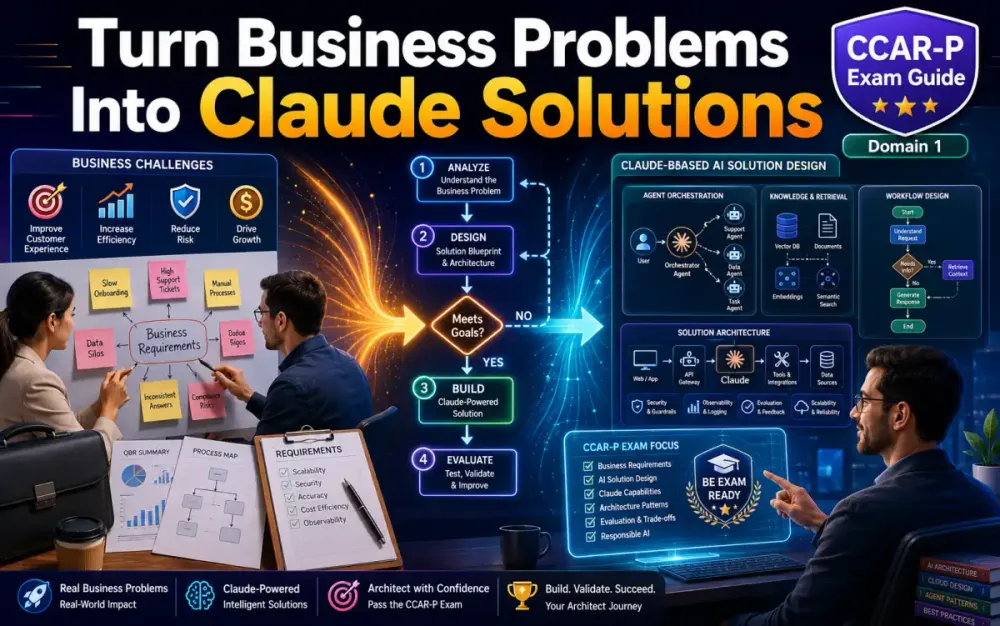
This objective tests whether you can take a real business problem and translate it into an appropriate Claude-based solution.
The exam is unlikely to simply ask:
“What is an agent?”
Instead, you may receive a business scenario describing:
- a problem the organization wants to solve;
- existing processes;
- users and stakeholders;
- performance expectations;
- cost constraints;
- security or compliance requirements;
- a proposed architecture.
You will then need to determine:
- what the actual business requirement is;
- what role Claude should perform;
- whether Claude is even needed for every step;
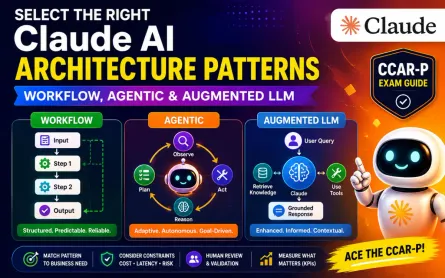
- which architectural pattern best fits;
- which constraints drive that choice;
- whether the proposed solution is over-engineered or under-engineered.
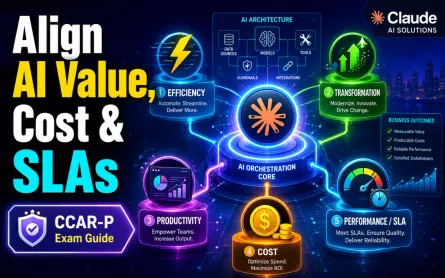
The official CCAR-P blueprint includes this objective under Domain 1: Solution Design & Architecture, which represents 17% of the exam. Candidates are expected to translate business problems into Claude-based solutions and align designs with business value such as efficiency, transformation, productivity, cost, and performance SLAs.
1 The Core Exam Mindset
The most important principle is:
Start with the business problem, not with Claude.
Do not assume that every business requirement needs:
- an agent;
- multiple agents;
- RAG;
- the most powerful model;
- several Claude calls;
- complex orchestration.
The exam often rewards the simplest architecture that satisfies the actual requirement.
Think in this order:
Business Problem
       ↓
Business Outcome
       ↓
Task to be performed
       ↓
Constraints
       ↓
Claude's role
       ↓
Architecture pattern
       ↓
Controls and validation
       ↓
Measurable business result
2 A Simple Framework to Use in the Exam
Use the following five-step framework whenever you see a business scenario.
O-T-C-P-F
O — Outcome
What business result is required?
Examples:
- reduce processing time;
- reduce operating cost;
- increase employee productivity;
- improve customer response time;
- automate repetitive work;
- improve accuracy;
- improve scalability.
T — Task
What work actually needs to happen?
Examples:
- classify;
- extract;
- summarize;
- retrieve information;
- generate a response;
- analyze evidence;
- call tools;
- decide what to investigate next.
C — Constraints
What limits the solution?
Look for:
- latency;
- cost;
- accuracy;
- auditability;
- security;
- compliance;
- throughput;
- human-review requirements;
- data freshness.
P — Pattern
What is the simplest suitable architecture?
Possible answers include:
- single Claude call;
- augmented LLM;
- workflow;
- agent;
- parallel workflow;
- orchestrator-worker or multi-agent architecture.
F — Feedback
How will the organization know the solution is working?
Examples:
- response time;
- task completion rate;
- review time;
- cost per transaction;
- error rate;
- human approval rate;
- customer satisfaction;
- evaluation results.
3 Example: Converting a Business Request into an Architecture
A stakeholder says:
“We want an AI agent for customer support.”
This is not yet a sufficient requirement.
An architect should translate it further.
Business problem
Support representatives spend too much time searching multiple policy documents.
Business outcome
Reduce average ticket handling time by 30%.
Required task
- Understand the customer’s question.
- Find the relevant policy.
- Draft a grounded response.
Constraints
- policies change weekly;
- support representative sends the final reply;
- response should be generated quickly;
- the system must not autonomously issue refunds.
Suitable architecture
Customer Question
       ↓
Retrieve relevant policy
       ↓
Claude generates grounded response
       ↓
Support representative reviews
       ↓
Final response
This is likely an augmented LLM / RAG solution.
A complex autonomous multi-agent system would provide little additional business value.
4 First Identify the Shape of the Task
Architecture selection becomes much easier when you identify the task type.
Type 1 — Simple Transformation
Example:
Classify incoming support emails into one of eight categories.
Email
  ↓
Claude
  ↓
Category
Likely pattern
Single Claude call
Use this when the task is:
- narrow;
- well-defined;
- usually completed in one reasoning step.
5 Knowledge-Grounded Tasks
Example:
Employees need answers based on HR policies that change frequently.
Employee Question
       ↓
Retrieve relevant policies
       ↓
Claude
       ↓
Grounded Answer
Likely pattern
Augmented LLM / RAG
Use this when Claude requires:
- organization-specific knowledge;
- current information;
- a large document corpus;
- authoritative source material.
Exam clue
Look for phrases such as:
- “knowledge changes frequently”;
- “must answer using company documents”;
- “authoritative source”;
- “current policies”;
- “grounded response.”
6 Predictable Multi-Step Tasks
Example:
Process a loan application by extracting fields, validating them, applying established policy rules, and preparing a review packet.
Application
     ↓
Extract Fields
     ↓
Validate
     ↓
Apply Policy Rules
     ↓
Generate Review Packet
Likely pattern
Workflow
Use a workflow when:
- the steps are known;
- the order is known;
- the process should remain consistent;
- success can be verified;
- business rules are well-defined.
The Practitioner Workbook highlights workflow vs. agent as one of the most important Domain 1 distinctions.
7 Dynamic and Open-Ended Tasks
Example:
Investigate why a production application failed.
Claude may need to:
Inspect Logs
      ↓
Discover DB Error
      ↓
Inspect Database Metrics
      ↓
Discover Connection Saturation
      ↓
Inspect Recent Deployment
      ↓
Form Root-Cause Hypothesis
The exact path cannot be predicted before the investigation starts.
Likely pattern
Agent
Use an agent when:
- the next step depends on what Claude discovers;
- the number of steps cannot be predicted;
- Claude must dynamically choose tools;
- the problem is exploratory.
8 The Most Important Exam Distinction: Workflow vs. Agent
This is one of the highest-value concepts for Domain 1.
Ask:
Can the sequence of steps reasonably be determined before execution begins?
If YES
Use a:
Workflow
If NO
And the next action genuinely depends on intermediate findings:
Agent
Remember:
Workflow
Developer controls the path.

Agent
Claude dynamically determines the path.
9 Quick Workflow vs. Agent Comparison
| Requirement | Workflow | Agent |
|---|---|---|
| Steps known beforehand | ✓ | |
| Fixed business process | ✓ | |
| Highly repeatable | ✓ | |
| Easy to validate | ✓ | |
| Next step depends on discoveries | ✓ | |
| Number of steps unknown | ✓ | |
| Tool selection changes dynamically | ✓ | |
| Open-ended investigation | ✓ |
Exam Shortcut
Known path = Workflow Discovered path = Agent
10 Do Not Confuse Tool Use with Agentic Architecture
A common mistake is:
“Claude uses tools, therefore it must be an agent.”
Incorrect.
A workflow can also use tools.
Example:
Invoice
   ↓
Claude extracts values
   ↓
ERP API validates supplier
   ↓
Rule engine checks limits
   ↓
Claude generates explanation
The system uses tools, but the path is predetermined.
It is still a workflow.
11 Augmented LLM vs. Agent
Suppose the requirement says:
Retrieve the relevant product policy and produce one grounded answer.
The solution may simply be:
Question
   ↓
Retrieval
   ↓
Claude
   ↓
Answer
You probably do not need:
Planning Agent
      ↓
Retrieval Agent
      ↓
Reasoning Agent
      ↓
Writer Agent
      ↓
Review Agent
Exam lesson
Do not introduce agentic architecture when:
- the task is straightforward;
- there is no dynamic planning;
- one retrieval/generation cycle solves the requirement.
12 Use the Architecture Complexity Ladder
When reading an exam question, move from the simplest solution upward.
Can one Claude call solve it?
          ↓ No

Does Claude mainly need extra knowledge/tools?
          ↓ Yes

Augmented LLM
          ↓

Are several processing steps required?
          ↓ Yes

Can those steps be defined beforehand?

        Yes              No
         ↓                ↓
     Workflow           Agent
                           ↓
             Are dynamic independent
             subtasks/delegation needed?
                           ↓
                     Multi-Agent
Exam Rule
Increase architectural complexity only when the business problem requires it.
13 Business Constraints Can Decide the Architecture
A business requirement may contain one phrase that eliminates several architectures.
Learn to spot these clues.
| Requirement wording | Architectural implication |
|---|---|
| “same sequence every time” | Workflow |
| “consistent and auditable” | Workflow / deterministic controls |
| “depends on what is discovered” | Agent |
| “cannot predict the required steps” | Agent |
| “current company knowledge” | RAG / augmented LLM |
| “independent analyses” | Parallelization |
| “different known request categories” | Routing |
| “strict latency target” | Reduce sequential model/tool calls |
| “cost is the primary objective” | Avoid unnecessary agents/model calls |
| “must always enforce” | Deterministic control outside the model |
| “repeatedly improve against clear criteria” | Evaluator-optimizer |
14 Business Value Must Drive Architecture
The official blueprint expects solutions to align with business-value pillars such as:
- efficiency;
- transformation;
- productivity;
- cost;
- performance SLAs.
For exam questions, always identify the primary business driver.
Efficiency Example
Business problem:
Customer-service representatives spend too much time researching policies.
Architecture:
Ticket
  ↓
Retrieve Policy
  ↓
Claude Draft
  ↓
Human Review
Measure:
Average handling time
Productivity Example
Business problem:
Analysts spend three hours reviewing large reports.
Architecture:
Report
  ↓
Claude extracts and summarizes
  ↓
Analyst verifies
Measure:
Review time per report
Cost Example
Business problem:
Process millions of straightforward classifications economically.
Good solution:
- simple architecture;
- appropriate model;
- batching where suitable.
Poor solution:
- several agents;
- multiple sequential calls;
- highest-capability model for every stage.
Exam lesson
An architecture may be technically valid but still be wrong because it conflicts with the business objective.
15 Performance and SLA Requirements
Suppose the requirement says:
Response must complete within one second.
Be suspicious of:
Claude
   ↓
Agent
   ↓
Tool
   ↓
Claude
   ↓
Tool
   ↓
Claude
   ↓
Final Response
Every serial step adds latency.
Exam principle
A hard performance SLA can invalidate an otherwise technically capable architecture.
16 Decomposition
Complex business problems should usually be decomposed before selecting the implementation pattern.
Example:
Evaluate whether the company should acquire another business.
This may contain:
Acquisition Analysis
        |
  ┌─────┼─────────┬─────────┐
  ↓     ↓         ↓         ↓
Finance Market   Legal   Cyber Risk
  └─────┼─────────┴─────────┘
        ↓
     Synthesis
The architect should determine for each subtask:
- Does Claude perform it?
- Does it require retrieval?
- Is deterministic code needed?
- Does it require a tool?
- Can it run in parallel?
- Does a human need to validate it?
17 Decomposition Does Not Automatically Mean Multi-Agent
This is another important exam trap.
If the process is:
Extract
   ↓
Classify
   ↓
Summarize
you do not automatically need three agents.
It may simply be one workflow.
Use separate agents only when they provide a meaningful advantage such as:
- different tool access;
- context isolation;
- parallel work;
- specialized capabilities;
- independent verification;
- dynamic task delegation.
18 Fixed vs. Dynamic Decomposition
Fixed Decomposition
You already know the subtasks:
Document
   ↓
Extract
   ↓
Classify
   ↓
Summarize
Likely:
Workflow
Dynamic Decomposition
Claude discovers what work is required.
Example:
Analyze a software repository and implement a requested feature.
Claude may discover:
Database change required
API update required
UI update required
Tests required
Configuration update required
These subtasks were not fully known beforehand.
Potential architecture:
Orchestrator-worker / agentic decomposition
19 Sequential vs. Parallel Execution
Architecture should reflect dependencies.
Sequential
When B needs A’s result:
A → B → C → DRun sequentially.
Parallel
When tasks are independent:
          ┌→ Financial ─────┐
          ├→ Legal ─────────┤
Input ────┼→ Market ────────┼→ Synthesis
          └→ Security ──────┘
Parallel execution may reduce total latency.
Exam clue
Look for:
- “independent”;
- “can be performed simultaneously”;
- “latency is important.”
20 Claude vs. Deterministic Code
Claude should not make every decision.
Good uses of Claude
Use Claude for:
- natural-language understanding;
- extraction from unstructured text;
- summarization;
- synthesis;
- reasoning over ambiguity;
- drafting;
- adaptive tool selection.
Good uses of deterministic code
Prefer code for:
- exact calculations;
- fixed eligibility rules;
- permission checks;
- mandatory restrictions;
- transaction integrity;
- deterministic validations.
Example
Instead of:
Claude
   ↓
Decides regulatory fee
prefer:
Claude extracts attributes
       ↓
Deterministic rule engine
       ↓
Fee calculation
       ↓
Claude explains result
Exam principle
Use Claude for reasoning and language; use deterministic controls for rules that must always hold.
21 Worked Example — Loan Underwriting
Scenario
A lender wants Claude to:
- extract information from applications;
- apply established policy rules;
- generate a decision packet.
Auditors require consistent processing.
Step 1 — Outcome
Increase processing efficiency while retaining consistent auditability.
Step 2 — Task
Extraction + policy processing + explanation.
Step 3 — Constraint
Consistency and auditability.
Step 4 — Pattern
Workflow.
Recommended architecture
Loan Application
       ↓
Claude Field Extraction
       ↓
Schema Validation
       ↓
Deterministic Policy Engine
       ↓
Claude Explanation
       ↓
Human Review
Why not an agent?
The process is already known.
Agent autonomy adds unnecessary variability.
22 Worked Example — Production Incident Investigation
Scenario
Claude must investigate incidents using:
- application logs;
- database metrics;
- deployment history;
- network information.
The next investigation step depends on previous findings.
Analysis
Outcome:
Reduce incident-resolution time.
Task:
Open-ended investigation.
Constraint:
Path cannot be predetermined.
Architecture
Engineer Request
       ↓
Claude Agent
       ↓
Select Diagnostic Tool
       ↓
Review Result
       ↓
Choose Next Action
       ↓
...
       ↓
Root-Cause Hypothesis
       ↓
Engineer Validation
Correct pattern
Agent
23 Worked Example — HR Policy Assistant
Scenario
Employees need answers from company policies that change regularly.
Analysis
Outcome:
Improve employee self-service.
Task:
Retrieve relevant policy and generate answer.
Constraint:
Knowledge must stay current.
Architecture
Employee Question
       ↓
Policy Retrieval
       ↓
Claude
       ↓
Grounded Answer + Source
Correct pattern
Augmented LLM / RAG
Why not agent?
There is no meaningful dynamic planning requirement.
24 Worked Example — Due-Diligence Report
Scenario
A report requires:
- financial analysis;
- legal analysis;
- market analysis;
- cybersecurity analysis.
Each analysis is independent.
Architecture
                 ┌→ Financial ──────┐
                 ├→ Legal ──────────┤
Request ─────────┼→ Market ─────────┼→ Final Synthesis
                 └→ Cybersecurity ──┘
Correct design principle
Parallelize independent work.
Do not execute the tasks sequentially unless dependencies require it.
25 Common Exam Traps
Trap 1 — “Agents are more advanced, therefore better.”
Wrong.
Architecture should be selected based on the business problem.
Trap 2 — “Tool use means agent.”
Wrong.
Workflows can also call tools.
Trap 3 — “Complex problem means multi-agent.”
Wrong.
First decompose the problem.
Trap 4 — “More flexibility is always better.”
Wrong.
Flexibility can increase:
- cost;
- latency;
- variability;
- testing complexity.
Trap 5 — “The most capable model should always be used.”
Wrong.
Model and architecture choices must consider:
- quality;
- cost;
- latency;
- workload complexity.
Trap 6 — Ignoring the stated business metric
If the requirement says:
Reduce processing cost by 40%.
An architecture that significantly increases model calls may be inappropriate even if it improves reasoning quality.
Trap 7 — Using Claude for deterministic rules
If a rule must always hold, use deterministic enforcement.
Do not rely entirely on prompting.
Trap 8 — Solving an architecture problem with prompt engineering
If the system violates a strict latency requirement because it has six sequential calls, rewriting the prompt does not solve the fundamental issue.
26 How to Approach These Questions During the Exam
When you see a long scenario, ask these five questions.
Question 1
What business outcome matters most?
Question 2
What work actually needs to happen?
Question 3
What is the strongest constraint?
Examples:
- latency;
- cost;
- consistency;
- freshness;
- auditability.
Question 4
Is the processing path known beforehand?
YES → Workflow

NO → Consider Agent
Question 5
What is the simplest architecture that satisfies all requirements?
This question can eliminate many attractive distractors.
27 High-Yield Revision Table
| Scenario Signal | Think |
|---|---|
| One simple transformation | Single Claude call |
| Need current/private knowledge | Augmented LLM / RAG |
| Known sequence | Workflow |
| Unknown next step | Agent |
| Known independent subtasks | Parallelization |
| Dynamic unknown subtasks | Orchestrator-worker |
| Strong auditability | More deterministic control |
| Strict latency | Fewer serial calls |
| Cost-sensitive high volume | Simpler architecture / efficient processing |
| Hard business rule | Code / rule engine |
| Poor outputs are not being detected | Feedback/evaluation loop |
28 What to Memorize
You should be able to answer these without notes:
1
What is the most important difference between a workflow and an agent?
Answer: Whether the execution path is predefined or dynamically determined based on intermediate results.
2
When should you use an augmented LLM?
Answer: When Claude needs additional knowledge or capabilities but does not require open-ended autonomous planning.
3
Does decomposition automatically require multiple agents?
Answer: No.
4
When should deterministic code be preferred?
Answer: For hard rules, permissions, calculations, transaction controls, and other requirements that must always hold.
5
What should determine architecture complexity?
Answer: Business requirements and constraints, not technical sophistication.
29 Recommended Exercise 1 — Architecture Triage
For each scenario, write only four things:
Business Outcome:
Task:
Binding Constraint:
Architecture:
Scenario A
A legal department reviews 3,000 supplier contracts every month. Lawyers spend significant time locating unusual clauses. The organization wants to reduce first-pass review effort by 50%. Lawyers remain responsible for final decisions.
Suggested Answer
Business Outcome: Reduce legal review effort by 50%.
Task: Identify and summarize relevant clauses.
Binding Constraint: Final legal judgment remains human.
Architecture: Document-processing workflow using Claude for extraction/analysis with human review.
Scenario B
An operations engineer wants Claude to investigate production incidents. Depending on what logs reveal, Claude may inspect database metrics, deployments, network events, or other systems.
Suggested Answer
Business Outcome: Reduce incident-resolution time.
Task: Investigate evidence across multiple tools.
Binding Constraint: Investigation path cannot be predefined.
Architecture: Agent with controlled diagnostic-tool access.
30 Recommended Exercise 2 — Simplify the Architecture
Consider this design:
Employee Question
       ↓
Coordinator Agent
       ↓
Intent Agent
       ↓
Retrieval Agent
       ↓
Policy Agent
       ↓
Writer Agent
       ↓
Reviewer Agent
       ↓
Answer
Business requirement:
Employees need answers from an HR policy repository. Answers should arrive quickly and policies change weekly.
Your task
Identify which complexity is unnecessary.
Better architecture
Employee Question
       ↓
Retrieve Relevant Policy
       ↓
Claude
       ↓
Grounded Answer + Citation
Reason
The business problem requires fresh knowledge and grounded generation, not autonomous planning.
This exercise is particularly useful because CCAR-P questions frequently include plausible but unnecessarily complex designs.
31 Practice Questions
Question 1
A retailer wants Claude to process return requests. Every request follows the same procedure:
- extract order information;
- verify eligibility against established rules;
- calculate the approved refund;
- prepare a customer response.
The organization requires consistent and auditable processing.
Which architecture is MOST appropriate?
A. Autonomous agent that dynamically chooses every next step B. Multi-agent system with a specialist agent for each stage C. Workflow with predefined steps and deterministic policy enforcement D. Orchestrator-worker architecture
Correct Answer: C
Why?
The process is:
- known;
- predictable;
- sequential;
- easily validated.
That is the workflow pattern.
Why the others are wrong
A: Adds unnecessary autonomy.
B: Adds complexity without a demonstrated need.
D: Dynamic task decomposition is unnecessary because the subtasks are already known.
Exam Takeaway
Known and repeatable process → Workflow.
32 Practice Question 2
A cloud operations team wants Claude to investigate outages. Depending on initial telemetry, Claude may inspect logs, database metrics, deployment history, or network systems. The investigation path cannot be predicted beforehand.
Which architecture is MOST appropriate?
A. Fixed workflow containing every possible diagnostic step B. Single summarization prompt C. Agent that selects diagnostic tools based on intermediate results D. Retrieval-only augmented LLM
Correct Answer: C
Why?
The strongest clue is:
The investigation path cannot be predicted beforehand.
Claude must repeatedly:
Observe
  ↓
Reason
  ↓
Choose Action
  ↓
Observe New Result
That is agentic behavior.
Exam Takeaway
Next step depends on discoveries → Agent.
33 Practice Question 3
A company wants to reduce the cost of processing two million simple product descriptions each month. Each description requires the same one-step classification.
The proposed architecture uses five specialized agents and the most capable model for every step.
What is the PRIMARY problem?
A. Agents cannot perform classification B. Multi-agent architectures cannot support high volume C. The design is unnecessarily complex and conflicts with the cost objective D. Classification requires retrieval
Correct Answer: C
Why?
The business objective is cost reduction.
The task is simple and repeatable.
Multiple agents and unnecessary model calls increase:
- token consumption;
- latency;
- operational complexity.
Exam Takeaway
A technically capable architecture can still be wrong if it does not align with the business objective.
34 Practice Question 4
A healthcare organization builds this solution:
Clinical Notes
      ↓
Claude
      ↓
Structured Summary
      ↓
Doctor
After deployment, inaccurate summaries occasionally reach doctors. The system has no mechanism for measuring these failures or incorporating them into future testing.
What is the MOST important missing architectural component?
A. Another Claude agent B. Feedback and evaluation mechanism C. Larger context window D. MCP integration
Correct Answer: B
Why?
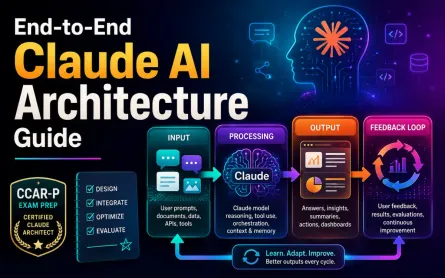
An end-to-end architecture should include:
Input
  ↓
Processing
  ↓
Output
  ↓
Feedback / Evaluation
Without feedback, quality problems may continue without systematic detection or improvement.
Exam Takeaway
Production architecture does not end at output.
35 Practice Question 5
A company uses Claude to prepare due-diligence reports. Every report requires independent:
- financial analysis;
- legal analysis;
- market analysis;
- cybersecurity analysis.
None of the analyses depends on another, and overall response time is important.
Which design is MOST appropriate?
A. Execute the four analyses sequentially B. Execute the independent analyses in parallel and aggregate their results C. Let an autonomous agent randomly determine the execution order D. Combine all sources into one very large prompt
Correct Answer: B
Why?
The tasks are explicitly:
- independent;
- decomposable;
- suitable for simultaneous execution.
Parallel execution reduces overall latency.
Exam Takeaway
Independent subtasks + latency concern → Parallelization.
36 Final Exam-Day Cheat Sheet
Remember this sequence:
BUSINESS PROBLEM
      ↓
What outcome matters?
      ↓
What task must Claude perform?
      ↓
What constraint controls the design?
      ↓
Is the execution path known?
      ↓
Choose simplest suitable pattern
      ↓
Add validation and feedback
And remember these mappings:
Single well-defined task
→ Single Claude call

Needs external/current knowledge
→ Augmented LLM / RAG

Known multi-step process
→ Workflow

Unknown/adaptive process
→ Agent

Known independent subtasks
→ Parallel workflow

Unknown dynamic subtasks
→ Orchestrator-worker / Multi-agent

Mandatory deterministic rule
→ Code / policy engine

Strict latency or cost constraint
→ Reduce unnecessary model calls
The One Rule to Remember
Do not choose the most sophisticated Claude architecture. Choose the simplest architecture that satisfies the business outcome and its constraints.
That is the architectural judgment this CCAR-P objective is primarily testing.