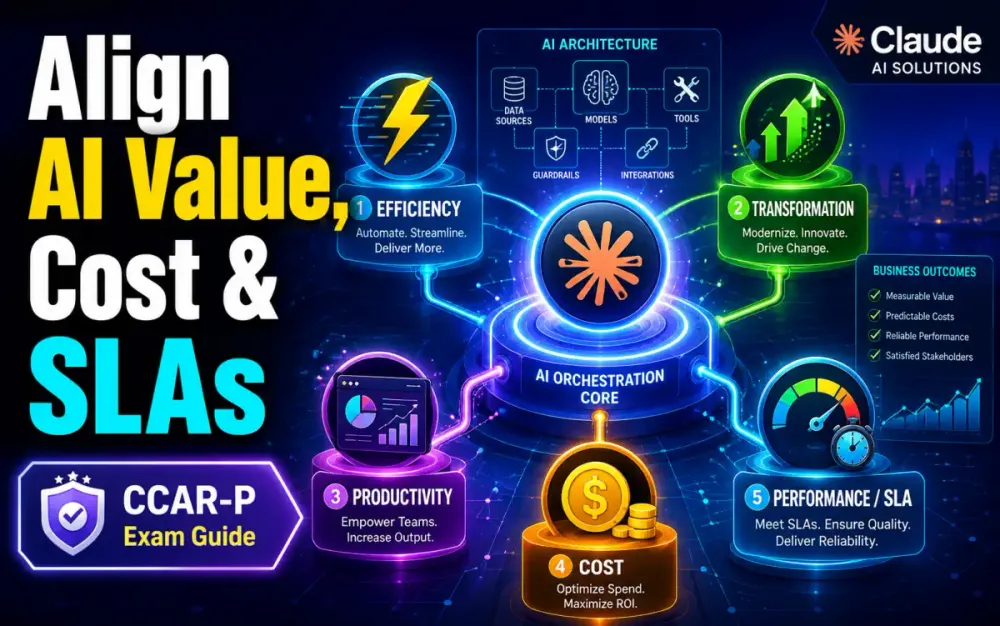
Align Claude Solutions to Business Value Pillars
CCAR-P Domain 1 Exam Guide: Efficiency, Transformation, Productivity, Cost & Performance SLAs
The official Claude Certified Architect – Professional (CCAR-P) blueprint places this topic explicitly under Domain 1: Solution Design & Architecture (17%):
Align solutions to business value pillars: efficiency, transformation, productivity, cost, performance SLAs.
1 What the Exam Is Really Testing
Do not interpret this objective as five independent definitions to memorize.
The exam is much more likely to give you:
Business Goal → Existing/Proposed Architecture → Constraint → Best Architectural Decision
For example:
The company wants to reduce operating cost. The workload is a simple classification task. Every request currently invokes three specialized agents using the most capable model. What is wrong?
The issue is not that multi-agent architecture is “bad.”
The issue is:
The architecture is misaligned with the primary business-value pillar.
Both provided practice exams contain essentially this reasoning pattern: a simple task whose primary goal is cost reduction should not automatically use an expensive multi-agent architecture with the most capable model at every step.
The central exam principle
Architecture exists to deliver measurable business value under constraints—not to maximize AI sophistication.
Anthropic’s current engineering guidance strongly supports this. Anthropic recommends starting with the simplest solution that works and adding agentic complexity only where needed because agentic systems often exchange additional latency and cost for improved task performance.
That single principle connects almost this entire objective.
2 The Five Business Value Pillars
For the exam, think of the pillars like this:
| Pillar | Business Question | Typical KPI | Architecture implication |
|---|---|---|---|
| Efficiency | Can the process use fewer steps/resources? | Cycle time, touches/case, automation rate | Remove unnecessary work and handoffs |
| Transformation | Can AI enable a fundamentally new operating model? | New capability, straight-through processing, service coverage | May justify larger redesign and agentic capability |
| Productivity | Can people accomplish more/better work? | Tasks/user/hour, review time, cases handled | Augment humans; reduce repetitive cognitive work |
| Cost | Can we lower unit economics? | Cost/request, cost/resolved case, monthly run cost | Right-size model, architecture, context, batch/cache |
| Performance / SLA | Can the service consistently meet required responsiveness/reliability? | p95 latency, throughput, availability, timeout/error rate | Architecture becomes constrained by measurable NFRs |
A critical distinction:
Efficiency, productivity, and cost are related—but not interchangeable.
You need to recognize which one the scenario actually prioritizes.
3 Pillar 1 — Efficiency
What efficiency means
Efficiency is about completing the same business outcome with less process friction.
Think:
- fewer manual steps,
- fewer handoffs,
- less duplicate work,
- shorter process duration,
- fewer unnecessary model/tool calls,
- less rework,
- higher straight-through-processing rate.
Example
Current process
Customer refund request:
Customer request
      ↓
Agent reads email
      ↓
Agent opens CRM
      ↓
Agent searches return policy
      ↓
Agent checks order
      ↓
Agent drafts response
      ↓
Supervisor reviews
      ↓
Response sent
Suppose Claude can:
- classify the request,
- retrieve the applicable return policy,
- retrieve order information,
- prepare the response and evidence,
- present it to the employee for approval.
The business value is primarily:
Process efficiency.
The goal isn’t necessarily “replace customer-support agents.”
It is:
Reduce unnecessary work required to complete each case.
Efficiency metrics
Potential measures include:
- average handling time,
- number of manual process steps,
- number of systems the employee must manually visit,
- percentage of cases automatically prepared,
- rework rate,
- queue time,
- time-to-resolution.
Before
12 minutes / case
7 manual actions
3 applications opened
After
5 minutes / case
2 manual actions
1 consolidated review
That is demonstrable efficiency value.
Architecture implications
If efficiency is the primary value pillar, ask:
What complexity can be removed?
Common answers:
- replace unnecessary agents with workflows,
- parallelize independent operations,
- automate repetitive retrieval,
- use structured outputs to eliminate parsing/reformatting,
- connect directly to authoritative systems,
- remove duplicate LLM calls,
- cache repeated context,
- automate validation where deterministic checks exist.
Exam trap
“Add more specialized agents so every activity has an AI expert.”
Not automatically.
More agents may increase:
- coordination,
- latency,
- token consumption,
- failure surface,
- debugging complexity.
Anthropic explicitly warns against unnecessary complexity and notes that many applications can be adequately addressed with a single LLM call enhanced with retrieval or examples.
Remember
Efficiency ≠ maximum automation.
Removing human review from a high-risk decision might make a process faster while making the overall solution unacceptable.
4 Pillar 2 — Transformation
Transformation is the easiest pillar to misunderstand.
Transformation ≠ making an existing process slightly faster
Efficiency asks:
“How can we perform this existing process better?”
Transformation asks:
“What operating capability becomes possible because Claude is available?”
Example: Support knowledge
Efficiency use case
Existing help-desk analyst:
Search knowledge base
→ read several articles
→ write response
Claude:
Retrieve relevant articles
→ synthesize response
→ analyst approves
That’s mainly efficiency/productivity.
Transformation use case
Claude becomes an enterprise support layer capable of:
Understand request
      ↓
Identify product + tenant + issue
      ↓
Retrieve customer-specific configuration
      ↓
Inspect operational telemetry
      ↓
Run approved diagnostics
      ↓
Generate probable root cause
      ↓
Recommend remediation
      ↓
Route unusual cases to specialist
Now the organization has a capability that did not meaningfully exist before.
That is closer to business transformation.
5 Transformation Often Justifies More Architectural Complexity
This is where you should not blindly apply:
“Always choose the simplest workflow.”
Instead:
Choose the simplest architecture capable of delivering the required business capability.
Suppose an enterprise wants an AI research analyst that can:
- dynamically determine what information is needed,
- search several systems,
- change direction based on findings,
- compare conflicting information,
- perform additional investigation,
- synthesize conclusions.
A simple fixed workflow may not deliver the transformative capability.
An agent could be justified because the required value depends on adaptive decision-making.
Anthropic distinguishes workflows—predefined code paths—from agents, where the LLM dynamically directs its own process and tool usage. Agents are appropriate when flexibility and model-driven decision-making are genuinely required.
6 Transformation Exam Trap
Imagine:
The CIO wants an “AI transformation initiative,” so the architecture team proposes multiple autonomous agents for every business process.
Wrong reasoning.
Transformation is a business outcome, not an architecture pattern.
Agentic ≠ transformative.
Multi-agent ≠ transformative.
A transformation initiative could technically be built from:
- single calls,
- workflows,
- RAG,
- agents,
- or combinations.
The architecture follows the capability required.
7 Pillar 3 — Productivity
Productivity is human output amplification
Productivity usually asks:
Can people accomplish more valuable work within the same amount of time?
This is particularly relevant to Claude because many business scenarios retain people as accountable reviewers.
Examples:
- software developers generate tests faster,
- analysts review documents faster,
- lawyers obtain first-pass contract analysis,
- customer-support staff receive draft responses,
- clinicians receive draft documentation,
- architects generate design alternatives,
- compliance staff receive summarized evidence.
8 Productivity vs Efficiency
This distinction is worth knowing for exam questions.
Efficiency
Process-centric:
Reduce steps required to complete a support ticket.
Productivity
Worker-centric:
Increase tickets handled per support analyst.
They may result from the same technical capability, but the business metric differs.
Example: Clinical documentation
Business problem:
Doctors spend significant time converting clinical notes into structured documentation.
Possible Claude solution:
Clinical notes / transcript
            ↓
      Claude extraction
            ↓
 Structured draft record
            ↓
 Rule-based validation
            ↓
 Clinician review
            ↓
 Approved documentation
The productivity goal could be:
Current:
18 minutes documentation / encounter

Target:
10 minutes / encounter

Business KPI:
44% reduction in documentation effort
The model output quality is a technical success measure.
The reduction in clinician documentation time is the business success measure.
That distinction is extremely important.
9 The “Model Metric vs Business Metric” Trap
Suppose the system achieves:
- 96% extraction accuracy,
- 1.4-second latency,
- excellent grounding.
Has the project delivered business value?
Not necessarily.
If users still spend the same amount of time reviewing and correcting results, the productivity objective has not been met.
You need both:
TECHNICAL SUCCESS
Accuracy
Latency
Groundedness
Reliability
Cost

        ↓ enables

BUSINESS SUCCESS
Review time ↓
Cases handled ↑
Resolution time ↓
Cost/case ↓
Customer satisfaction ↑
The practice exams explicitly test this concept: when the stated goal is “reduce manual review time by 40%,” good architecture connects design choices to that measurable outcome and makes it possible to evaluate whether the result actually improved the metric.
10 Pillar 4 — Cost
Cost is one of the highest-yield areas because it intersects:
- Domain 1 architecture,
- Domain 2 model selection/context,
- Domain 3 integration,
- Domain 4 optimization,
- Domain 6 stakeholder trade-offs.
11 Think in Cost per Business Outcome
A weak design optimizes:
cost per API call
A stronger architect optimizes:
cost per completed business task
For example:
Model A
$0.008 / call
Average 3 calls / successful task

Task cost ≈ $0.024
Model B
$0.015 / call
Average 1 call / successful task

Task cost ≈ $0.015
The apparently cheaper model is actually more expensive.
The practitioner workbook specifically emphasizes measuring evaluation and economics at the unit the business cares about—such as a resolved ticket or completed task, not an isolated LLM request.
12 Architecture-Level Cost Levers
12.1 Choose the appropriate architectural pattern
A task that can be completed using:
Input → Claude → Outputshould not automatically become:
Input
 ↓
Coordinator
 ↓
Planner
 ↓
Research Agent
 ↓
Validation Agent
 ↓
Reviewer Agent
 ↓
Coordinator
 ↓
Output
Each added stage may introduce:
- tokens,
- inference requests,
- context,
- latency,
- infrastructure,
- engineering effort.
The practice exams specifically include a scenario where a simple task with a cost-reduction objective is wrongly implemented using multi-agent architecture and the strongest model at every step.
13 Model Selection Is a Business Decision
Current Anthropic guidance frames model selection around a balance of:
- capability,
- speed,
- cost,
and, on supported models, reasoning effort can also be adjusted to trade intelligence for latency/cost. Anthropic recommends efficiency-first approaches for high-volume, straightforward, cost-sensitive, or latency-sensitive workloads, while capability-first approaches are appropriate where task complexity and accuracy justify them.
For exam purposes, avoid memorizing individual model names.
Memorize the reasoning:
Task complexity
      +
Quality requirement
      +
Latency requirement
      +
Volume
      +
Cost budget
      ↓
 Appropriate model / effort
14 Other Important Cost Levers
Prompt caching
If substantial prompt content repeats across calls, prompt caching can reduce processing cost and latency. Anthropic currently describes it specifically as an optimization for repetitive prompts and repeated context.
Batch processing
When nobody is waiting synchronously:
Real-time API calls
       ↓
     maybe wrong

Batch processing
       ↓
 potentially better
Think:
- overnight enrichment,
- large-scale classification,
- offline summarization.
Context discipline
Don’t repeatedly send unnecessary:
- huge histories,
- irrelevant documents,
- stale tool results.
Routing
Simple requests → efficient model/path

Complex requests → capable model/path

High-risk requests → verification / escalation
Parallelization
Independent steps can sometimes execute concurrently rather than serially.
But remember:
Parallelization mainly helps elapsed time, not necessarily total token cost.
15 Pillar 5 — Performance SLAs
This is perhaps the most architect-like part of the objective.
A vague requirement:
“The assistant must be fast.”
is not architecturally actionable.
A usable requirement:
“95% of interactive requests must return a completed response within 2 seconds.”
is.
16 SLA vs KPI vs SLO — Exam-Friendly Understanding
You probably don’t need standards-level definitions for the exam, but understand the conceptual separation.
KPI
Measures business or system performance.
Example:
Average customer ticket handling time.
SLO
A target level for a service metric.
Example:
p95 end-to-end latency < 2 seconds.
SLA
A formal service commitment, often tied to operational/business expectations or contractual obligations.
Example:
99.9% monthly availability.
The official blueprint explicitly ties this Domain 1 objective to performance SLAs, and Domain 6 separately expects candidates to manage stakeholder feedback and expectation alignment including SLAs.
17 Key Performance Metrics to Know
Latency
Do not think only in averages.
Suppose:
Average latency = 900 msSounds excellent.
But:
p95 latency = 6.8 secCustomer experience may be unacceptable.
For interactive AI systems, examine:
- p50,
- p95,
- sometimes p99,
- time to first token,
- total response completion time.
Anthropic’s current latency guidance specifically distinguishes overall response latency from time to first token (TTFT) and recommends considering model choice, prompt/output length, and streaming when reducing user-visible latency.
18 Why p95 Appears in Practice Questions
One of the supplied practice exams uses:
p95 latency under 500 ms
while the other uses:
p95 latency under 1 second
Both pair the SLA with a sequential multi-agent architecture containing several coordinator round trips.
The expected diagnosis is:
The architecture itself may be incompatible with the SLA; simplify the pattern or reduce/parallelize serial round trips.
This is highly representative of the reasoning you should master.
19 Why Sequential Agent Architecture Hurts Latency
Consider:
User
 ↓
Coordinator      600 ms
 ↓
Agent A          900 ms
 ↓
Coordinator      500 ms
 ↓
Agent B         1000 ms
 ↓
Coordinator      500 ms
 ↓
Final answer     700 ms
Very roughly:
Total ≈ 4.2 secondsIf the SLA is:
p95 < 1 secondprompt tuning alone probably won’t fix the architectural mismatch.
The correct exam reasoning is:
An NFR can invalidate an architecture pattern.
This is also consistent with Anthropic’s observation that agentic complexity may exchange latency and cost for better task performance.
20 Throughput
Latency asks:
How long does one request take?
Throughput asks:
How many requests can we successfully process within a time period?
Example:
Peak volume: 1,000 req/sec
Average volume: 100 req/sec
The peak often matters more architecturally.
Potential consequences:
- queueing,
- backpressure,
- concurrency control,
- rate-limit management,
- batching,
- capacity headroom,
- load shedding,
- asynchronous processing.
21 Availability
Example requirement:
Customer-support assistant must achieve 99.9% service availability.
The architecture must answer:
What happens when Claude/API fails?
What happens when retrieval fails?
What happens when CRM is unavailable?
What happens when one tool times out?
Potential designs:
Primary Claude path
      ↓ failure
Retry/backoff
      ↓ failure
Degraded capability
      ↓
Clearly tell user what cannot be completed
Not:
Dependency fails
      ↓
Application silently hangs
22 Performance SLA Is End-to-End
This is another likely exam trap.
Suppose Claude responds in:
700 msbut:
Authentication     100 ms
Retrieval          500 ms
Claude             700 ms
Tool call          900 ms
Validation         300 ms
Network/UI         200 ms
-------------------------
Total             2700 ms
If the customer SLA is:
2 seconds end-to-end
the solution fails.
It does not matter that “Claude itself responded in 700 ms.”
Exam rule
Business SLAs apply to the service the user experiences, not merely the model API call.
23 Business Value Is Usually Multi-Dimensional
Real scenarios rarely have only one objective.
Example:
Reduce customer-support costs by 25%, maintain 95% response quality, and keep p95 response latency below 3 seconds.
Now the architecture must balance:
                 QUALITY
                    ▲
                    │
                    │
 COST ◄─────────────┼────────────► PERFORMANCE
Changing one can move others.
Examples:
Larger/more capable model
Potentially:
Quality ↑
Cost ↑
Latency ↑
Smaller/faster model
Potentially:
Cost ↓
Latency ↓
Quality ? ↓
More verification calls
Potentially:
Quality ↑
Cost ↑
Latency ↑
Caching repeated context
Potentially:
Cost ↓
Latency ↓
Quality ≈
Parallel independent tasks
Potentially:
Latency ↓
Cost ≈
Complexity ↑
The architect’s job is not to optimize every dimension simultaneously.
It is to identify the priority and boundaries.
24 Hard Constraint vs Optimization Goal
This distinction is extremely important.
Consider:
Reduce operating cost by 20%, but every request must complete in less than 2 seconds at p95.
Here:
Goal
Cost ↓ 20%Hard constraint
p95 latency < 2 secIf a cost optimization breaks the SLA, it is not acceptable.
25 Use the “Primary Pillar + Guardrails” Method
When reading an exam question, translate it into:
PRIMARY VALUE
What are we trying to improve?

+

NON-NEGOTIABLE CONSTRAINTS
What must not deteriorate beyond limits?
Example:
Primary:
Reduce processing cost 30%

Guardrails:
Accuracy ≥ 95%
p95 latency ≤ 2 sec
No increase in escalation rate
This is much more useful than treating cost, performance, and quality equally without prioritization.
26 The CCAR-P Value Alignment Chain
This is the framework I recommend memorizing.
1. BUSINESS PROBLEM
        ↓
2. VALUE PILLAR
        ↓
3. BUSINESS KPI
        ↓
4. CONSTRAINTS / SLA
        ↓
5. ARCHITECTURE
        ↓
6. TECHNICAL METRICS
        ↓
7. EVALUATION
        ↓
8. BUSINESS OUTCOME
Example
BUSINESS PROBLEM
Support costs are increasing.

        ↓

VALUE PILLAR
Cost + Productivity

        ↓

BUSINESS KPI
Reduce cost/resolved case by 25%

        ↓

CONSTRAINTS
Quality ≥ 95%
p95 response < 3 sec

        ↓

ARCHITECTURE
Classification
→ Retrieval
→ Claude response draft
→ Human review for selected cases

        ↓

TECHNICAL METRICS
Accuracy
Latency
Tokens/request
Escalation rate

        ↓

EVALUATION
Pilot + production monitoring

        ↓

BUSINESS OUTCOME
Cost/resolved case -27%
Handling time -32%
Quality unchanged
That is the type of end-to-end reasoning expected from a professional architect.
27 Technical Metric Must Trace Back to Business Value
A useful mapping:
| Business value | Business KPI | Supporting technical measure |
|---|---|---|
| Efficiency | processing time/case | latency, tool-call count |
| Efficiency | automation rate | task success rate |
| Transformation | new service capability | end-to-end autonomous task success |
| Productivity | cases/user/day | completion rate, review effort |
| Productivity | review time | output accuracy, acceptance rate |
| Cost | cost/resolved task | tokens, model usage, retries |
| Cost | monthly inference spend | request volume × unit cost |
| SLA | p95 < 2 sec | stage-level latency |
| SLA | availability | dependency/error/fallback rate |
| SLA | throughput | requests/sec, queue depth |
The official Claude ticket-routing guidance follows this same basic idea: first establish success criteria and thresholds, then evaluate output on relevant dimensions such as accuracy, cost and response time instead of simply asking whether the prompt “looks good.”
28 The Most Important Architecture Decisions by Pillar
| Primary pillar | Likely design emphasis |
|---|---|
| Efficiency | remove unnecessary stages; automate repetitive work |
| Transformation | enable genuinely new capabilities; agentic design may be justified |
| Productivity | human augmentation, high acceptance rate, low review burden |
| Cost | model right-sizing, fewer calls, caching, batching, routing |
| Performance SLA | minimize serial calls, faster path, parallelize, stream, degrade gracefully |
But this is not a rigid mapping.
Always ask:
What architecture best achieves the stated outcome within the constraints?
29 A Worked Scenario
Business request
A retail organization says:
“We want Claude to improve our returns operation.”
Too vague.
Step 1 — Discover the actual value
After discovery:
Average returns processing takes 12 minutes. Target: reduce human handling to 5 minutes.
Primary pillar:
Productivity + efficiency
Step 2 — Capture guardrails
Requirements:
Policy compliance ≥ 98%
p95 first response ≤ 2 sec
Cost ≤ $0.03 / request
Human approval required for refund > $200
Step 3 — Architecture
Could be:
Customer Request
      ↓
Fast Classification
      ↓
Retrieve Return Policy
      ↓
Retrieve Order
      ↓
Claude drafts recommended action
      ↓
Programmatic policy checks
      ↓
 ┌───────────────────────┐
 │ Refund <= $200        │──→ approved workflow
 └───────────────────────┘
            │
            │ > $200
            ▼
      Human Approval
            ↓
          Action
Notice:
A fully autonomous agent is not automatically needed.
Step 4 — Measurements
Business metrics
- handling time,
- agent cases/hour,
- cost/resolved return.
AI/system metrics
- classification accuracy,
- policy grounding,
- p95 latency,
- cost/request,
- escalation rate.
Step 5 — Validate business value
Suppose pilot results:
Handling time:
12 min → 6 min

Cost:
$0.024/request

Accuracy:
98.6%

p95:
1.7 sec
Strong result.
But if:
Handling time:
12 min → 11 min
then even if model accuracy is 99%, the productivity objective has largely failed.
30 Architecture Value Scorecard
For exam scenarios, mentally construct something like this:
| Dimension | Target | Proposed design | Decision |
|---|---|---|---|
| Business handling time | -40% | -45% | ✅ |
| Accuracy | ≥95% | 97% | ✅ |
| p95 latency | ≤2 sec | 4.8 sec | ❌ |
| Cost/task | ≤$0.05 | $0.03 | ✅ |
| Availability | ≥99.9% | TBD | ⚠️ |
The architecture is not acceptable because one hard SLA is violated.
Do not average the columns and say four out of five are good.
31 Architecture Choices Should Have a “Why”
Weak architecture statement:
“Use Sonnet with RAG and an agent.”
Better:
“Use retrieval because responses must reflect frequently changing policy documents.”
Better:
“Use a constrained workflow rather than an autonomous agent because the process is known in advance and the 2-second p95 SLA makes multiple sequential reasoning/tool loops undesirable.”
Best:
“Use a constrained retrieval workflow because it satisfies the policy-grounding requirement while minimizing serial inference steps. We reject a multi-agent design because its additional coordination does not create enough business value to justify the cost and latency impact.”
That’s architect-level reasoning.
32 High-Yield CCAR-P Exam Traps
Trap 1 — “Most capable model = best architecture”
No.
Ask whether the task needs that capability.
Anthropic currently recommends explicitly balancing capability, speed, and cost rather than defaulting to the strongest model.
Trap 2 — “Multi-agent = enterprise-grade”
No.
Multi-agent is justified by actual:
- isolation,
- specialization,
- parallelism,
- independent reasoning/verification,
- context management requirements.
Not organizational prestige.
Trap 3 — Optimizing cost per call
Instead evaluate:
cost per successful/resolved business task.
Retries, escalations and human rework count.
Trap 4 — Average latency satisfies SLA
SLA may specify:
p95 latency.
Average cannot prove compliance.
Trap 5 — Optimize model when architecture violates SLA
Example:
5 sequential agents
p95 requirement = 1 sec
A prompt optimization may not solve the structural problem.
Evaluate:
- number of serial calls,
- orchestration,
- retrieval hops,
- tool calls.
Trap 6 — Technical accuracy = business success
No.
A 99%-accurate system that produces zero reduction in employee workload may fail a productivity initiative.
Trap 7 — Every pillar must be optimized simultaneously
Usually impossible.
Prioritize:
Primary business objective
+
Minimum acceptable guardrails
Trap 8 — Transformation means autonomy
False.
Transformation concerns business capability, not agent autonomy.
Trap 9 — Efficiency means removing humans
False.
Human review may remain while the surrounding work is drastically reduced.
Trap 10 — “Fast model” guarantees SLA
No.
End-to-end latency includes:
UI
+
network
+
authentication
+
retrieval
+
model
+
tools
+
validation
+
orchestration
33 Five Signals to Look for in Exam Stems
Signal 1: “Primary driver”
“The primary business driver is cost reduction…”
Immediately prioritize cost.
Signal 2: Numeric goal
“Reduce manual review time by 40%.”
Look for a solution that can be evaluated against that exact outcome.
Both practice exams explicitly use this pattern.
Signal 3: SLA
“p95 < 1 second.”
Treat it as an architecture constraint.
Signal 4: Scale
“2 million requests per day.”
Think:
- unit economics,
- throughput,
- caching,
- batching,
- model routing.
A tiny cost difference becomes enormous at scale.
Signal 5: “New capability”
“Today this process cannot be performed because…”
Potential transformation signal.
34 A Fast Exam Decision Framework
When you encounter a business-value question, use:
V-MATCH
V — Value
What value pillar is primary?
Efficiency?
Transformation?
Productivity?
Cost?
Performance?
M — Metric
What measurable business outcome proves success?
A — Architecture
Which pattern delivers the capability?
T — Trade-offs
What do we gain and what gets worse?
C — Constraints
Which SLA/NFR cannot be violated?
H — How measured
How will we prove the business outcome and system quality?
35 Example Using V-MATCH
Scenario:
An organization handles 500,000 straightforward classifications per day. Leadership wants a 40% reduction in processing cost while keeping accuracy above 95%.
V
Cost.
M
Cost/classification ↓40%.
A
Simple classification call/workflow rather than multi-agent.
T
Cheaper/faster model may reduce quality.
C
Accuracy ≥95%.
H
Compare:
Accuracy
Cost/classification
Latency
Retries
Escalation rate
Then choose the least expensive option satisfying the quality floor.
36 Business Value and Architecture Pattern Mapping
This should be understood—not memorized blindly.
Simple predictable task
+
Cost / efficiency priority
        ↓
Single call / workflow often wins
Knowledge grounding
+
Productivity priority
↓
Augmented LLM / RAGDynamic investigative task
+
Transformative capability required
↓
Agent may be justifiedIndependent complex specialties
+
Parallelism / isolation required
↓
Multi-agent may be justifiedVery strict latency SLA
↓
Minimize sequential reasoning/tool hops37 Cross-Domain Connections You Should Recognize
This Domain 1 objective connects strongly with the rest of CCAR-P.
Domain 2 — Models
Business value tells you how much capability/cost/latency you can afford.
Domain 3 — Integration
Tool calls, retrieval, network round trips and permissions affect:
- cost,
- latency,
- reliability.
Domain 4 — Evaluation
The official blueprint expects evaluation metrics spanning accuracy, latency, cost, safety and security, plus optimization of token use and cost-performance trade-offs.
Domain 1 asks:
What value are we designing for?
Domain 4 asks:
How do we prove we achieved it safely?
Domain 6 — Stakeholders
The business value must be communicated using:
- SLA impact,
- business outcomes,
- budget,
- user experience,
- risks.
The practitioner workbook emphasizes explaining technical trade-offs in terms the stakeholder owns rather than presenting raw architecture jargon.
38 What to Memorize for the Exam
Rule 1
Start with the business outcome, not the AI pattern.
Rule 2
Every important business value should become a measurable KPI.
Rule 3
Separate optimization goals from hard constraints.
Rule 4
Measure cost per successful business outcome—not just per LLM call.
Rule 5
Performance SLAs are end-to-end.
Rule 6
p95/p99 can matter more than average latency.
Rule 7
Agentic complexity must justify its latency/cost overhead.
Rule 8
Productivity value frequently means human augmentation, not human removal.
Rule 9
Transformation is a new business capability—not “use more agents.”
Rule 10
A technically excellent system can still be a business failure.
39 Exam Shortcut Table
| If the stem says… | Think… |
|---|---|
| “reduce manual steps” | Efficiency |
| “reduce handling time” | Efficiency/Productivity |
| “employees should handle more cases” | Productivity |
| “create a capability we cannot perform today” | Transformation |
| “reduce cost by 30%” | Cost |
| “millions of requests” | Unit economics |
| “p95 < 1 second” | Binding latency SLA |
| “99.9% availability” | Reliability/availability architecture |
| “simple well-defined task + multi-agent” | Likely over-engineering |
| “most capable model everywhere” | Cost/latency misalignment unless justified |
| “accuracy is excellent but users save no time” | Technical success, business failure |
| “average latency meets SLA” | Check whether SLA is percentile-based |
| “optimize everything” | Identify priority + guardrails |
40 Two Better Exercises for This Topic
Instead of a generic build exercise, these are more directly aligned with CCAR-P architectural judgment.
Exercise 1 — Value-to-Architecture Decision
Scenario
A company processes 50,000 customer-support requests per day.
Current baseline:
Average handling time:     8 minutes
Cost/resolved ticket:      $6.20
p95 first response:        5 minutes
Escalation rate:           18%
Business wants:
Handling time:             -40%
Cost/resolved ticket:      -25%
Customer-facing AI p95:    <3 seconds
Accuracy:                  ≥95%
Three options:
Option A
One strong model with RAG.
Option B
Three-agent system:
Classifier
→ Research Agent
→ Response Agent
Option C
Hybrid:
Fast classifier
→ retrieval
→ Claude draft
→ escalate complex minority
Your task
For each architecture:
- identify the business pillars served,
- estimate likely cost/latency implications,
- identify the binding SLA,
- select the best option,
- state one trade-off accepted,
- define three business KPIs,
- define three technical metrics.
Expected reasoning
Option C will often provide the strongest alignment because routine cases receive an efficient path while expensive reasoning is reserved for harder cases.
But the point is not memorizing C.
The point is defending the selection against:
Value
+
SLA
+
Cost
+
Quality
41 Exercise 2 — Fix the Misaligned Architecture
Scenario
A finance organization has designed:
User
 ↓
Coordinator Agent
 ↓
Intent Agent
 ↓
Retriever Agent
 ↓
Policy Agent
 ↓
Reasoning Agent
 ↓
Reviewer Agent
 ↓
Coordinator
 ↓
Response
Business requirements:
Task: answer routine employee policy questions
Corpus: controlled policy documents
p95 SLA: 1.5 sec
Volume: 1 million queries/month
Cost target: <$0.02/query
Human escalation needed only for unresolved questions
Your task
Redesign it.
A reasonable answer might become:
User Question
      ↓
Lightweight Routing
      ↓
Permission-Aware Retrieval
      ↓
Claude grounded answer
      ↓
Citation / structured validation
      ↓
 ┌───────────────┐
 │ Answer found? │
 └───────┬───────┘
       Yes│No
          │
     Answer   Escalate
Then justify every removed agent using:
- cost,
- latency,
- business benefit,
- maintainability.
This mirrors exactly the style of reasoning encouraged by both the official blueprint and the supplied practice exams.
42 Five CCAR-P-Style Practice Questions
These are new study questions, not official exam items.
Question 1 — Cost Alignment
A healthcare organization introduces a Claude-based coding assistant for a highly standardized classification task. The business objective is to reduce processing cost by 35% while maintaining current accuracy. The proposed architecture uses a coordinator plus four specialized agents, all running the highest-capability model.
What should the architect recommend?
A. Keep the architecture because multiple agents always improve enterprise reliability. B. Add additional agents so each classification category has its own specialist. C. Evaluate a simpler single-call or workflow architecture using the least expensive model configuration that still meets the required accuracy threshold. D. Ignore model and architecture cost because productivity improvements will automatically compensate.
Correct answer: C
Why?
The primary business pillar is cost.
The task is also:
- standardized,
- predictable,
- easy to evaluate.
Therefore unnecessary agent orchestration works directly against the stated goal.
The exam wants:
Architecture aligned with the business objective—not maximum architectural sophistication.
Anthropic likewise recommends starting with simpler solutions and increasing complexity only when required.
Why the others are wrong
A: Multi-agent architecture is not inherently more reliable.
B: Adds more coordination cost without evidence of business value.
D: Architecture cost is explicitly part of professional Claude solution design.
Exam clue
“Primary objective = reduce cost” + “simple standardized task.”
Think:
simplify.
43 Question 2 — SLA Constraint
A customer-facing assistant has the following requirement:
95% of requests must complete within 2 seconds.
The solution currently performs four Claude calls sequentially:
Classify → Retrieve/Reason → Verify → RewriteEach step individually performs well, but end-to-end p95 latency is 4.7 seconds.
What is the BEST architectural response?
A. Accept the solution because each individual service is fast. B. Increase the context window to improve output quality. C. Redesign the critical path by eliminating unnecessary serial model calls and parallelizing independent operations where appropriate. D. Measure average latency instead because it will normally be lower than p95.
Correct answer: C
Why?
The SLA is end-to-end p95, not per component.
The architecture violates the business constraint.
You must change the critical path.
Potential options:
- combine stages,
- use programmatic validation,
- parallelize independent work,
- reduce model calls,
- choose a faster appropriate model.
Anthropic’s latency guidance similarly identifies model choice, prompt/output size, and response delivery strategy as practical latency levers.
Why D is particularly dangerous
Changing the measurement does not fix the SLA violation.
Exam clue
“p95 target” + “many serial calls.”
Think:
architecture-level latency problem.
44 Question 3 — Productivity vs Technical Metrics
A legal-document assistant achieves 98% extraction accuracy and meets all latency targets. However, attorneys spend almost the same amount of time reviewing each contract as before deployment.
The project was funded primarily to improve attorney productivity.
What should the architect conclude?
A. The project is successful because model accuracy exceeds 95%. B. Increase the model size even though accuracy already exceeds the target. C. The technical system is performing well, but the business-value objective has not yet been demonstrated; measure and address attorney review time and workflow friction. D. Remove attorney review entirely.
Correct answer: C
Why?
The primary business KPI is productivity.
Technical quality is an enabler, not the ultimate business outcome.
You must measure:
review time
acceptance rate
rework
documents/user/day
not merely model accuracy.
This is precisely the logic used in the practice exam scenario connecting architecture to a measurable reduction in manual review time.
45 Question 4 — Transformation
A logistics company wants Claude to investigate shipment disruptions. The correct investigation path varies based on what the system discovers: it may inspect warehouse status, weather data, carrier records, inventory, or customer commitments, and additional investigation frequently depends on intermediate findings.
The goal is to create a decision-support capability that the existing fixed process cannot provide.
Which architecture is most aligned?
A. A rigid single fixed sequence regardless of the incident. B. An agentic architecture with carefully scoped tools, because dynamic investigation is central to the transformative capability. C. A five-agent system solely because transformation projects should use multi-agent architectures. D. A single static prompt containing every possible logistics condition.
Correct answer: B
Why?
The transformative value depends on:
adaptive investigation based on what is discovered.
That’s a legitimate agent signal.
Anthropic describes agents as systems where the LLM dynamically directs its process/tool usage, in contrast with predefined workflows.
Why C is wrong
Transformation does not automatically imply multi-agent.
You still choose the minimum sufficient complexity.
46 Question 5 — Multi-Objective Trade-off
A B2B reporting assistant currently uses a highly capable model for all requests.
Business requirements:
- reduce cost per completed report by 30%,
- p95 completion time below 8 seconds,
- maintain at least 97% acceptance without manual rewrite.
Testing shows:
| Option | Acceptance | p95 | Cost/report |
|---|---|---|---|
| A | 99% | 10.5 sec | $0.22 |
| B | 97.5% | 6.5 sec | $0.14 |
| C | 94% | 4.0 sec | $0.09 |
| D | 99.5% | 14 sec | $0.35 |
Current cost/report is $0.20.
Which option best aligns to the requirements?
A. Option A B. Option B C. Option C D. Option D
Correct answer: B
Work through every constraint
Required cost reduction:
Current = $0.20
30% reduction = $0.06

Maximum acceptable:
$0.20 - $0.06 = $0.14
Option B:
Cost = $0.14 ✅
p95 = 6.5 sec ✅
Acceptance = 97.5% ✅
Option A:
Acceptance ✅
Cost ❌
Latency ❌
Option C:
Cost ✅
Latency ✅
Acceptance ❌
Option D:
Acceptance ✅
Cost ❌
Latency ❌
Exam lesson
The “best model” is the cheapest/simplest architecture that satisfies all required business and technical thresholds—not the one with the highest quality score.
Anthropic’s current model guidance similarly recommends balancing capability, speed, and cost against workload requirements.
47 The Exam Pattern Revealed by Your Practice Exams
Both practice exams are remarkably consistent on this objective.
They test three related ideas.
Pattern A — Value-pillar mismatch
Primary goal = Cost
Simple task
+
Expensive multi-agent architecture
        ↓
Misaligned / over-engineered
Pattern B — SLA invalidates architecture
p95 requirement
+
Several sequential agent round trips
        ↓
Architecture likely violates SLA
Pattern C — Business goal must remain measurable
"Reduce manual review by 40%"
        ↓
Architecture should explicitly enable
measurement against that outcome
This suggests that the high-value exam skill is not memorizing definitions of the five pillars.
It is:
Given a stated business priority, recognize whether the proposed architecture supports or conflicts with it.
48 One-Minute Revision Sheet
Before the exam, know this cold:
BUSINESS VALUE FIRST
       ↓
Determine primary pillar
       ↓
Translate it into measurable KPI
       ↓
Identify hard constraints / SLA
       ↓
Choose simplest sufficient architecture
       ↓
Measure technical + business outcomes
       ↓
Optimize without violating guardrails
Efficiency
Same outcome, less process effort.
Transformation
New business capability or operating model.
Productivity
More/better human output per unit of effort.
Cost
Optimize unit economics—prefer cost/resolved task.
Performance SLA
Measurable end-to-end service commitment such as p95 latency, throughput or availability.
49 Highest-Yield Exam Rules
1. Never select architecture before understanding the business objective.
2. More agents are not more business value.
3. A simple task plus a cost objective normally favors simple architecture.
4. Agentic complexity must earn its extra latency and cost.
5. Technical metrics support business KPIs; they don’t replace them.
6. Cost per completed task matters more than cost per call.
7. SLA requirements can rule out an otherwise capable architecture.
8. p95 is not the same as average.
9. Performance must be measured end-to-end.
10. Optimize the primary pillar while maintaining minimum acceptable guardrails.
11. Productivity usually means augmentation and reduced review effort—not automatically eliminating humans.
12. Transformation refers to business capability, not technology sophistication.
Final Exam Mental Model
When you see a CCAR-P scenario about efficiency, transformation, productivity, cost, or SLAs, ask only these five questions first:
1. What business outcome are they paying for?

2. What metric proves that outcome?

3. What constraint must never be violated?

4. Is the proposed architecture more complex than
   the business problem requires?

5. How will we prove the resulting solution created
   business value rather than merely good AI output?
If you can answer those five consistently, this objective becomes one of the more predictable parts of Domain 1.
Source hierarchy used: the official CCAR-P exam guide is the authoritative basis for the objective and expected architect competencies. The practitioner workbook and the two practice exams were used only to understand preparation framing and likely scenario/distractor patterns; they are not treated as official Anthropic material.