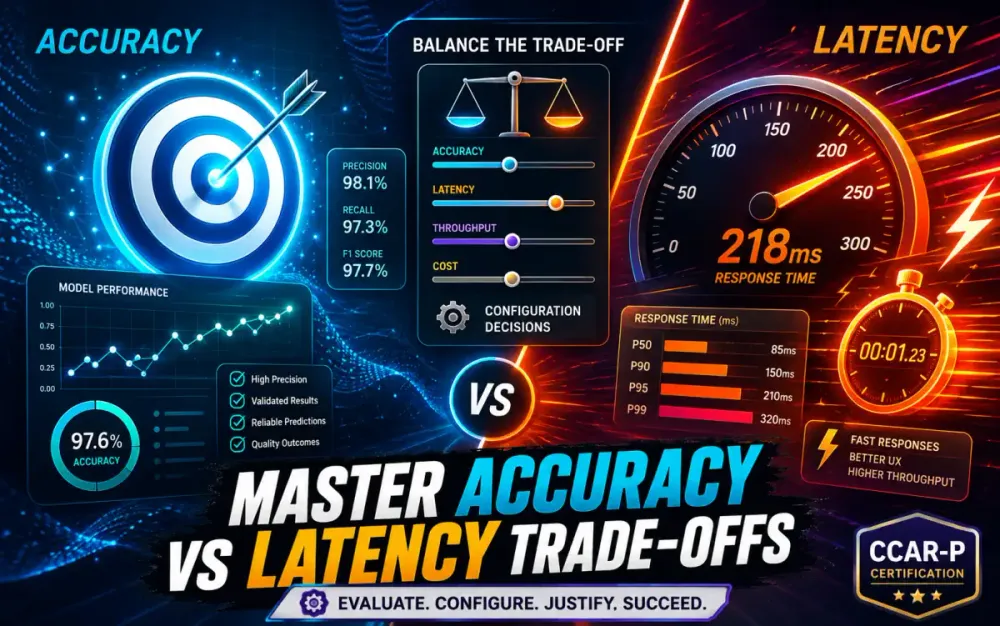
Evaluate Accuracy–Latency Trade-offs and Justify Configuration Decisions
Claude Certified Architect – Professional (CCAR-P) Domain 3: Integration — 19%
The CCAR-P blueprint explicitly expects candidates to be able to “Evaluate accuracy-latency trade-offs and justify configuration decisions.”
This objective is deceptively short. It is not simply asking:
“Should I choose accuracy or speed?”
At the Professional Architect level, you are expected to determine:
- How accurate the solution actually needs to be.
- How quickly it actually needs to respond.
- Which part of the architecture is creating latency.
- Which configuration change improves accuracy.
- Whether the accuracy improvement is worth the latency it introduces.
- Whether a different architecture could provide the same quality with less latency.
- How you would prove the decision through measurements.
- How you would explain and document the decision to stakeholders.
1 What This Objective Really Tests
For exam purposes, think of this objective as:
Quality requirement + latency SLA + workload characteristics + configuration options + measured evidence = defensible architecture decision
A typical scenario may say:
A clinical documentation assistant can improve accuracy by adding another reasoning or verification step, but doing so adds 700 ms to response time.
The exam is unlikely to reward answers such as:
- “Always prioritize accuracy.”
- “Always prioritize latency.”
- “Always use the largest model.”
- “Never add another model call.”
- “Use streaming because it makes the system faster.”
Instead, the architect should ask:
Does the measured accuracy improvement justify the measured latency increase while still satisfying the business SLA and risk profile?
That exact reasoning pattern appears in both provided practice exams. One asks about a clinical assistant and another about a returns-processing assistant. In each case, a short additional reasoning step increases latency while meaningfully improving accuracy. The correct answer is to evaluate the measured accuracy gain against the latency cost, stated latency target, and stakes of the workload.
Exam takeaway
When the stem gives you both an accuracy improvement and a latency cost, do not automatically choose one.
Look for:
Measured benefit + SLA compliance + business risk.
2 Accuracy and Latency Are System Properties
A common exam trap is treating accuracy and latency as properties of the model alone.
They are properties of the complete solution.
Consider this architecture:
User
  |
  v
Authentication
  |
  v
Intent Classification
  |
  v
Knowledge Retrieval
  |
  v
Reranking
  |
  v
Claude Reasoning
  |
  v
Tool Call
  |
  v
Claude Verification
  |
  v
Response
The final accuracy may depend on:
- model capability,
- reasoning effort,
- prompt quality,
- retrieved context,
- chunking,
- reranking,
- tool results,
- verification,
- structured output validation,
- human review.
Latency may come from:
- model inference,
- input size,
- output size,
- retrieval,
- reranking,
- network calls,
- database queries,
- tool execution,
- sequential agent calls,
- verification calls,
- retries,
- overloaded services.
Therefore:
Do not optimize model latency before identifying end-to-end latency.
If retrieval consumes 2.5 seconds and Claude consumes 800 ms, changing Claude configuration may not solve the real problem.
3 Start With the Business Requirement
Before changing a model, prompt, reasoning level, retrieval strategy, or agent architecture, identify the requirement.
Accuracy questions
Ask:
- What does “accurate” mean for this workload?
- Is 90% sufficient?
- Is 97% required?
- Is there a specific error type that matters more than overall accuracy?
- Is an incorrect answer inconvenient or dangerous?
- Can a human review the result?
- Is the system making a recommendation or executing a decision?
Consider these very different workloads:
| Workload | Consequence of Error | Likely Accuracy Priority |
|---|---|---|
| Product-category classification | Low | Moderate |
| Customer email summarization | Low–Medium | Moderate |
| Executive financial report | Medium–High | High |
| Clinical information extraction | High | Very high |
| Loan decision evidence preparation | High | Very high |
| Creative marketing copy | Low | Accuracy may be secondary |
The required quality threshold should therefore come from the business consequence of being wrong, not from an arbitrary desire for the highest benchmark score.
4 Define the Latency Requirement Correctly
“Fast” is not an architecture requirement.
A professional requirement looks more like:
p95 end-to-end response latency < 2.5 secondsor:
First visible response should begin within 750 ms.
Final result may complete within 8 seconds.
or:
Processing may complete asynchronously within 10 minutes.Those requirements lead to completely different architectures.
The workbook emphasizes that latency is an NFR capable of invalidating an architecture altogether. A strict latency budget can rule out repeated agent loops or excessive serial retrieval operations.
Anthropic’s current latency guidance similarly recommends measuring latency and considering factors such as model choice, prompt/output size, and streaming. It distinguishes measures such as overall latency and time to first token (TTFT).
5 Average Latency Is Often the Wrong Metric
Suppose:
Average latency = 1.6 s
p95 latency     = 6.8 s
If the SLA says:
p95 < 3 secondsthe architecture fails.
The average being good does not matter.
This becomes especially important with:
- agents,
- variable tool use,
- conditional retrieval,
- retries,
- multiple reasoning steps.
Some requests may require one call while others require five.
For interactive production workloads, think in terms of:
- p50,
- p95,
- potentially p99,
- TTFT,
- total completion time.
Exam rule
If an option says:
“Average response time is acceptable, so the SLA is satisfied”
but the scenario explicitly specifies p95, reject it.
6 The Core Accuracy–Latency Decision Framework
Use this six-step method on the exam.
Step 1 — Identify the binding requirement
Ask:
Which constraint must not be violated?
Examples:
- p95 under 1 second.
- At least 97% extraction accuracy.
- Human-facing workflow must feel interactive.
- Medical summary must meet a strict quality threshold.
Do not optimize without knowing what is binding.
Step 2 — Establish a quality baseline
Evaluate the simplest configuration that could reasonably satisfy the requirement.
For example:
Configuration A

Single Claude call
No verification pass
Standard retrieval
Results:
Accuracy: 92%
p95:      1.4 sec
Step 3 — Measure the candidate improvement
Now evaluate:
Configuration B

Claude call
+
verification step
Results:
Accuracy: 97%
p95:      2.0 sec
You now have evidence rather than intuition.
Step 4 — Compare against requirements
Assume:
Accuracy target: >= 96%
Latency SLA:     p95 <= 2.5 sec
Configuration A:
92% accuracy  FAIL
1.4 sec       PASS
Configuration B:
97% accuracy  PASS
2.0 sec       PASS
Configuration B is justified.
The extra 600 ms is acceptable because it produces a material accuracy improvement without violating the latency requirement.
Step 5 — Check whether there is a cheaper latency path
Do not immediately accept the slower architecture.
Ask whether the same accuracy could be obtained through:
- better retrieval,
- better context,
- clearer prompts,
- schema enforcement,
- selective verification,
- parallel operations,
- smaller retrieved context,
- smarter routing.
Professional architecture means finding the minimum sufficient complexity.
Step 6 — Document why
A strong justification could be:
Configuration B was selected because testing improved task accuracy from 92% to 97%, exceeding the 96% quality threshold, while p95 latency increased from 1.4 seconds to 2.0 seconds and remained below the 2.5-second SLA.
That sentence is much stronger than:
“We selected Configuration B because it is more accurate.”
7 Think in Terms of a Pareto Frontier
This concept is extremely useful even if the term itself never appears on the exam.
Consider:
| Configuration | Accuracy | p95 Latency |
|---|---|---|
| A | 88% | 0.6 s |
| B | 94% | 1.0 s |
| C | 97% | 1.8 s |
| D | 97.2% | 4.5 s |
| E | 97.3% | 8.0 s |
Configuration E is not automatically “best.”
Moving:
B -> Cgives:
+3 percentage points accuracy
+0.8 seconds latency
That may be worthwhile.
Moving:
C -> Dgives:
+0.2 percentage points accuracy
+2.7 seconds latency
That may not be.
The question is therefore:
What incremental value are we receiving for the incremental latency?
8 Configuration Lever 1 — Model Selection
Model selection changes both capability and latency.
The exam does not expect:
“Use the most capable model whenever accuracy matters.”
It expects the architect to match model capability to workload requirements.
A simple classification or routing task may benefit from a faster model.
A difficult synthesis or high-stakes reasoning task may justify a more capable model.
Current Anthropic documentation explicitly describes model selection as a workload-dependent trade-off, and recent Claude models provide an effort control that trades greater intelligence/reasoning against latency and cost within a model.
Example
Suppose:
| Configuration | Accuracy | p95 |
|---|---|---|
| Faster model | 96.2% | 600 ms |
| More capable model | 97.0% | 1.8 s |
If requirement is:
Accuracy >= 95%
p95 <= 1 sec
the faster configuration is better.
The additional 0.8 percentage point is not useful if it breaks the SLA.
But if the workload involves potentially harmful clinical advice and testing shows the faster configuration misses critical information, the quality requirement may dominate.
9 Configuration Lever 2 — Reasoning / Effort
Some tasks benefit from more reasoning.
Examples include:
- multi-step analysis,
- ambiguous decisions,
- complex planning,
- difficult coding,
- evidence reconciliation.
But additional reasoning has a cost.
Conceptually:
More reasoning
     |
     +--> potentially higher quality
     |
     +--> more tokens
     |
     +--> higher latency
     |
     +--> potentially higher cost
Anthropic’s current documentation advises that extended reasoning adds latency and should be used when it meaningfully improves answer quality, particularly for sufficiently complex tasks.
Exam trap
“Enable maximum reasoning for every request to maximize accuracy.”
Usually wrong.
Why?
Because many tasks do not need it.
Classification:
"Billing", "Technical", "Cancellation", "Other"may not justify deep reasoning.
A complex contract-risk comparison might.
10 Use Selective Reasoning Instead of Universal Reasoning
A strong production pattern is:
Incoming Request
       |
       v
Simple / Clear?
   /        \
 Yes         No
 |           |
Fast path    Higher reasoning
 |           |
 +-----------+
       |
    Response
For example:
- 85% of requests use a low-latency configuration.
- 15% of difficult requests use deeper reasoning.
This can produce a better system-level trade-off than forcing every request through the expensive path.
Think of this as:
Spend latency where it buys accuracy.
11 Configuration Lever 3 — Verification
Verification can improve quality significantly.
Pattern:
Generate
   |
   v
Verify
   |
   +---- Pass ----> Return
   |
   +---- Fail ----> Correct / Escalate
But a second sequential model call increases latency.
A better question is:
Does every request require verification?
You might instead use:
Generate
   |
   v
Risk / Confidence Gate
      /       \
   Low risk   High risk
      |          |
    Return     Verify
For consequential workloads, the extra latency may be entirely justified.
For autocomplete, it probably is not.
12 Configuration Lever 4 — Retrieval Depth
Retrieval introduces another accuracy-latency trade-off.
Suppose:
Retrieve top 3is fast, but sometimes misses supporting evidence.
Increasing to:
Retrieve top 20
+ rerank
may improve recall but adds:
- retrieval latency,
- reranking latency,
- context size,
- model processing time.
And importantly:
More retrieved context does not automatically mean greater answer accuracy.
Irrelevant passages can dilute relevant information.
The provided practice exams reinforce that retrieval strategy should be selected according to the data shape and query pattern, rather than applying one universal configuration.
13 Progressive Discovery vs. Monolithic Context
This becomes especially important in Domain 3.
Monolithic context
Load everything
      |
      v
    Claude
Potential advantages:
- fewer retrieval round trips,
- everything immediately available.
Potential disadvantages:
- large input,
- context dilution,
- more processing,
- potentially greater cost.
Progressive discovery
Question
   |
   v
Determine Need
   |
   v
Retrieve Relevant Data
   |
   v
Reason
   |
 Need More?
 /      \
No      Yes
|        |
Answer  Retrieve again
Potential benefits:
- less irrelevant context,
- more targeted evidence,
- reduced token consumption.
Potential cost:
- additional retrieval/tool round trips.
The provided practice exams explicitly characterize progressive discovery as fetching relevant material when needed rather than loading an entire large knowledge base up front, thereby reducing context dilution and unnecessary token usage.
Important nuance
Do not memorize:
“Progressive discovery is faster.”
It may not be.
Repeated retrieval can add latency.
Instead memorize:
Progressive discovery trades additional discovery steps against smaller and more relevant context.
14 Configuration Lever 5 — Number of Agent Steps
A common agent pattern is:
Observe
   |
Think
   |
Act
   |
Observe
   |
Think
   |
Act
   |
...
Each iteration may require:
Model inference
+
tool invocation
+
network round trip
+
tool execution
+
another model inference
Accuracy may improve because the system can gather more evidence or correct itself.
Latency can increase dramatically.
For strict interactive SLAs, an unnecessarily agentic architecture can therefore be the wrong solution.
The project workbook repeatedly emphasizes that serial agent iterations and retrieval hops are additive, and a strict latency NFR may require a simpler architecture or fewer round trips.
15 Sequential vs. Parallel Work
Suppose an assistant must retrieve:
Customer profile      700 ms
Order history         600 ms
Policy information    500 ms
Sequential execution:
700 + 600 + 500
= approximately 1,800 ms
If the calls are independent, parallel execution could approach:
max(700, 600, 500)
= approximately 700 ms
plus orchestration overhead.
Conceptually:
Sequential
A --> B --> CParallel
     +--> A --+
     |        |
Start+--> B --+--> Aggregate
     |        |
     +--> C --+
Exam principle
If independent work is being performed serially and latency matters:
parallelization is worth evaluating before sacrificing accuracy.
16 Reduce Model Round Trips
Agentic systems can accumulate significant latency through model/tool/model loops.
Recent Anthropic tooling supports programmatic tool calling, where Claude can execute tool-call logic through code execution rather than requiring a separate model round trip for every individual tool interaction. Anthropic documents this specifically as a way to reduce model round trips, latency, and token consumption in multi-tool workflows.
This illustrates an important architectural lesson:
Do not assume the only way to reduce latency is to reduce model intelligence.
Sometimes you can preserve the same reasoning quality while removing unnecessary orchestration overhead.
17 Prompt and Context Size Affect Latency
Longer prompts mean more input processing.
Long responses mean more generation.
Therefore:
Huge prompt
+
large retrieved corpus
+
many tool schemas
+
verbose output
can significantly affect response time.
Anthropic’s current latency guidance explicitly recommends trimming prompt and output tokens where appropriate as a latency optimization.
But the exam trap is:
“Remove context until latency improves.”
That may destroy accuracy.
Correct approach:
Remove irrelevant context
not
Remove required context
18 Prompt Caching Can Reduce Latency Without Sacrificing Accuracy
Suppose every request contains:
System instructions      2,000 tokens
Company policies         7,000 tokens
Tool definitions         2,000 tokens
User question              100 tokens
If the first 11,000 tokens are stable across requests, repeatedly processing the same prefix is inefficient.
Prompt caching allows stable prefixes to be reused. Anthropic documents prompt caching as reducing processing time and cost for repetitive requests with consistent prompt components.
This is particularly attractive because it may improve latency without requiring you to remove useful context.
The official CCAR-P sample questions already test this neighboring architectural concept: when a large static system prompt and policy document are reused repeatedly, placing stable content before dynamic content and enabling prompt caching is the preferred optimization.
19 Streaming: Understand the Exam Trap
Streaming often improves the user experience because users see tokens sooner.
Without streaming:
Request
|
|.............. waiting ..............|
                                       Response
With streaming:
Request
|
|...|
    first token
    |------ remaining generation ------|
Streaming can improve perceived responsiveness and time to first visible output.
But:
Streaming does not necessarily make the model finish its complete answer sooner.
The unofficial workbook explicitly makes this distinction: streaming improves perceived latency rather than necessarily reducing total completion time.
Anthropic similarly recommends streaming as one technique for improving latency-sensitive user experiences.
Exam trap
Question:
A report takes eight seconds to fully generate. The SLA requires the completed report within five seconds. What solves the problem?
Answer:
Streaming alone does not satisfy the completion-time SLA.
20 Fine-Grained Tool Streaming: Speed vs. Validation
A useful current Claude-specific example of an accuracy/reliability versus latency decision is fine-grained tool streaming.
Anthropic supports streaming tool parameters without waiting for full server-side buffering and JSON validation. This can reduce the time before large tool inputs start arriving, but the application must then be prepared to receive partial or invalid JSON and handle parsing carefully.
This is a perfect architect-level pattern:
Lower latency
    vs.
Stronger built-in validation
Neither is always correct.
For a latency-sensitive workload with robust client-side validation, fine-grained streaming may be reasonable.
For a highly controlled transaction where malformed tool input carries serious consequences, standard validation may be more appropriate.
21 Batch Is a Different Kind of Optimization
Sometimes the answer is not “make inference faster.”
It is:
Stop requiring an immediate response.
Suppose you must summarize 2 million documents overnight.
An interactive synchronous architecture makes little sense.
Batch processing changes the requirement:
Submit jobs
     |
     v
Asynchronous processing
     |
     v
Collect results later
Anthropic’s Message Batches API is specifically intended for high-volume workloads that do not require immediate responses.
This is important because latency must always be interpreted against the business workflow.
Twenty minutes may be unacceptable for chat.
Twenty minutes may be excellent for an overnight processing job.
22 Accuracy Does Not Mean “Use More Everything”
Candidates often fall into this pattern:
Higher accuracy?
    ↓
More context
More retrieval
More tools
More agents
More reasoning
More verification
Bigger model
That is not architecture.
Each additional mechanism must solve an observed error.
Use this diagnostic mapping:
| Accuracy Problem | Better First Investigation |
|---|---|
| Missing authoritative information | Retrieval |
| Retrieved wrong document | Retrieval/index configuration |
| Retrieved right information but model ignores it | Prompt/context assembly |
| Ambiguous task | Examples/clarification |
| Complex reasoning failure | Reasoning/model capability |
| Incorrect structured output | Schema validation |
| Multi-step factual inconsistency | Verification |
| Tool result wrong | Tool/integration layer |
| System degrades over long sessions | Context management |
The practice exams reinforce this diagnostic mindset. When a RAG system suddenly becomes confidently wrong after a document refresh while model version and latency remain unchanged, the expected first investigation is retrieval/indexing—not temperature, context-window size, or an unexplained model change.
23 High-Stakes vs. Low-Stakes Workloads
The same latency penalty may be acceptable in one workload and unacceptable in another.
Scenario A — Search suggestions
Current:
Accuracy = 92%
p95      = 250 ms
Candidate:
Accuracy = 96%
p95      = 1.8 sec
Probably unattractive.
Users are waiting interactively, and the consequence of a wrong suggestion is low.
Scenario B — Clinical record synthesis
Current:
Accuracy = 92%
p95      = 2 sec
Candidate:
Accuracy = 97.5%
p95      = 3 sec
If the operational requirement allows five seconds, the additional second may be well justified.
The consequence of an inaccurate synthesis is much greater.
Memorize
Acceptable latency depends partly on the cost of being wrong.
24 Marginal Accuracy Improvement Matters
Compare these two cases.
Case 1
Accuracy: 88% -> 97%
Latency:  1 s -> 2 s
Large quality benefit.
Case 2
Accuracy: 97.0% -> 97.1%
Latency:  1 s -> 5 s
Very small quality benefit.
Do not ask simply:
“Does accuracy increase?”
Ask:
“How much does accuracy increase, and what do we pay for that improvement?”
This is the difference between optimization and architectural judgment.
25 Selective Escalation Is Often Better Than One Global Configuration
Imagine 100 requests:
80 simple
15 moderate
5 difficult
One architecture could send every request through the highest-accuracy path.
A better approach may be:
Request
   |
   v
Triage
   |
   +---- Simple ------> Fast path
   |
   +---- Moderate ----> Standard path
   |
   +---- Difficult ---> Deep reasoning / verification
Benefits:
- lower average latency,
- lower cost,
- high accuracy where needed,
- avoids penalizing simple requests.
This is an important professional pattern because configuration can be dynamic rather than global.
26 Think About End-to-End Task Success
Suppose:
Configuration A
Latency per attempt: 1.0 sec
Success first attempt: 70%
Configuration B
Latency per attempt: 1.6 sec
Success first attempt: 96%
Configuration A looks faster per request.
But if it causes retries, corrections, or human escalation, the actual time to a successful outcome may be worse.
The practitioner workbook makes the same broader point for evaluation: assess the system using the unit the business values, such as a resolved ticket or completed task, not merely a single API call.
Therefore
Measure:
time per successfully resolved tasknot only:
time per model call27 Accuracy–Latency–Cost Form a Three-Way Trade-off
Although this objective specifically names accuracy and latency, professional questions may introduce cost as a third constraint.
Consider:
| Option | Accuracy | p95 | Cost |
|---|---|---|---|
| A | 91% | 0.5 sec | $ |
| B | 96% | 1.2 sec | $$ |
| C | 98% | 4.5 sec | $$$$ |
Requirements:
Accuracy >= 95%
p95 <= 2 sec
Budget <= $$$
Option B is the obvious architectural fit.
Option C may be “best” on accuracy but is not the best solution.
This aligns with the workbook’s repeated message that optimization should consider accuracy, latency, cost, safety, and security rather than treating any one measure in isolation.
28 A Useful Configuration Decision Matrix
For exam scenarios, mentally build something like this:
| Decision | Accuracy Effect | Latency Effect | Best When |
|---|---|---|---|
| More capable model | Often ↑ | Often ↑ | Task complexity requires it |
| Higher reasoning/effort | Often ↑ for hard tasks | ↑ | Complex reasoning |
| Additional verification | ↑ | ↑ | High-stakes outputs |
| More retrieval | Recall may ↑ | ↑ | Missing evidence is the problem |
| Reranking | Relevance may ↑ | ↑ | Initial retrieval is noisy |
| Smaller context | Could ↓ if overdone | ↓ | Context contains unnecessary material |
| Prompt caching | Usually unchanged | ↓ | Large stable prefix repeats |
| Streaming | Usually unchanged | Perceived latency ↓ | Interactive UX |
| Parallel tool calls | Usually unchanged | ↓ | Calls are independent |
| Fewer agent iterations | May ↓ | ↓ | Current loop is over-engineered |
| Selective escalation | Maintains high-risk quality | Average latency ↓ | Workload difficulty varies |
| Batch processing | Usually unchanged | Interactive latency irrelevant | No immediate answer needed |
29 What “Justify Configuration Decisions” Means
This phrase is important.
The architect should not merely state:
“Use higher reasoning.”
A professional justification contains five parts.
1 Requirement
Clinical summary accuracy must exceed 97%.2 Evidence
Standard reasoning = 94.8%
Higher reasoning   = 97.6%
3 Consequence
p95 rises from 1.7 s to 2.4 s.4 Constraint check
Latency SLA = 3 seconds.5 Decision
Enable higher reasoning for the identified high-risk clinical cases because it raises accuracy above the required threshold while remaining within the p95 latency SLA.
That is an architectural justification.
30 Use an Architecture Decision Record
A compact ADR can contain:
Context
What requirement creates the decision?
Decision
What configuration did you select?
Alternatives
What else was evaluated?
Consequences
What did you gain and what did you sacrifice?
Revisit When
What measurable change would cause the decision to be reconsidered?
Example:
Context:
Claims analysis requires >=97% evaluation accuracy
and p95 response time below 4 seconds.

Decision:
Use enhanced reasoning only for ambiguous claims.

Alternative:
Use enhanced reasoning for every request.

Consequences:
Maintains accuracy on difficult cases while reducing
overall latency and cost.

Revisit when:
Ambiguous-case volume exceeds 40% or baseline-model
accuracy rises above 97%.
The workbook uses this style of decision record for architecture trade-offs because it makes the reasoning explicit instead of presenting configuration as personal preference.
31 Exam Decision Algorithm
When you encounter an accuracy-latency question, use this sequence:
1. What accuracy is required?
            |
2. What latency SLA is required?
            |
3. What are the consequences of error?
            |
4. Where is latency actually coming from?
            |
5. What configuration improves accuracy?
            |
6. How much latency does it add?
            |
7. Does the candidate still meet the SLA?
            |
8. Is there a simpler way to achieve the quality target?
            |
9. Choose based on measured evidence.
This should become automatic.
32 High-Yield Exam Traps
Trap 1 — “Always prioritize accuracy”
Wrong.
A configuration with:
99% accuracy
12-second response
does not satisfy a 2-second SLA.
Trap 2 — “Always prioritize latency”
Also wrong.
A 300-ms medical assistant that frequently returns incorrect results is not a successful architecture.
Trap 3 — “Always use the largest model”
Wrong.
Model choice must match workload complexity and required quality.
Trap 4 — “Never add another reasoning step”
Wrong.
A high-stakes workload may justify added latency if the improvement is material and the SLA remains satisfied.
This is the exact reasoning pattern emphasized in both practice exams.
Trap 5 — “Streaming solves total latency”
Not necessarily.
It primarily improves how quickly the user begins seeing output.
Trap 6 — “More retrieved context means more accuracy”
Wrong.
Irrelevant context can dilute useful evidence.
Trap 7 — “Optimize before establishing a quality baseline”
Wrong.
Anthropic’s latency guidance recommends first engineering a solution that performs well, then applying latency optimizations rather than prematurely constraining the solution before understanding achievable quality.
Trap 8 — “Average latency meets the SLA”
Check what the SLA actually says.
If it says p95, evaluate p95.
Trap 9 — “A technically faster component guarantees a faster system”
Wrong.
Measure end-to-end latency.
Trap 10 — “The configuration decision is obvious without testing”
Professional architecture decisions should be evidence-based.
Compare candidate configurations using the same evaluation set.
The practice material also reinforces A/B or equivalent comparative testing for choosing between candidate prompt configurations rather than relying on anecdotal examples.
33 Exam Heuristic: What Usually Wins?
When several answers look plausible, prefer the answer that:
- Uses measured evidence.
- References the stated SLA.
- Accounts for workload risk.
- Meets the required quality threshold rather than maximizing quality blindly.
- Avoids unnecessary architectural complexity.
- Optimizes the full workflow instead of one isolated API call.
- Explicitly acknowledges the trade-off.
Be suspicious of answers containing:
- always,
- never,
- regardless of workload,
- use maximum reasoning,
- choose the biggest model,
- latency does not matter,
- accuracy is the only metric.
34 Worked Example — Customer Support
Requirement:
p95 < 2 seconds
Accuracy >= 94%
Measurements:
| Configuration | Accuracy | p95 |
|---|---|---|
| Fast model, direct generation | 91% | 0.6 sec |
| Balanced model | 95% | 1.3 sec |
| Deep reasoning + verification | 98% | 4.8 sec |
Correct choice:
Balanced configuration.
Why?
It is the simplest configuration meeting both requirements.
The 98% option has the highest accuracy but violates the SLA.
35 Worked Example — Healthcare
Requirement:
Accuracy >= 98%
p95 < 5 sec
Results:
| Configuration | Accuracy | p95 |
|---|---|---|
| Standard | 94% | 1.2 sec |
| Higher reasoning | 97% | 2.5 sec |
| Higher reasoning + verification | 98.4% | 4.1 sec |
Best fit:
Higher reasoning + verification.
It is slower but satisfies both requirements.
Choosing the 1.2-second configuration simply because it is fastest would fail the quality requirement.
36 Worked Example — Mixed-Complexity Workload
Requests:
80% easy
15% moderate
5% difficult
Running maximum reasoning on 100% of traffic gives:
Accuracy: 98%
p95: 5.1 sec
Using dynamic routing:
Easy     -> fast configuration
Moderate -> standard configuration
Difficult-> high reasoning + verification
might give:
Accuracy: 97.8%
p95 overall: 1.8 sec
This is often the better architecture.
Why?
Because the expensive accuracy mechanism is used where it provides value.
37 Two Practical Exercises
Exercise 1 — Choose the Configuration
You are architecting an insurance claims assistant.
Business requirements:
Accuracy target: >= 96%
p95 latency SLA: <= 3 seconds
Volume: 500,000 requests/month
Human review: only for flagged cases
Testing gives:
| Option | Configuration | Accuracy | p95 |
|---|---|---|---|
| A | Fast model | 91% | 0.7 s |
| B | Balanced model | 95.2% | 1.4 s |
| C | Balanced + additional reasoning | 96.8% | 2.2 s |
| D | Maximum reasoning + verification | 98.1% | 5.6 s |
Questions
- Which configuration would you recommend?
- Why?
- Why is D not automatically superior?
- What would make you reconsider C?
- How would you reduce latency further without sacrificing the 96% target?
Suggested answer
Choose C.
It is the lowest-complexity configuration currently demonstrated to satisfy both:
Accuracy >= 96%
p95 <= 3 seconds
D provides another 1.3 percentage points of accuracy but violates the latency SLA.
Potential optimizations to C could include:
- prompt caching,
- reducing irrelevant context,
- parallelizing independent retrieval,
- selective deeper reasoning,
- reducing unnecessary tool calls.
Then rerun the evaluation suite to confirm accuracy remains above 96%.
Exercise 2 — Find the Real Latency Problem
A RAG assistant has:
Authentication        100 ms
Query transformation  250 ms
Vector retrieval      900 ms
Reranking             1,200 ms
Claude generation     800 ms
Verification call     700 ms
Total approximately:
3,950 msRequired:
p95 < 2,500 ms
Accuracy >= 97%
Testing shows removing verification reduces accuracy:
97.4% -> 93.2%Question
What should you do first?
A. Remove verification because it adds 700 ms. B. Switch immediately to the smallest Claude model. C. Investigate retrieval/reranking latency and whether independent operations can be reduced or parallelized while preserving verification. D. Reduce the accuracy requirement.
Answer
C.
Verification contributes latency, but evidence shows that it is important to meeting the accuracy target.
Retrieval and reranking together account for:
2,100 mswhich is much larger.
The architect should first optimize the largest latency contributors that do not destroy the required quality.
This exercise captures the main lesson of the objective:
Do not sacrifice the component that protects accuracy merely because it is visible. Find the actual bottleneck.
38 Sample CCAR-P Exam Questions
Question 1 — Core Accuracy-Latency Trade-off
A healthcare platform adds an additional reasoning step to its clinical documentation assistant. Testing shows that accuracy improves from 93% to 97.5%, while p95 latency rises from 1.8 seconds to 2.6 seconds. The documented SLA permits p95 latency up to 3 seconds. Which action is MOST appropriate?
A. Remove the reasoning step because latency should always be minimized. B. Retain the reasoning step because the measured accuracy improvement is material and the resulting latency remains within the stated SLA. C. Replace the system with the smallest available model. D. Increase reasoning further because maximum accuracy should always be preferred.
Correct Answer: B
Why: The configuration materially improves accuracy while remaining inside the latency requirement. This is precisely the type of evidence-based trade-off expected by the blueprint.
Why A is wrong: It optimizes latency without considering the quality requirement.
Why C is wrong: Model downsizing is not justified by the evidence presented and may reduce accuracy.
Why D is wrong: More accuracy is not automatically worth additional latency.
Exam lesson
The goal is not minimum latency. The goal is sufficient accuracy within the required latency envelope.
Question 2 — Finding the Correct Bottleneck
A report-generation assistant has a p95 latency of 5.2 seconds against a 3-second SLA. Profiling shows:
Retrieval and reranking: 2.9 seconds
Claude generation:       1.1 seconds
Other processing:        1.2 seconds
The current model configuration already meets the required accuracy threshold. What should the architect investigate FIRST?
A. Replace Claude with a more capable model. B. Increase reasoning effort to improve answer quality. C. Optimize the retrieval/reranking path because it is the largest latency contributor while existing model quality already meets requirements. D. Remove retrieved context completely.
Correct Answer: C
Why: Architecture optimization should target the actual bottleneck. Retrieval and reranking dominate latency.
Why A is wrong: A more capable model may increase latency and the quality threshold is already met.
Why B is wrong: There is no demonstrated quality problem.
Why D is wrong: Removing required grounding can damage accuracy.
Exam lesson
Profile before optimizing.
Question 3 — Streaming Trap
A customer-facing assistant takes six seconds to fully generate a response. Users complain that the interface appears frozen, although the service’s completion-time SLA is eight seconds. Which configuration change MOST directly improves the user experience without necessarily changing final completion time?
A. Enable streaming so the user begins receiving output earlier. B. Add a second verification call. C. Increase retrieval top-k from 5 to 50. D. Increase reasoning effort for every request.
Correct Answer: A
Why: Streaming improves time to first visible output and perceived responsiveness.
Why B, C, and D are wrong: Each is likely to increase processing rather than address perceived responsiveness.
Important distinction
If the requirement instead said:
Complete response must arrive in <= 4 secondsstreaming alone would not solve the problem.
Question 4 — Selective Escalation
An e-commerce assistant processes 1 million requests per day. Evaluation shows that 90% of requests are simple and achieve required accuracy with a fast configuration. The remaining 10% are ambiguous and need additional reasoning to achieve the required accuracy. What architecture BEST balances accuracy and latency?
A. Apply maximum reasoning to all requests. B. Use the fastest configuration for all requests and accept reduced accuracy for ambiguous cases. C. Route straightforward requests through the fast path and escalate ambiguous requests to additional reasoning. D. Randomly send half the traffic to each configuration.
Correct Answer: C
Why: It spends additional latency only on the portion of traffic that benefits from it.
Why A is wrong: It unnecessarily penalizes 90% of requests.
Why B is wrong: It knowingly fails the accuracy requirement for difficult requests.
Why D is wrong: Routing should be based on task characteristics, not chance.
Exam lesson
Configuration can be conditional. Do not assume one setting must serve all requests.
Question 5 — High-Stakes Accuracy
A loan-analysis assistant has two candidate configurations:
Configuration A
Accuracy: 94.5%
p95: 1.1 sec

Configuration B
Accuracy: 98.2%
p95: 2.7 sec
The business requires at least 98% accuracy, and the SLA allows up to 4 seconds p95. Which configuration should the architect recommend?
A. A, because it is more than twice as fast. B. A, because low latency is always preferred for production systems. C. B, because it satisfies both the accuracy requirement and latency SLA, whereas A fails the stated quality requirement. D. Neither; accuracy and latency cannot be traded off objectively.
Correct Answer: C
Why: Configuration A fails an explicit requirement. Configuration B meets both.
The question is not:
“Which configuration is faster?”
It is:
“Which configuration satisfies the complete set of requirements?”
39 Quick Revision Sheet
For this CCAR-P objective, know these principles cold:
- Accuracy and latency are end-to-end system properties, not only model properties.
- Start with explicit accuracy and latency requirements.
- Use measured results rather than architectural intuition alone.
- Do not optimize accuracy or latency in isolation.
- Evaluate marginal accuracy improvement against marginal latency cost.
- Higher reasoning should be used where it measurably improves difficult tasks, not universally.
- Verification can be worth additional latency for consequential workloads.
- More retrieval/context does not automatically improve accuracy.
- Parallelize independent operations when possible.
- Reduce unnecessary model/tool round trips before sacrificing quality.
- Prompt caching can lower processing latency for large repeated prefixes without removing required context.
- Streaming improves perceived responsiveness and TTFT; it does not necessarily reduce completion time.
- Use selective escalation when request difficulty varies.
- Measure p95/p99 when the SLA specifies tail latency; averages can hide failures.
- Measure time and cost per successful business outcome, not only per API call.
- Choose the simplest configuration that satisfies all binding requirements.
- Document the decision, alternatives, consequences, and conditions for revisiting it.
40 The One Sentence to Remember
If you remember only one sentence for the exam, use this:
Choose the least complex configuration that meets the required accuracy while remaining within the stated latency SLA, and justify the decision with measured evidence and the consequences of error.
That reasoning pattern aligns directly with the provided CCAR-P practice exams, where the expected answer is not “accuracy first” or “latency first,” but a deliberate comparison of the measured accuracy gain, latency cost, workload stakes, and stated latency target.