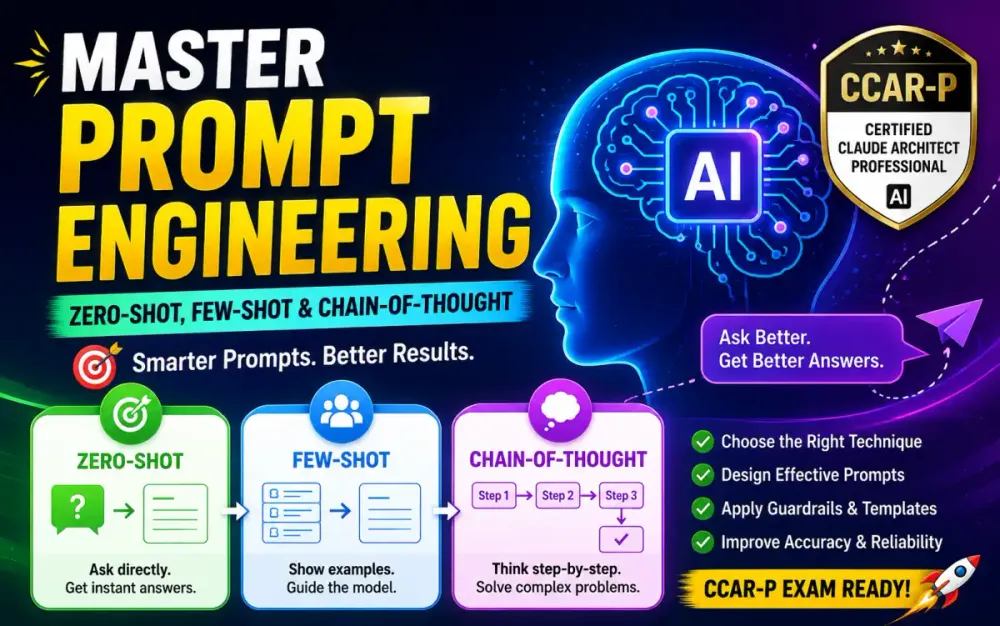
Apply Prompt Engineering Techniques: Zero-Shot, Few-Shot & Chain-of-Thought
CCAR-P Exam Guide — Domain 2: Claude Models, Prompting & Context Engineering
Exam: Claude Certified Architect – Professional (CCAR-P) Domain 2: Claude Models, Prompting & Context Engineering — 13% Target objective: Apply prompt engineering techniques — zero-shot, few-shot, chain-of-thought Closely related objective: Design system prompts, templates, and guardrails
1 What You Need to Know for the Exam
For CCAR-P, think about prompt engineering through this decision:
What information is missing from the basic instruction that Claude needs in order to perform the task reliably?
Usually the answer falls into one of three categories:
| Situation | Technique |
|---|---|
| Task is clear and Claude can infer the behavior directly | Zero-shot |
| Desired behavior, format, classification boundary, tone, or edge handling is difficult to describe but easy to demonstrate | Few-shot |
| Task involves genuinely difficult multi-step reasoning where intermediate reasoning improves the result | Chain-of-thought / reasoning |
This distinction is strongly reflected in both supplied practice exams. In particular, the practice questions repeatedly distinguish:
- hard multi-step reasoning → chain-of-thought
- unusual output format → few-shot
- ambiguous classifications best demonstrated by examples → few-shot
- persistent persona and behavioral instructions → system prompt
That is probably the most important decision framework to memorize.
2 The Big Picture: Prompt Architecture
Before studying zero-shot, few-shot, and chain-of-thought independently, understand where they fit.
A well-designed Claude request can conceptually look like:
SYSTEM PROMPT
│
├── Role / persona
├── Persistent behavioral instructions
├── Standing constraints
├── Output conventions
└── Escalation / uncertainty behavior

USER / REQUEST TEMPLATE
│
├── Task instructions
├── Context
├── Retrieved information
├── Examples (optional → few-shot)
├── Current input
└── Required output

REASONING STRATEGY
│
├── Direct response → simple task
└── Deliberate reasoning → complex task
Anthropic’s current guidance recommends giving Claude clear, explicit instructions, including desired output format and constraints. It also recommends structured prompts when instructions, examples, context, and input need to be clearly separated.
Exam implication
Do not automatically solve every quality problem by:
- adding examples,
- asking Claude to reason longer,
- adding more system-prompt text,
- selecting a bigger model.
Instead diagnose the failure first.
3 Zero-Shot Prompting
3.1 What Is Zero-Shot Prompting?
Zero-shot prompting means asking Claude to perform the task without supplying demonstrations of the desired input/output behavior.
Example:
Classify the following support request into one of:

- Billing
- Technical Support
- Account Access
- Cancellation

Return only the category.

Request:
"I forgot my password and can no longer sign in."
Claude receives:
- an instruction,
- allowed categories,
- an input,
but no worked examples.
4 When Zero-Shot Is the Best Choice
Use zero-shot when:
1 The task is straightforward
Example:
Extract the invoice number from this text.2 The categories are self-explanatory
Classify as Positive, Neutral, or Negative.3 The required format is easy to describe
Return JSON with:
customer_id
issue_type
priority
4 Additional examples would add unnecessary tokens
If Claude already understands the task reliably, examples create:
- additional token consumption,
- maintenance overhead,
- possible unwanted pattern imitation.
5 Zero-Shot Example — Enterprise Scenario
Suppose an e-commerce platform receives:
Customer:
"I received my package, but one of the items was damaged."
Prompt:
You classify customer requests.

Choose exactly one category:

DELIVERY
DAMAGED_ITEM
RETURN
PAYMENT
OTHER

Return only the category.

<request>
{{customer_request}}
</request>
Expected:
DAMAGED_ITEMNo examples are necessary because the classification boundary is clear.
6 Zero-Shot Strengths and Weaknesses
| Strength | Why It Matters |
|---|---|
| Simple | Easy to design |
| Low token usage | Better cost/latency |
| Easy to maintain | No example library |
| Easy to update | Change instructions rather than examples |
But zero-shot becomes weaker when:
- categories overlap,
- business definitions differ from ordinary meanings,
- output style is unusual,
- edge cases dominate,
- desired behavior is difficult to explain precisely.
That is the point where few-shot prompting becomes useful.
7 Few-Shot Prompting
7.1 What Is Few-Shot Prompting?
Few-shot prompting gives Claude representative input/output examples before asking it to handle a new case.
Anthropic currently describes examples as one of the most reliable ways to steer output format, tone, structure, accuracy, and consistency. Its guidance recommends relevant, diverse, well-structured examples and currently suggests roughly 3–5 examples as a useful starting point.
8 When Few-Shot Is the Best Technique
This is extremely important for CCAR-P.
Use few-shot when:
1 The desired behavior is easier to SHOW than describe
Suppose:
Premium customers with payment failures should be escalated,
except expired-card failures should be handled automatically,
unless the account has more than two previous failures...
You could keep adding prose.
Or demonstrate several representative cases.
2 Classification boundaries are ambiguous
Example:
A message says:
“The system crashes every time I attempt to update my credit card.”
Is this:
- Billing?
- Technical issue?
Your organization’s desired classification might be Technical Support even though the subject involves payment.
Examples teach Claude your organization’s interpretation.
3 Output format is unusual
This exact reasoning pattern appears in both supplied CCAR-P practice exams.
If the requirement is:
“Produce output in an unusual format that is difficult to describe.”
The likely answer is:
Few-shot prompting.
Why?
Examples communicate:
- formatting,
- ordering,
- punctuation,
- tone,
- nesting,
- labels,
- exceptions,
more effectively than a lengthy textual description.
4 Tone/style needs consistency
For example:
Customer complaint:
"This software is useless and your support is terrible."

Desired response:
"I understand how frustrating this experience has been. Let's get the immediate problem resolved first..."
A few carefully selected examples can establish the desired response style.
9 Few-Shot Example
Without examples
Classify the request as SIMPLE_RETURN or COMPLEX_RETURN.

Request:
"The jacket doesn't fit and I want another size."
“Complex” versus “simple” is underspecified.
With examples
Classify requests as SIMPLE_RETURN or COMPLEX_RETURN.

<examples>

<example>
<input>
The shirt is too small. Can I exchange it for medium?
</input>
<output>
SIMPLE_RETURN
</output>
</example>

<example>
<input>
I ordered three items. Two arrived damaged,
one is missing, and I was charged twice.
</input>
<output>
COMPLEX_RETURN
</output>
</example>

<example>
<input>
I want to return this unopened item within 14 days.
</input>
<output>
SIMPLE_RETURN
</output>
</example>

</examples>

<input>
{{request}}
</input>
Anthropic recommends separating examples and other components cleanly, including with XML-style tags where they improve parsing clarity.
10 Good vs Bad Few-Shot Examples
Examples are not automatically beneficial.
Poor example set
Example 1: easy billing issue
Example 2: easy billing issue
Example 3: easy billing issue
Example 4: easy billing issue
Claude may learn an overly narrow pattern.
Better example set
Include:
- normal case,
- ambiguous case,
- edge case,
- negative case,
- potentially confusing boundary case.
Anthropic specifically recommends examples that are relevant and diverse, rather than repeatedly illustrating essentially the same case.
11 Critical Exam Trap: Few-Shot Is NOT Chain-of-Thought
Consider:
An assistant must classify ambiguous requests. Written rules don’t fully communicate the distinction, but several representative examples would make the intended behavior obvious.
Possible answers:
A. Chain-of-thought B. Bigger Claude model C. Few-shot prompting D. Longer system prompt
Correct: C — Few-shot
Why?
The problem is:
“Claude doesn’t understand our decision boundary.”
Not:
“Claude cannot reason through the problem.”
Remember
Demonstrating judgment → Few-shot Increasing reasoning depth → Chain-of-thought
This distinction appears explicitly in the supplied practice exams.
12 Chain-of-Thought Prompting
12.1 What Does It Mean?
Traditional chain-of-thought prompting encourages the model to perform intermediate reasoning before producing the final conclusion.
Conceptually:
Problem
  ↓
Analyze relevant facts
  ↓
Work through dependencies
  ↓
Check assumptions
  ↓
Reach conclusion
It is useful for problems where a direct answer is less reliable than deliberate reasoning.
13 When Chain-of-Thought / Reasoning Helps
Use deliberate reasoning for:
- multi-step calculations,
- architectural trade-offs,
- constraint satisfaction,
- troubleshooting,
- complex policy interpretation,
- planning,
- dependency analysis,
- reasoning across tool results.
Anthropic’s current documentation says thinking capabilities are particularly valuable for complex multistep reasoning and reasoning that needs to happen around tool interactions.
14 Example: Direct Prompt vs Reasoning
Zero-shot/direct
Which hosting option should we use?Too vague.
Structured reasoning task
Evaluate the two architecture options against:

1. p95 latency under 2 seconds
2. maximum infrastructure budget of $15,000/month
3. HIPAA requirements
4. 99.9% availability
5. 10,000 concurrent users

Identify the binding constraints,
compare the alternatives,
and recommend the best architecture.

State your final recommendation separately.
The task requires reasoning because several constraints interact.
15 Important 2026 Update: Don’t Memorize “Always Say Think Step by Step”
This deserves special attention because the exam blueprint uses the phrase chain-of-thought, but Claude’s modern reasoning capabilities are more sophisticated than traditional prompt recipes.
Anthropic’s current guidance recommends general reasoning instructions over overly prescriptive hand-written reasoning steps in many cases. Modern Claude models can use built-in/adaptive thinking, with reasoning depth influenced by the task and model configuration. Anthropic still documents manual CoT prompting as a fallback when thinking is disabled.
So distinguish:
Exam concept
Chain-of-thought =
encourage deliberate reasoning for difficult multistep problems
from:
Production implementation
Modern Claude reasoning may use:
- model-native thinking
- adaptive thinking
- effort controls
- high-level reasoning instructions
- or manual CoT where appropriate
Exam rule
If the scenario says:
“A genuinely difficult multi-step reasoning problem needs more reliable reasoning.”
and the choices include:
- zero-shot,
- few-shot,
- chain-of-thought,
choose:
Chain-of-thought.
Both supplied practice exams test essentially this exact distinction.
16 Chain-of-Thought vs Few-Shot
This is probably the highest-value comparison to memorize.
| Problem | Best Technique |
|---|---|
| Task is obvious | Zero-shot |
| Desired behavior needs demonstration | Few-shot |
| Output format is unusual | Few-shot |
| Classification boundaries are ambiguous | Few-shot |
| Claude must follow organizational examples | Few-shot |
| Complex multi-step logic | Chain-of-thought |
| Hard arithmetic/reasoning | Chain-of-thought |
| Complex architecture trade-offs | Chain-of-thought |
| Simple extraction | Zero-shot |
| Straightforward classification | Zero-shot |
Memory trick
Zero-shot: Tell it.
Few-shot: Show it.
Chain-of-thought: Reason through it.
17 Can You Combine the Techniques?
Yes.
This is important at professional level.
An architecture problem isn’t always:
zero-shot OR few-shot OR chain-of-thought.
You can combine them.
For example:
SYSTEM
You are a financial policy analyst.

<instructions>
Evaluate applications according to the policy supplied below.
Never invent missing applicant data.
If a required fact is missing, return NEEDS_REVIEW.
</instructions>

<examples>
...
several representative policy decisions
...
</examples>

<policy>
...
</policy>

<application>
...
</application>

Evaluate the application carefully against the policy.
Return:
decision
supporting_policy
missing_information
Here we have:
- system prompt → standing role/behavior
- few-shot → decision-boundary demonstrations
- reasoning → policy evaluation
- structured output → predictable downstream integration
Professional architecture frequently combines techniques.
18 Where Does the System Prompt Fit?
The workbook makes a useful distinction:
Persistent, request-independent behavior belongs in the system prompt.
Anthropic similarly recommends using the system prompt to establish an appropriate role for Claude.
Think:
SYSTEM PROMPT
       ↓
Who Claude is
How Claude behaves generally
Standing rules
Persistent output conventions
Escalation behavior
versus:
USER / TEMPLATE
       ↓
What must be done now
Current input
Request-specific context
19 Example: System Prompt vs User Prompt
System
You are an enterprise customer-support assistant.

Your responsibilities:
- analyze customer issues accurately;
- use supplied customer records as the factual source;
- distinguish facts from assumptions;
- escalate when required information is missing;
- use concise, professional language.

Never claim an action was completed unless the corresponding
tool result confirms success.
User
Customer request:

<request>
{{customer_message}}
</request>

Customer record:

<customer>
{{customer_record}}
</customer>

Determine the appropriate next action.
This is much better than repeating all standing behavior in every user request.
20 System Prompt vs Prompt Template
A system prompt defines persistent behavior.
A template defines reusable request structure.
Example template:
<task>
Analyze the support case.
</task>

<context>
{{customer_context}}
</context>

<request>
{{customer_message}}
</request>

<output_format>
{
  "category": "...",
  "priority": "...",
  "recommended_action": "...",
  "reason": "..."
}
</output_format>
Values such as:
{{customer_context}}
{{customer_message}}
change per request.
The structure remains constant.
21 Why Templates Matter Architecturally
Templates improve:
- consistency,
- maintainability,
- reuse,
- testability,
- prompt versioning,
- separation between instructions and data.
This becomes important when multiple applications use Claude.
Instead of:
App A → Prompt copied manually
App B → Prompt copied manually
App C → Prompt copied manually
prefer a controlled reusable prompt strategy.
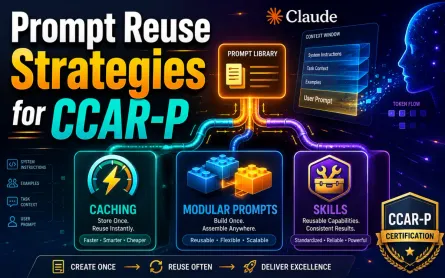
That connects directly with another Domain 2 blueprint objective: prompt reuse strategies.
22 Guardrails: Prompt Instructions Are NOT Security Controls
This is one of the most important CCAR-P concepts.
Suppose the system prompt says:
Never delete an account unless the user is authorized.That is useful behavioral guidance.
But it is not sufficient authorization enforcement.
The workbook makes this distinction explicitly: persistent behavioral guidance can belong in the system prompt, but requirements that must hold even under prompt injection belong in enforced layers, such as authorization, harness controls, or approval workflows.
Wrong architecture
Claude
  ↓
"Please do not delete unauthorized accounts"
  ↓
DELETE ACCOUNT API
Better architecture
Claude
  ↓
Requests delete_account
  ↓
Authorization service
  ├── Authorized → Execute
  └── Unauthorized → Deny
23 Prompt Guardrail vs Enforced Guardrail
| Requirement | Best Location |
|---|---|
| “Write professionally” | System prompt |
| “Ask for clarification when information is missing” | System prompt |
| “Return JSON” | Prompt/template/schema |
| “Use supplied policies” | Prompt |
| “Never reveal another customer’s records” | Authorization/data layer |
| “Only managers can issue refunds > $500” | Authorization layer |
| “Human approval required before wire transfer” | Workflow |
| “Never expose API credentials” | Architecture/secret management |
Exam heuristic
If failure would create a security, authorization, regulatory, irreversible financial, or safety breach, don’t rely on a prompt alone.
24 Clear Instructions Come Before Fancy Prompting
A common mistake is immediately adding few-shot examples or chain-of-thought.
Anthropic recommends starting with clear and direct instructions, including explicit output requirements and constraints.
For example:
Weak
Analyze this ticket.Better
Classify the ticket into exactly one of:

BILLING
ACCOUNT
TECHNICAL
CANCELLATION

Return JSON:

{
 "category": "",
 "confidence": ""
}
Before adding examples, determine whether clearer instructions already solve the problem.
25 Prompt Structure with XML Tags
Anthropic recommends XML-style structure when complex prompts combine multiple semantic components such as:
- instructions,
- context,
- examples,
- inputs,
- documents.
Example:
<instructions>
Classify the customer request.
</instructions>

<categories>
BILLING
ACCOUNT
TECHNICAL
CANCELLATION
</categories>

<examples>
...
</examples>

<customer_request>
{{request}}
</customer_request>
Why?
Without separation:
Instructions + policies + customer text + examples + documentscan become ambiguous.
With structure:
<instructions>...</instructions>
<policy>...</policy>
<input>...</input>
the semantic roles are much clearer.
26 What Prompt Engineering Cannot Fix
Another high-value exam concept:
Not every system problem is a prompt problem.
Anthropic explicitly recommends defining success criteria and evaluations before iterating on prompts, and notes that some failures are better addressed through model choice or another architectural change.
For example:
| Problem | Better Solution |
|---|---|
| Missing current company information | Retrieval/RAG |
| Unauthorized tool access | Authorization |
| Excessive latency | Model/architecture optimization |
| Huge repeated static prefix | Prompt caching |
| Missing database access | Integration/tool |
| Long-session context degradation | Context management |
| Difficult classification semantics | Few-shot prompting |
| Complex reasoning failures | Reasoning/CoT |
Exam trap
Question:
Claude does not know the company’s latest refund policy.
Wrong:
Use chain-of-thought.
Correct:
Provide/retrieve the policy.
Reasoning cannot create missing knowledge.
27 Prompt Engineering Decision Framework
For the exam, use this sequence:
START
  │
  ▼
Does Claude have the information needed?
  │
  ├─ NO → Fix context / retrieval / tools
  │
  ▼ YES
Is the task straightforward and clearly defined?
  │
  ├─ YES → ZERO-SHOT
  │
  ▼ NO
Would examples clearly demonstrate expected behavior?
  │
  ├─ YES → FEW-SHOT
  │
  ▼ NO
Is the failure caused by difficult multi-step reasoning?
  │
  ├─ YES → REASONING / CHAIN-OF-THOUGHT
  │
  ▼
Evaluate model/task mismatch,
architecture, context, or workflow.
This is much more useful than memorizing definitions.
28 Failure Diagnosis — Exam-Focused
Symptom 1
Claude understands the categories but frequently confuses two organization’s internal categories.
Best first approach
Few-shot examples.
Why?
Your organization’s distinction needs demonstration.
Symptom 2
Claude performs simple tasks well but struggles with problems requiring multiple dependent logical steps.
Best approach
Chain-of-thought/reasoning.
Symptom 3
Claude gives poor output because the instructions say only:
Make this better.Best approach
Improve the instructions first.
Not necessarily few-shot.
Symptom 4
Claude consistently fails because it does not know today’s product catalog.
Best approach
Retrieval/tool integration.
Not chain-of-thought.
Symptom 5
Every application call must use the same role and standing behavior.
Best approach
System prompt.
Symptom 6
Only authorized managers may issue high-value refunds.
Best approach
Authorization enforcement.
Not a system-prompt instruction.
29 Common CCAR-P Exam Traps
Trap 1 — “Few-shot improves everything”
No.
Examples add:
- context,
- tokens,
- maintenance,
- possible unintended pattern learning.
Use them where demonstrations solve a real ambiguity.
Trap 2 — “Chain-of-thought is always better”
No.
Reasoning adds computational work and potentially latency/cost. Modern Anthropic guidance recommends applying thinking where it meaningfully improves complex tasks, rather than indiscriminately forcing it on simple requests.
Don’t make:
"Extract email address"into a deep reasoning task.
Trap 3 — “Use chain-of-thought for ambiguous classifications”
Usually not.
If intended classifications are organization-specific:
Few-shot is typically stronger.
This distinction appears directly in the supplied practice exams.
Trap 4 — “A system prompt is an enforcement mechanism”
Wrong.
System prompts guide behavior.
Authorization systems enforce capability.
Trap 5 — “A bigger model fixes poor prompting”
Possibly—but that’s not the correct first diagnosis.
If the prompt does not explain the task or provide required context, bigger-model selection may simply make an unnecessarily expensive bad design.
Trap 6 — “More prompt = better prompt”
No.
A long prompt can introduce:
- contradictory instructions,
- irrelevant context,
- token cost,
- maintenance difficulty.
Clarity beats verbosity.
Trap 7 — “Use CoT when the model lacks facts”
Reasoning ≠ knowledge.
If facts are missing, retrieve them.
30 Zero-Shot vs Few-Shot vs Chain-of-Thought — Master Comparison
| Dimension | Zero-Shot | Few-Shot | Chain-of-Thought / Reasoning |
|---|---|---|---|
| Examples supplied | No | Yes | Not necessarily |
| Primary goal | Direct task completion | Demonstrate desired behavior | Improve complex reasoning |
| Best for | Clear tasks | Ambiguous/custom behaviors | Multistep problems |
| Token overhead | Lowest | Higher | Usually higher |
| Maintenance | Lowest | Example set must be maintained | Reasoning strategy/config |
| Classification | Clear categories | Ambiguous categories | Only if classification itself requires complex reasoning |
| Unusual formatting | Possible | Excellent | Usually unnecessary |
| Complex logic | Limited | Examples may help | Best fit |
| Main risk | Under-specification | Bad examples bias behavior | Cost/latency/overthinking |
31 Prompt Engineering Escalation Ladder
A practical optimization strategy:
Level 1 — Clear zero-shot prompt
Instruction + context + output definition↓
If insufficient:
Level 2 — Improve structure
Role
Instructions
Context
Input
Output requirements
↓
If behavior still ambiguous:
Level 3 — Add few-shot examples
Representative + edge + boundary cases↓
If complex reasoning remains unreliable:
Level 4 — Add reasoning / thinking strategy
↓
If still insufficient:
Level 5 — Investigate
- context quality,
- model fit,
- tools,
- RAG,
- decomposition,
- workflow,
- evaluation results.
This is a much more architecturally mature strategy than blindly creating an enormous prompt.
32 How Prompt Engineering Connects to Evaluation
Prompt engineering without evaluation is guessing.
Anthropic recommends establishing success criteria and empirical tests before systematic prompt improvement.
For example:
Baseline zero-shot
Accuracy: 83%

↓ add 4 representative examples

Few-shot
Accuracy: 94%
Latency: +80 ms
Cost: +6%

↓ decision

Use few-shot because the accuracy gain
justifies the small cost increase.
That is the kind of reasoning expected from a professional architect.
Not:
“Few-shot is considered better.”
But:
“Few-shot improved the specific failing behavior sufficiently to justify its cost and complexity.”
33 The Professional-Level Architecture View
Consider a production financial assistant:
┌──────────────────────────────┐
│        SYSTEM PROMPT         │
│ role + standing behavior     │
└──────────────┬───────────────┘
               │
               ▼
┌──────────────────────────────┐
│       PROMPT TEMPLATE        │
│ instructions + variables     │
│ structured sections          │
└──────────────┬───────────────┘
               │
               ├── Few-shot examples
               │
               ├── Retrieved context
               │
               ▼
┌──────────────────────────────┐
│            CLAUDE            │
│ direct or deeper reasoning   │
└──────────────┬───────────────┘
               │
               ▼
┌──────────────────────────────┐
│       OUTPUT VALIDATION      │
│ schema / policy checks       │
└──────────────┬───────────────┘
               │
               ▼
┌──────────────────────────────┐
│     AUTHORIZATION / HUMAN    │
│        APPROVAL GATE         │
└──────────────────────────────┘
This illustrates a very important exam principle:
Prompt engineering is one layer of the architecture—not the architecture itself.
34 Prompt Engineering Anti-Patterns
❌ Mega-prompt
Hundreds of loosely organized instructions copied into one block.
Better: modular structure and explicit sections.
❌ Example overload
30 examples for a simple classification task.
Better: a small representative, diverse set.
Anthropic’s current guidance suggests approximately 3–5 examples as a good starting point.
❌ Prompt-only security
Never execute dangerous actions.Better: remove or authorize dangerous capabilities outside the model.
❌ Reasoning every request
Think deeply through every request.even for:
Extract account number.Better: reserve deeper thinking for problems where it materially improves results.
❌ Examples with accidental bias
All examples:
Premium customer → escalate
Premium customer → escalate
Premium customer → escalate
Claude may infer:
Premium → always escalateeven when that wasn’t intended.
Use diverse examples.
35 Exam-Focused “Which Technique?” Cheat Sheet
When you see:
“No examples are necessary”
→ Zero-shot
“Straightforward instruction”
→ Zero-shot
“A handful of examples would clarify”
→ Few-shot
“Hard to explain in words”
→ Few-shot
“Unusual output format”
→ Few-shot
“Representative edge cases”
→ Few-shot
“Complex multi-step reasoning”
→ Chain-of-thought / thinking
“Needs deliberate analysis”
→ Chain-of-thought / reasoning
“Same persona every request”
→ System prompt
“Persistent behavioral instructions”
→ System prompt
“Must absolutely prevent unauthorized action”
→ Enforced guardrail / authorization
“Model lacks information”
→ Context / retrieval, not prompting technique
36 Two Recommended Exercises
The linked Foundation-level guide uses a Build Exercise. For CCAR-P preparation, I would replace it with more architecture-oriented exercises. The linked guide is useful stylistically because it builds concepts progressively with explanations and exam-oriented distinctions, but CCAR-P candidates need more emphasis on architectural judgment.
Exercise 1 — Prompt Technique Selection Lab
You have a support assistant with four problems:
Problem A
Straightforward ticket categories are being classified correctly 98% of the time.
Question: Add few-shot examples?
Answer: No. Keep zero-shot unless evaluation shows a material need.
Problem B
“Billing Dispute” and “Payment Technical Failure” are repeatedly confused because internal definitions differ from normal usage.
Solution: Add diverse few-shot examples, especially boundary cases.
Problem C
The assistant must analyze six dependent policy rules before determining eligibility.
Solution: Use a reasoning / chain-of-thought strategy.
Problem D
The assistant doesn’t know a policy released yesterday.
Solution: Retrieval, not additional reasoning.
Learning objective
For every failure, identify whether the solution is:
ZERO-SHOT
FEW-SHOT
REASONING
CONTEXT
SYSTEM PROMPT
GUARDRAIL
MODEL
This is very close to how scenario questions test judgment.
37 Exercise 2 — Prompt Architecture Review
Review:
You are a bank assistant.

Never approve an unauthorized transaction.
Always be helpful.

Here are 20 examples...

Here are all customer policies...

Think step by step about everything.

User:
{{request}}
Identify at least five problems.
Expected observations
- Authorization cannot be guaranteed by prompt text.
- Examples may be excessive or poorly selected.
- Static policy should be managed as context/retrieval where appropriate.
- “Think step by step about everything” may waste reasoning resources.
- Instructions/context/examples should be structured clearly.
- Current input should be clearly separated from trusted instructions.
- Prompt should have measurable success criteria and an eval set.
- Persistent behavior and dynamic request context should be separated.
This exercise tests architecture rather than prompt syntax.
38 Five CCAR-P-Style Practice Questions
These are newly created practice questions based on the official objective and the reasoning style evident in the supplied materials; they are not actual exam questions. The official guide says its sample items are illustrative of style and cognitive level rather than live exam-bank questions.
Question 1 — Zero-Shot vs Few-Shot
A SaaS company needs Claude to classify incoming requests into SALES, SUPPORT, and BILLING. The category descriptions are simple and a representative evaluation shows 97% accuracy using only clear instructions. An architect proposes adding ten examples to improve the prompt further.
What is the BEST approach?
A. Add ten examples because few-shot prompting always improves classification. B. Keep the zero-shot prompt unless evaluation identifies a meaningful failure that examples solve. C. Replace the prompt with chain-of-thought prompting. D. Upgrade to the most capable Claude model.
Correct Answer: B
Why?
The existing zero-shot prompt already meets the task effectively. Adding examples introduces token and maintenance overhead without demonstrated value.
Why the others are wrong
A: Few-shot is not automatically superior.
C: There is no difficult multi-step reasoning problem.
D: No model mismatch has been established.
Exam lesson
Do not optimize a prompt without a demonstrated problem.
Question 2 — Few-Shot Boundary Cases
A healthcare platform classifies requests as CLINICAL_QUESTION, ADMINISTRATIVE, or URGENT_ESCALATION. Written definitions are clear to domain experts, but Claude repeatedly misclassifies cases near the boundary between CLINICAL_QUESTION and URGENT_ESCALATION. Several carefully selected examples clearly demonstrate the distinction.
What should the architect try first?
A. Add representative few-shot examples, including boundary cases. B. Ask Claude to reason step-by-step about every request. C. Increase context-window capacity. D. Add the categories to a retrieval database.
Correct Answer: A
Examples directly address the missing information: how the organization distinguishes ambiguous cases.
Anthropic recommends examples for steering output and consistency, with relevance and diversity important to avoid accidental pattern learning.
Exam lesson
Ambiguous behavioral boundary + examples clarify it = few-shot.
Question 3 — Chain-of-Thought / Reasoning
A financial-services application must evaluate a proposed transaction against six policy conditions. Later conditions depend on conclusions reached from earlier conditions, and simple direct prompting frequently produces inconsistent answers.
Which prompt-engineering approach most directly addresses the problem?
A. Add examples showing the desired JSON output. B. Use deliberate reasoning / chain-of-thought for the multistep analysis. C. Move the instructions into the user message. D. Increase the number of retrieved documents.
Correct Answer: B
The failure concerns reasoning depth across dependent steps.
Anthropic’s current documentation identifies thinking as particularly useful for complex multistep reasoning.
Exam lesson
Complex dependent reasoning = CoT/reasoning, not merely examples.
Question 4 — System Prompt vs Guardrail
A refund assistant should maintain a professional persona on every request. Only supervisors may approve refunds exceeding $1,000.
Where should these two requirements be implemented?
A. Put both requirements in the system prompt. B. Put the persona in few-shot examples and the refund rule in chain-of-thought. C. Put the standing persona in the system prompt and enforce the refund limit through authorization/workflow controls. D. Put both requirements in the user message.
Correct Answer: C
Persistent request-independent behavior is appropriate for the system prompt.
But a financial authorization requirement must be enforced outside the model, not merely requested through advisory prompt text.
Exam lesson
Behavior → prompt. Permission → enforcement.
Question 5 — Diagnose Before Prompting
A legal research assistant produces logically coherent answers but repeatedly cites outdated internal policies. The policies are updated every week. The team proposes adding the instruction:
Think carefully and ensure you use the newest policy.What should the architect recommend?
A. Use chain-of-thought to reason harder about policy freshness. B. Add five examples containing recent policies. C. Implement retrieval of current authoritative policies and provide the relevant material in context. D. Add a stronger system prompt saying outdated policies must never be used.
Correct Answer: C
The problem is missing/fresh information, not reasoning capability.
No amount of prompt sophistication allows Claude to reliably reason from information it does not have.
Exam lesson
Knowledge problem → context/retrieval. Reasoning problem → reasoning technique.
39 Last-Minute Revision Table
| Signal in Question | Think |
|---|---|
| “straightforward task” | Zero-shot |
| “clear instruction is sufficient” | Zero-shot |
| “representative examples” | Few-shot |
| “hard-to-describe behavior” | Few-shot |
| “unusual output format” | Few-shot |
| “ambiguous categories” | Few-shot |
| “multi-step reasoning” | Chain-of-thought |
| “dependent logical steps” | Chain-of-thought |
| “persistent persona” | System prompt |
| “standing behavior” | System prompt |
| “specific current request” | User/template |
| “must never be allowed” | Enforced guardrail |
| “unauthorized action” | Authorization |
| “missing current facts” | RAG/context/tool |
| “repeated large static prompt” | Prompt caching |
| “prompt change” | Version + evaluate |
The official CCAR-P sample questions themselves demonstrate this broader exam philosophy: identify the mechanism that directly solves the stated architectural problem, rather than selecting something generally beneficial.
40 The 10 Rules to Remember for Maximum Marks
- Start zero-shot when the task is clear and evaluation shows it works.
- Use few-shot when showing is easier than explaining.
- Use diverse boundary examples, not ten copies of the same easy case.
- Use reasoning/CoT for genuinely difficult multi-step problems.
- Don’t force expensive reasoning onto simple extraction/classification tasks.
- System prompts hold persistent, request-independent behavior.
- Templates hold reusable structure plus dynamic request data.
- Prompts guide behavior; they do not replace authorization or security controls.
- Missing knowledge is a context/retrieval problem, not a reasoning problem.
- Evaluate every prompt change—don’t judge improvements from one impressive example.
Anthropic’s current prompt-engineering guidance strongly supports the last point: establish success criteria and empirical evaluation before optimizing prompts.
One-Sentence Exam Memory Formula
Tell it → Zero-shot. Show it → Few-shot. Make it reason → Chain-of-thought. Keep it persistent → System prompt. Must enforce it → Guardrail outside the prompt.
That formula covers most of the distinctions candidates are likely to face for this CCAR-P objective.